
.png)
Integrated accounting software brings every finance task – sales and purchase processing, bank reconciliation, budgeting, reporting, consolidation and more – into one connected system. It replaces the rekeying and spreadsheet work that separate tools and manual processes create, giving finance teams accurate, real-time information and freeing them to focus on higher-value work as the organisation grows.
.png)
The short version
- Integrated accounting software brings tasks like invoicing, bank reconciliation, budgeting, reporting and consolidation into one connected system.
- It removes the manual rekeying and spreadsheet work that disconnected systems create, cutting the risk of error along with the time cost.
- You benefit from real-time reporting, replacing the days or weeks some finance teams spend compiling month-end figures by hand.
- Entry-level software and bolted-together “app stacks” tend to reach their limits as an organisation adds entities, currencies or complexity.
- iplicit is built for organisations that have outgrown entry-level software but do not need the cost or complexity of an enterprise system.
Most finance teams start out with a handful of separate tools – a bookkeeping package here, a spreadsheet there and a manual process to bridge the gaps.
That can work while an organisation is small. But as you grow, the arrangement becomes increasingly inefficient and risky. Integrated accounting software handles every core finance task, from invoicing to consolidation, inside one connected system. Data only needs to be entered once, reports are pulled from a single accurate source, and finance teams spend less time rekeying and reconciling and more time on analysis. This guide covers what integrated accounting software does, the real benefits it delivers, how to tell you have outgrown entry-level tools and how iplicit approaches integrated accounting for growing organisations.
Features that are typically included with integrated accounting software
Integrated accounting software is a single system that handles the finance tasks organisations would otherwise run across separate programs or manual processes. Rather than exporting data between a bookkeeping tool, a spreadsheet and a separate reporting package, everything sits in one connected platform, giving every function access to the same up-to-date financial data. The functions it typically covers are set out below.
- Sales and purchase order processing
- Invoicing
- Bank reconciliation
- Budgeting and forecasting
- Reporting and business information
- Project accounting
- Revenue recognition
- Timesheets and expenses
- Credit control
- Consolidation for multi-entity groups
- Calculations for multiple tax regimes and different rates of VAT
- Fixed asset management
- Approval workflows
How does it compare to a stack of separate tools?
Entry-level accounting software works while an organisation is small and simple. As it grows and adds entities, currencies or complexity, that software (or the stack of bolted-together tools around it) starts to hold the finance team back rather than support it. Integrated accounting software is built to keep up as the organisation grows, rather than needing to be replaced or patched with more add-ons every time it does.
Start-up organisations can get away with software that is limited in its features, or with a “stack” of applications bolted together to handle a range of tasks. But organisations that grow substantially will outpace that entry-level software. That stack of applications will also start to pose risks as an organisation gets bigger and more complex.
Fireco, a UK fire safety systems manufacturer, spent 15 years on a system that couldn't keep pace with its custom CRM and internal systems. It went live with iplicit in under two months, replacing a patchwork of workarounds with one connected platform. Health Poverty Action moved from multiple copies of QuickBooks to iplicit and cut the time spent on a donor report from three weeks to two days.
What are the practical benefits?
Integrated accounting software cuts manual work, secures financial data and speeds up reporting. Finance teams spend less time rekeying information between systems and more time on analysis, while true-cloud hosting removes the security and maintenance burden of on-premises servers. Reporting, often the most stressful part of a finance team's month, becomes faster and more reliable because every number is pulled from one accurate source.
Automation cuts manual work
In many finance teams, people who could be adding real value are instead bogged down in manual work that software could handle, rekeying information from one system to another, or extracting data from the finance system to manipulate it in spreadsheets.
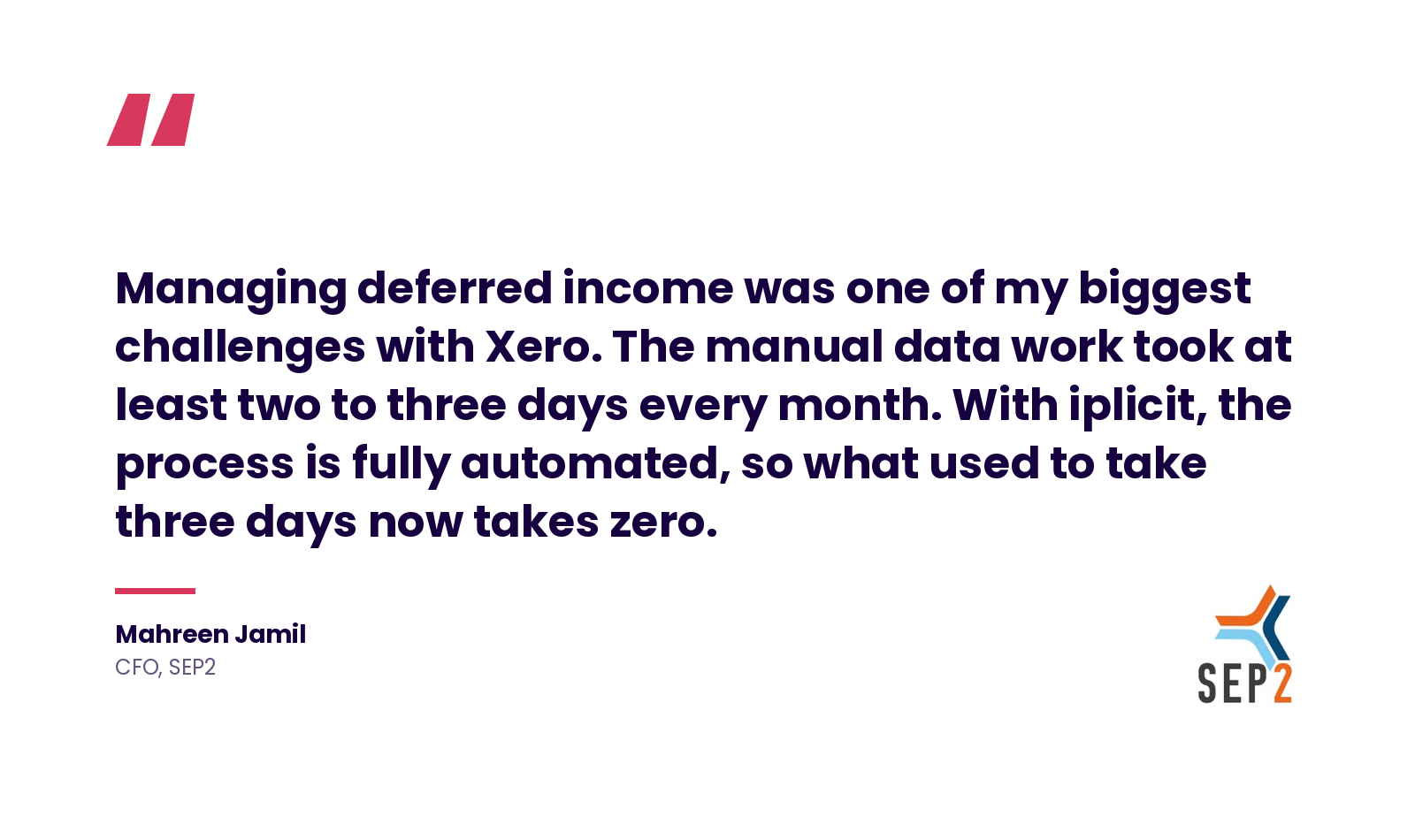
Integrated accounting software drastically reduces those manual processes. Walking With the Wounded saved 15 days a month on month-end tasks. The Recruitment Group cut invoice processing from 1.5 days to 2 hours. SEP2 eliminated 2–3 days a month of manual deferred-income work that had previously been managed in spreadsheets. That frees the finance team to concentrate on higher-value work and handle more as the organisation grows.
Secure, true-cloud data storage
An integrated accounting system is often a replacement for an on-premises system, one where all the data is stored on the organisation's own site, with the resulting risk of loss, damage or security breaches.
A move to true-cloud software means data is stored securely on the provider's servers, with security updates and patches applied in the background as the user works. Not every system marketed as “cloud” works this way; some are on-premises software simply hosted remotely, which carries different risks. See our guide True cloud vs fake cloud accounting software for how to tell the difference.
Faster, more reliable reporting
Preparing financial reports, whether monthly management accounts or audit-ready annual accounts, is one of the most stressful parts of a finance team's work.
Integrated accounting software simplifies this. It can strip out intercompany transactions, apply the right depreciation rates for fixed assets and handle multiple currencies and VAT rates automatically.
It can also present the same information differently for different audiences, for example, company directors, investors, charity trustees and regulators. That means business leaders work with accurate, real-time data instead of waiting days or weeks for month-end figures to be compiled.
Where iplicit fits
iplicit is cloud accounting software built for organisations that have outgrown entry-level tools but do not want the cost and complexity of an enterprise system. It brings automation and reporting for core finance tasks together with native integrations to the other systems a finance team already relies on, in a single platform designed for the mid-market.
iplicit's approach is enterprise capability without enterprise complexity, with implementation times measured in weeks rather than months. It integrates with the non-finance systems a finance team already relies on, rather than asking the organisation to work around it.
Read more about the platform on the cloud accounting software pillar page.
Is it time to move to integrated accounting software?
The key question is whether your current finance set-up will work once you've added another entity, another currency or another few years of growth. Entry-level software and disconnected spreadsheets rarely fail in one catastrophic event. Instead, they cost you ever more hours in rekeying data and compiling reports in spreadsheets. Integrated accounting software exists to remove that burden.
Ready to see integrated accounting software in action?
Read more about how iplicit brings finance functions together on the cloud accounting software pillar page, or watch the 3-minute quick tour to see the platform itself.
What is integrated accounting software?
Integrated accounting software is a single system that brings core finance tasks, such as invoicing, bank reconciliation, budgeting, reporting and multi-entity consolidation, together in one place. Instead of running each task through a separate program or spreadsheet, everything draws on the same connected, accurate financial data.
What's the difference between integrated accounting software and a stack of separate tools?
Integrated accounting software connects every finance task in one system, built on a single source of data from the start. A stack of bolted-together applications instead relies on separate tools that need manual exports, rekeying and reconciliation just to work together, which adds time and risk as the organisation grows.
Why do organisations move to integrated accounting software?
Organisations typically move to integrated accounting software when entry-level tools and disconnected spreadsheets start slowing the finance team down, usually as headcount, entity count or reporting complexity grows. At that point, manual rekeying and reconciliation start costing more time than the software itself is meant to save.
How do you know you've outgrown your current accounting software?
The clearest sign is a growing gap between what the finance team needs and what the current software can do. Watch for manual rekeying between systems, month-end reporting that takes weeks instead of days, or spreadsheets standing in for consolidation and revenue recognition.