
Want to see iplicit in action?
Summary
Organisations outgrow their accounting systems as they expand or take on more complexity, but the fix isn’t always to switch providers. Sometimes the existing system is fine and the problem is process; sometimes an upgrade from the same supplier closes the gap.
The distinction that matters is whether your limitations are procedural or architectural. Procedural problems, such as underused features or workaround spreadsheets, can usually be fixed without changing systems. Architectural ones, such as an inability to handle multiple entities or adapt reporting, usually mean it’s time to find a new, cloud-native platform.
The short version
- If your accounting system is not doing what you need it to, you need to consider your options.
- Not all problems are due to the system itself – you may just need to use it better.
- Upgrading to a new product from your existing provider may be the answer.
- If your limitations are architectural rather than procedural, it may be time to consider a new, cloud-native system without the “integration debt” that affects legacy systems.
So you’re aware of some issues with your accounting system – it’s not quite working the way you want it to, or your business has taken on new responsibilities that it struggles to deal with, or you’re growing so fast that the system is struggling to keep up.
What are you going to do next? You have a number of options, one of which, let’s be clear, is to stick with what you’ve got. You can also upgrade your existing system, or switch to something new. In the second of a series of articles about outgrowing your finance system, here are a few things to consider as you make that decision.
What do you need to think about?
One factor that will be important is whether you are running software onsite or in the cloud. If you’re using “on-premises” software, you will have a server that you own and maintain (or that you pay someone else to host). That gives you total physical and software control, and it could be an important factor if you are in a highly regulated industry and security is critical to your operations.
But it comes with high upfront costs in the form of a licence or copy of the software – and you’re limited by the physical space you have available if you want to expand the system.
You need to buy server hardware and employ IT staff to support and maintain the system. And every time you need to do an update, patch or back-up, you will have to schedule an upgrade, which can be disruptive. If you have a cloud-based system, your system supplier runs it and updates it centrally without you, as the client, having to be involved in every single upgrade.
Option 1: It’s not the system, it’s you – stick with what you’ve got but use it better
Sometimes the system you’re using is fine, it’s just not being used to its full potential – the problem is the process, not the software. By looking at how you’re using the system, you may be able to find existing, unused features that can improve the way you work.
You can also make the system more efficient – and remove the need to replace the entire system – by introducing tighter coding and process discipline across the company and by cutting down on the number of workaround spreadsheets you’re using.
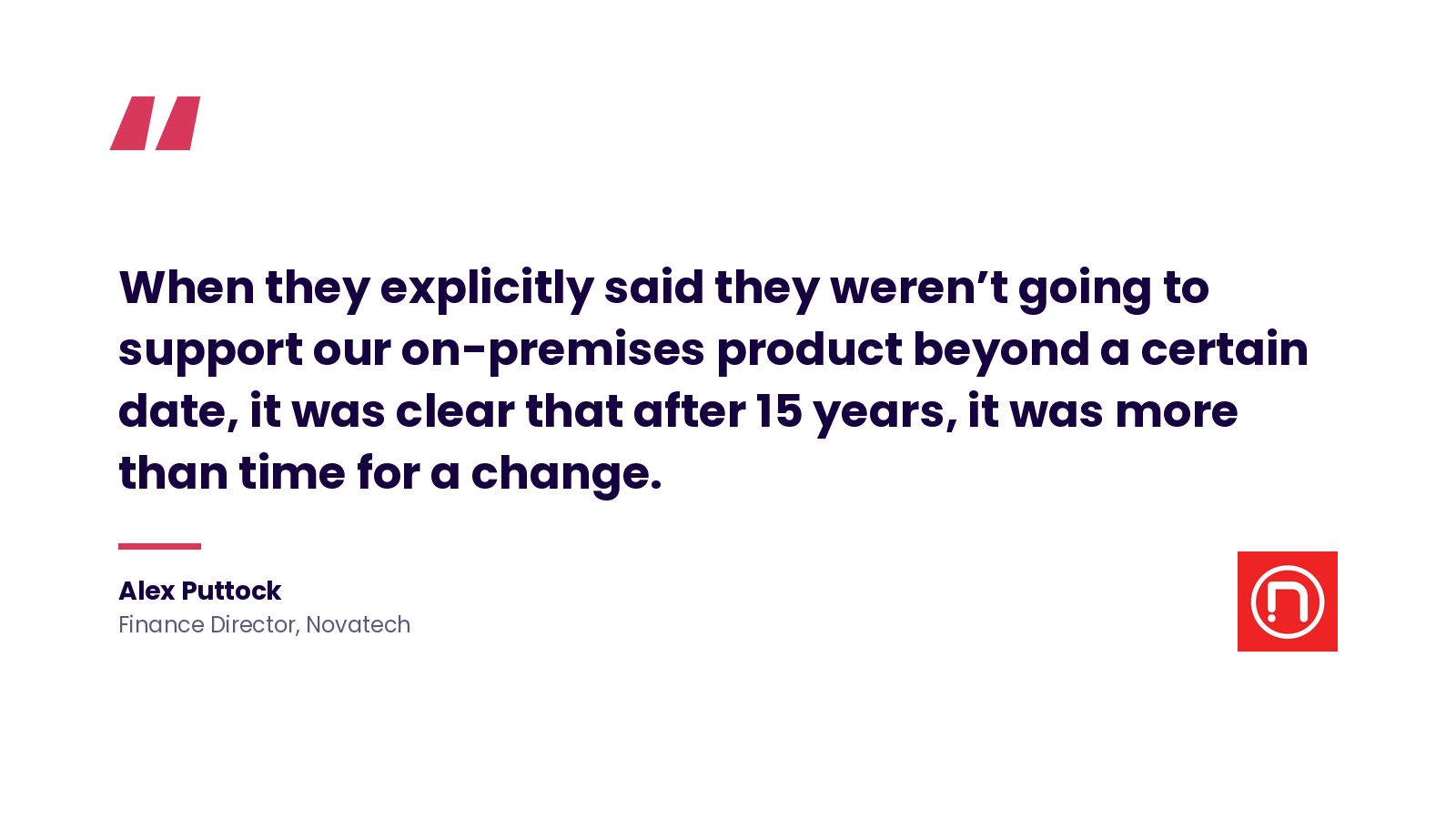
But if you’re using a legacy system, there may come a time when your provider stops supporting the product. Portsmouth-based IT hardware supplier Novatech had been using an Exchequer system. “But when they explicitly said they weren’t going to support our on-premises product beyond a certain date, it was clear that after 15 years, it was more than time for a change,” says Novatech’s Finance Director, Alex Puttock.
Option 2: Upgrade but with the same supplier
For some organisations, your current provider may offer other options that can address the challenges you’re facing. Take a look at their product portfolio and see what’s on offer.
Typically, moving up a range can give you more capacity and better reporting, with some offering a cloud-hosted option that is not available for the entry-level system you’re currently using.
While cloud-based servers allow regular data backup and remove capital costs, there is no guarantee that the functionality will improve. If your pinch point is the ability to handle multiple entities, or a lack of flexibility in reporting, an upgrade may not solve that.
When iplicit customer the Edinburgh International Festival was looking to upgrade its Sage system, it looked at a range of options. One of these was Access, which Head of Finance Andrew Brownlie says “felt very much like their previous Access server product that has just been refreshed and moved to the cloud”.
Option 3: Move to a new, cloud-based provider
You may want to consider moving to a new provider if the limitations you’re facing are architectural rather than something that a bigger version of the same product would fix.
These can include a system that can’t adapt to different reporting requirements, problems when it comes to reporting on multiple entities or physical limitations for onsite servers.
Another warning sign is when you are using an increasing number of bolted on workarounds to get the job done as a result of the “integration debt” we talked about in the first article in the series. Newer platforms – many of them cloud-based by design – can often get the job done without the need for add-ons and they are built to be able to cater for any changes your organisation experiences as it grows or takes on added complexity.
Cloud-based services allow you to pay only for the resources that you use, with no capital expenditure on hardware, maintenance and upkeep, helping you to keep costs down.
Where iplicit fits
The right accounting platform should handle every entity in your group without extra manual work, adapt its reporting to your organisation rather than the other way round, and update itself in the background so nobody has to schedule downtime for a patch.
iplicit is built as one platform for your whole group, whether that’s three entities or 30, which is often cited as the main reason organisations start evaluating it in the first place.
It’s hosted on Microsoft Azure with 99.8% uptime, and new releases go out regularly, so you’re not left waiting years for your next major version. Support is UK-based, and most organisations go live in weeks rather than months.
The bottom line: Looking at your future needs
Changing your accounting system should not be decided on a vibes-based feeling that “it’s time for a change”. Look at your constraints, where your system is no longer providing good service and why.
If you’re not getting the most out of your existing package, you may just need to think about how you can make it work better. And if it’s just a capacity issue, your current provider may be able to provide an upgrade that solves your problems.
But if the system struggles to handle multiple entities or to adapt to new reporting requirements, or if the subscription model is no longer value for money because you’ve grown, it could be time to find a system that has the capacity and flexibility to meet your needs, now and in the future.
See for yourself
To find out how iplicit can bring your accounting system up to date, take a three-minute tour or get in touch to see how it would work for your organisation.
See it for yourself
It takes just three minutes to see how iplicit could work for your organisation.
What's the difference between upgrading and switching accounting systems?
Upgrading means moving to a bigger product from your current provider, which can add capacity but does not guarantee new functionality. Switching means moving to a different provider's system entirely, which is worth considering when your limitations are architectural, such as an inability to handle multiple entities or flexible reporting.
Why do organisations outgrow their accounting system?
Most organisations outgrow their system as they add entities, take on more complex reporting requirements, or expand faster than their existing setup can support. The problem usually shows up as manual workarounds, like extra spreadsheets, filling gaps the software itself should cover.
How do I decide whether to stay, upgrade or switch?
Look at whether your issues are procedural, such as poor use of existing features or weak internal processes, or architectural, meaning the system genuinely cannot do what you need. Procedural problems can often be fixed by using your current system better; architectural ones usually mean it is time to change provider.
Is cloud-based accounting software better than on-premises?
Cloud-based systems remove upfront hardware costs and let your provider manage updates centrally, which reduces disruption. On-premises systems give you more direct control, which can matter in tightly regulated industries but they cost more to maintain and are harder to scale as you grow.
How long does switching to a cloud-native system like iplicit take?
Implementation timelines vary with complexity, but cloud-native platforms such as iplicit are designed to go live in weeks rather than months, with a UK-based team supporting the process throughout. You will also need to plan for data migration and staff training alongside the technical switch itself.
Want to see iplicit in action?
Book your demo and discover how iplicit can simplify your finance operations, automate manual processes, and give you real-time visibility - wherever you work.