
Accounting systems tend to become part of the furniture, so companies end up adapting to their limitations rather than the other way round. This article sets out the signs that a system has stopped keeping pace – from spreadsheet workarounds to manual inter-entity matching – and what it costs to keep working around them, including how Excalibur Academies Trust and Barwood Capital consolidated multiple entities after outgrowing their previous systems.

Key takeaways
- Accounting systems are so central to every company that they often become ‘part of the furniture’, and the company ends up adapting to the system’s limitations.
- As companies grow, or become more complex, their needs change, but their accounting system lacks the flexibility to grow with them – so the finance team finds itself working with a growing number of workarounds.
- Modern, flexible, AI-enabled systems can save huge amounts of time and money, making accounting processes leaner and more efficient.
Many companies are working with accounting systems that have not kept pace with their growth. If you have separate entities, complex transactions or demanding reporting requirements but find yourself relying on spreadsheets and manual, time-consuming reconciliation, it may be time to look at other options. Here – in the first of a series about outgrowing your accounting system – is what you need to know.
An accounting system is one of those things that every company needs from the start. So they buy a system, install it and then sort of forget about it. As the company grows, the system comes along for the ride, and the company adapts to the limitations of the system rather than the other way round.
But how do you know when you’ve got to the point where you need to think about upgrading or replacing your existing system?
There are three types of organisation that might have found themselves at this pain point, says James Bowers-Lee, Solutions Consultant Manager at iplicit. “There are those that have been using an entry-level system that was fine but the company has outgrown it. There are companies that upgraded their system 10 years ago or more and are now stuck with a legacy system that lacks automation and AI capabilities. And then there are those that are using a large enterprise system but are finding that system is overengineered for their needs.”
Companies grow and evolve in many different ways, while accounting systems are generally fairly inflexible – that doesn’t mean the system stops working as the company’s requirements grow. But it can mean that the workarounds required to make everything function create more work than is needed, a phenomenon sometimes called ‘spreadsheet sprawl’.
Sometimes, the problem is simply that a company has grown too big for its entry-level system. But that’s too simplistic. A small property investment firm running multiple different legal entities, for example, is going to be far more complex than a company with, say, 200 employees but only one legal entity.
How do you know when it’s time to look at new accounting systems?
You need to consider a number of issues, including:
- How many separate entities, currencies or bank accounts does your finance team have to deal with?
- How complex are your transactions and processes, not just how many are there?
- Do you have demanding reporting requirements – are there multiple stakeholders to satisfy, all wanting different information?
- How many other systems and tools does your finance data have to interact with?
- How tight are your control and compliance requirements?
- How many people need to use the system and where are they?
These are some of the signs that you might need to consider upgrading your system.
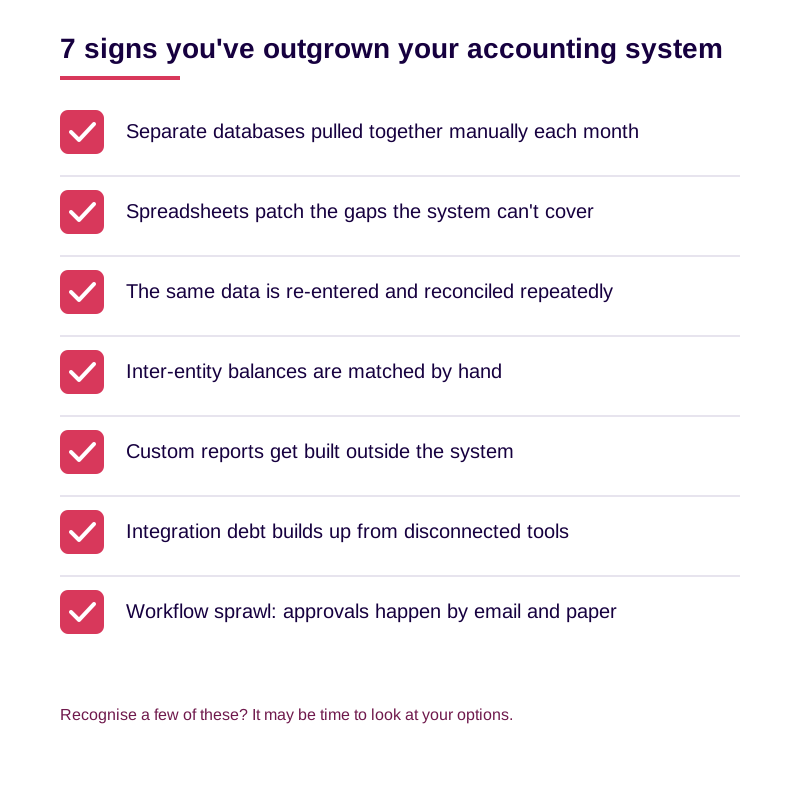
- You run separate databases or company files for different entities, and they have to be manually pulled together into a single group every month.
- You rely on spreadsheets to compensate for the bits that the system itself can’t do.
- The same data is bouncing around in and out of the accounting system over and over again, to be reconciled, reshaped or fed to another tool.
- You have to match the balances owed between your different entities manually rather than the system doing it automatically.
- If you want to build a custom report, you do it outside the system because it can’t provide the information the board, your investors or department heads are looking for.
- You’re having to deal with growing ‘integration debt’ – the cost of having to use several different tools, export data manually and write one-off scripts because all the different tools cannot communicate with each other effectively.
- As a result, you face increasing workflow sprawl – processes such as expense claims, purchase orders and approvals are being done by email, on paper or in separate apps because the core system can’t cater for them.
Sticking with an accounting system you’ve outgrown can cost you time and money
It isn’t so much that the system is broken – finance teams will find a way to get the job done using the system they have, but these fixes accumulate gradually over time, so the extra time it is taking to get everything done is not always noticed.
If none of this rings any bells, you’re probably better off sticking with your existing system. But if a few of these issues look familiar, it may be time to look more deeply at the hidden costs of sticking with your existing system, and whether something more up-to-date can save you time and money.
Accounting systems are part of the backbone of a company’s financial operations, so embedded that they are often taken for granted. But they often fail to grow with the organisation, or offer the flexibility that a more complex operation demands. If that’s the case, it may be time to look at more up-to-date options that can grow with you.
Where iplicit comes in
Excalibur Academies Trust, a 20-school, 10,000-pupil multi-academy trust, found itself with 16 separate finance databases after a merger with another trust – with no way to post journals between different schools. The finance team had to produce the management accounts manually in spreadsheets, leaving leaders with data that was always a month out of date, and audits took nearly a month.
With the aid of iplicit, the trust cut the audit to just two weeks, bank reconciliation is set to fall from three weeks to 2-3 days, and around 1,600 monthly invoices are now authorised digitally rather than manually.
Barwood Capital, a property investment business, managed 30 active legal entities, along with around 50 dormant ones, on Exchequer. That meant a separate login for each entity, making everyday operations increasingly difficult. Moving to iplicit allowed the finance team to consolidate efficiently. Jill Smith, Senior Finance Manager, says: “Manual data entry and duplication have been largely eliminated.”
To find out more about how iplicit’s modern, cloud-based system could transform your accounting, take a 3-minute tour or book a demonstration.