
Want to see iplicit in action?
Summary
A dashboard is only real time when the transaction processing, bank feeds and reconciliation behind it are current. A number may update live on screen and still be built on data that's days old underneath. This article sets out what 'real time' should mean in finance reporting, and a quick way to test whether a dashboard meets that bar.

The short version
- ‘Real-time reporting’ is one of the most overused claims in accounting software marketing and rarely defined precisely enough to mean anything.
- A dashboard is only real time if the data feeding it – transaction processing, bank feeds and reconciliation – is current. A live-updating screen can still be showing stale numbers.
- There’s a difference between a live, provisional figure and a closed, final one. Both are useful but a reader should know which one they’re looking at.
- In a 2025 TriFinance survey of senior finance leaders, 67% of FP&A heads and 50% of CFOs said they lack real-time access to financial data.
- A simple test is to ask where a number really came from and when it was last checked against the systems behind it.
Trust in a dashboard usually breaks down once the data feeding it turns out to be unreliable. A dashboard claiming to be “real time” can seem to be completely current while displaying data that’s been sitting unprocessed for days.
Almost every accounting software page claims real-time reporting. The phrase gets used so loosely that it’s almost lost its meaning. Sometimes it means the screen refreshes without a manual export, sometimes it means transactions post automatically, sometimes it just means the interface looks modern.
None of those things guarantee the number on screen reflects what’s actually happened in the organisation. This article sets out a more rigorous definition, and a short test finance leaders can run against their own dashboard.
The claim almost every reporting page makes
“Real-time reporting” appears on the features page of almost every accounting software vendor, and it means something different depending on who’s writing it. It’s often just shorthand for ‘faster than a spreadsheet,’ rather than a reflection of how current the underlying data actually is.
That vagueness isn’t necessarily dishonest. A dashboard that updates without a manual export is a genuine improvement on a monthly spreadsheet refresh.
The problem is that the phrase is used to describe both modest improvements and a system where every transaction, bank feed and reconciliation is current to the minute. A CFO evaluating software from the claim alone has no way of telling which one they’re being sold.
What real time should mean
A dashboard is only real time when the transaction processing, bank feeds and reconciliation feeding it are current, not simply when the screen itself refreshes instantly.
Screen refresh speed comes from the display. Data currency comes from everything that happens before the number reaches the screen, and that’s the part worth interrogating.
A number can update live on screen and still be built on data that’s a week old underneath. If a bank feed hasn’t been reconciled since the previous Tuesday, a dashboard showing that account balance in real time is displaying a real-time view of outdated information.
Live vs final: a distinction worth making explicit
A live, provisional number is one that’s been posted but not yet checked. A closed, final number is one that’s been checked and locked for the period. Both are useful for different purposes, but a reader needs to know which one they’re looking at before deciding how much weight to put on it.
A budget holder checking spend against budget on a Tuesday afternoon wants the live number, even knowing a few transactions might still shift before month-end.
A board reviewing last quarter’s results wants the final number, because provisional figures that are still moving aren’t a sound basis for external reporting. The mistake isn’t using live data, it’s presenting live and final numbers identically, so the reader doesn’t know which they’re looking at.
What this looks like when it isn’t real time
The gap between a dashboard that appears to be live and one that’s actually current isn’t always easy to spot.
It isn’t a rare problem either. In a TriFinance survey of senior finance leaders, 67% of FP&A heads and 50% of CFOs said they lack real-time access to financial data, despite most of them already using reporting tools.
At Age Scotland, the previous finance system meant bank transactions could still be unposted 10 days into the following month. The management accounts dashboard looked current every day of that period, but the bank position it was showing wasn’t.
A quick test for the reader
Two questions cut through most of the ambiguity in a real-time claim:
- How current is the data feeding this number?
- What data is still sitting in a queue, unreconciled or unposted, underneath this figure?
If those questions can’t be answered with certainty, the dashboard is likely to be showing a live view of something that isn’t actually current.
A-One Insurance Group’s story shows what passing that test looks like. Before moving to iplicit, group operations director Sarah Smith says the business was effectively “driving the business blind,” with information from nine group companies never fully consolidated.
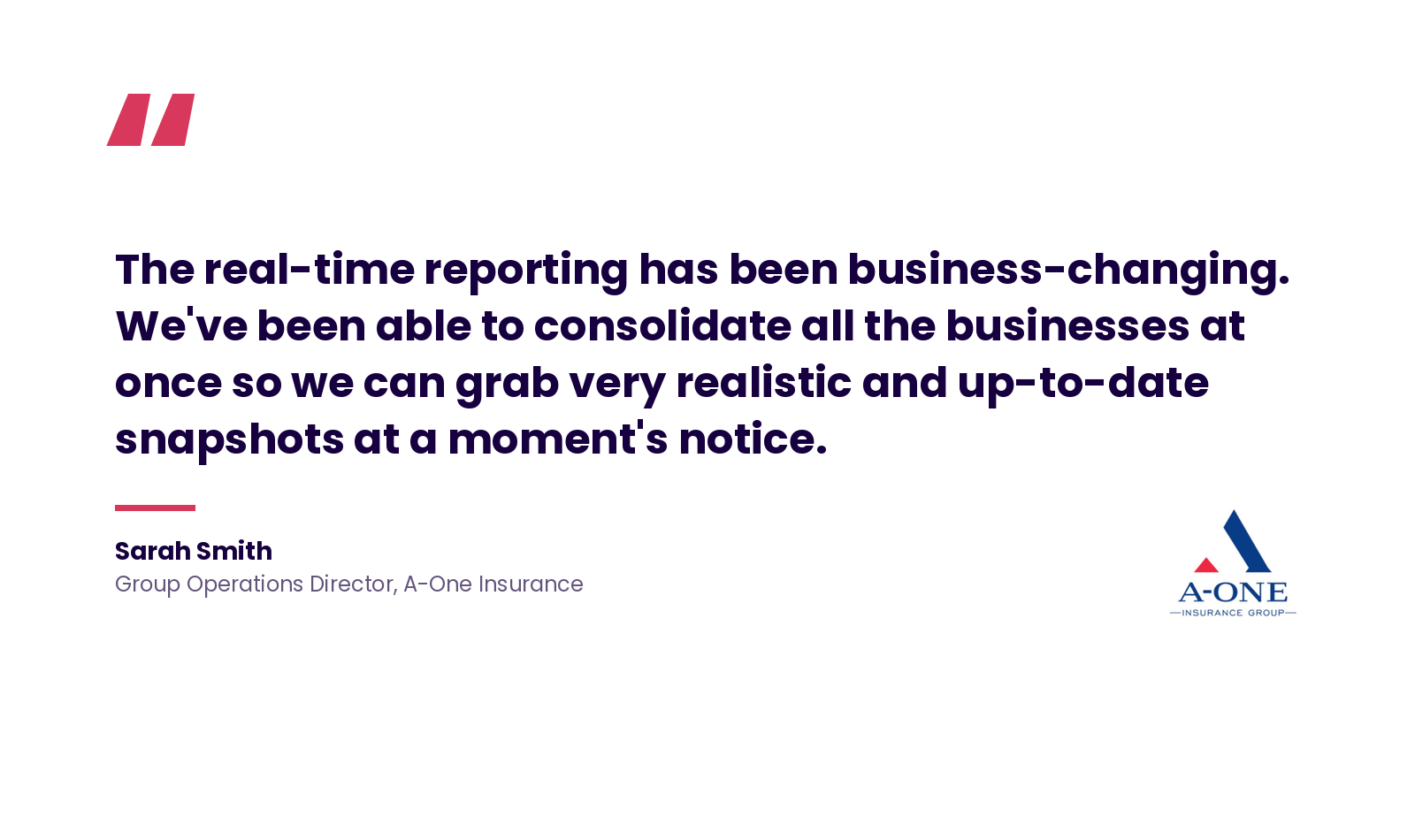
After connecting those entities into one continuously updated system, she describes being able to pull a realistic, current snapshot of the whole group at any moment, rather than waiting for month-end to find out where things stood.
Where iplicit fits
Continuous bank feeds and real-time reconciliation are part of what makes a number up to date and useful.
A connected bank feed removes the multi-day posting delay in the Age Scotland example above, and consolidating group entities into one system removes the wait A-One described.
Neither, on its own, resolves the live-versus-final distinction covered earlier; that still comes down to labelling data clearly and having a defined process for locking a period.
See how iplicit’s reporting works to understand how continuous feeds and reconciliation fit into the wider picture.
Frequently Asked Questions
Quick answers to common questions about real-time finance dashboards.
What does 'real-time accounting' really mean?
It means the transaction processing, bank feeds and reconciliation behind a number are current, not just that the screen updates instantly. Real-time accounting depends on how current the underlying data is, not how fast it's displayed.
What is the difference between live and final financial data?
Live data has been posted but not yet checked and can still change before the period closes. Final data has been checked and locked and won't move again. Both have a legitimate use – day-to-day monitoring versus formal reporting – but a reader needs to know which one they're looking at before relying on it.
How common is a lack of real-time financial data?
Very. In a 2025 TriFinance survey of senior finance leaders in Belgium, 67% of FP&A heads and 50% of CFOs said they lacked real-time access to financial data, despite most already using reporting tools. The gap tends to be in the processes feeding a dashboard, not the dashboard itself.
How do you check whether a finance dashboard is real time?
Ask two questions of any number on screen: how current is the data feeding it, not just how fast the screen updates? And what's still sitting unreconciled or unposted underneath it? If those questions don't have answers you're confident in, the dashboard is showing a live view of data that isn't actually current.
Want to see iplicit in action?
Book your demo and discover how iplicit can simplify your finance operations, automate manual processes, and give you real-time visibility - wherever you work.