
Businesses rarely fail for one dramatic reason. According to outsourced FD provider Insight Associates, the real cause is usually a finance function that never grew up: no solid transactional foundation, no meaningful reporting and directors without a handle on the figures. Founder Garry Mumford explains the pyramid model that fixes it, and how automation is reshaping its base.
“The main reason businesses fail? They haven’t got a handle on the finances.”
Think for a few uncomfortable moments about all that day-to-day processing work involved in your business’s finances.
There’s the ever-replenishing stack of invoices, whether paper-based or electronic. There are the expenses flying back and forth between claimer, approver and the finance team. And then there’s the general faff of updating records and keeping books. It all adds up to a teetering pile of regular Stuff To Do. Yet its significance is bigger than that. If you’re not keeping on top of it all, the consequences can go beyond an admin nightmare and can even mean the failure of a business.

The underlying reason for failure
Garry Mumford, Founder and Managing Director of Insight Associates, provides outsourced FD and bookkeeping services to small businesses. He also has years of experience dealing with distressed businesses and working to help turn them around.
While there are a host of commercial reasons a business can fail, he says there’s one common underlying factor.
“When you look behind the scenes, the main reason they fail is that the directors haven’t got a good handle on the finances,” he says.
The final collapse of any struggling business comes because it simply runs out of cash. Quite often, that fatal cash flow crisis comes as a surprise.
A big business will have a substantial team to keep on top of the cash flow. In a tiny one, the owner will often be close enough to the books to have a good idea how things are going. But in between, there are a lot of enterprises that are at risk because they’re not in good enough control.
These tend to be “adolescent” businesses, as defined by Michael E Gerber in his book The E-myth Revisited. They’ve grown beyond the founder’s ability to run them solo – but they haven’t yet put in place all the systems and processes of a mature business.
These adolescent businesses need to improve their financial management. And that means finally getting on top of all that processing work.
‘Their accounting was in a mess’
It wasn’t long after Garry started offering outsourced FD services that he realised the fundamental problem those adolescent businesses had.
“Originally, we focused just on doing the work of an FD and other senior financial roles – but we quickly discovered that you often couldn’t add any value that way for a smaller business because their accounting was often in a complete mess,” he says.
“Their basic core accounting wasn’t delivering what it needed to in order for someone above that level to make sense of it and then advise the leaders of that business. You needed to deal with that first.”
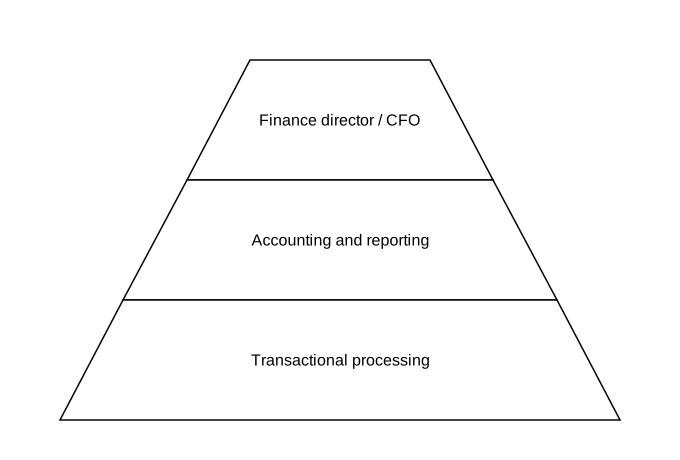
That realisation led Insight Associates to develop a “pyramid model” for understanding how a finance operation should work.
The pyramid model
The pyramid model is based on a simple idea: all that everyday activity in a finance team is essential to supporting the layer of work above it.
The bottom layer
“The bottom layer of the pyramid is the foundation on which you build,” says Garry.
“It’s all the day-to-day transactional processing – the paper pushing, getting all the records up to date, general bookkeeping. That has to be done and it has to be done well. It has to be accurate, it has to be on time, it has to be complete. Which is something we were seeing time and time again wasn’t happening.”
The middle layer
“The middle layer of the pyramid is what an accountant traditionally does,” says Garry.
“The accountant comes along and makes some sense of all that transactional work, adds the bits that are missing, does some fancy accounting stuff and turns out some reports. Hopefully, some of those reports are useful – when they’re not just scorekeeping.”
The top layer
“The very top of the pyramid is your Finance Director or CFO,” says Garry.
“That’s the person who, because they’re standing on those other layers of the pyramid, can confidently work with the directors and leaders of the business to help them understand the financial implications of where the business is. That person can steer them, be their candid friend and confidant and just generally make them think.”
Is the pyramid changing shape?
Garry’s aware he may soon need another metaphor, because the pyramid is becoming distinctly less pyramiddy. More sophisticated accounting software can handle a lot of the processing work that makes up that bottom layer of the structure.
“The transactional work is still the foundation on which you build the rest,” he says.
“It’s the bit that takes the most effort because you have to process all your purchases invoices, sales invoices, receipts, payments and so on, and there’s a huge amount of work to do in that area.
“But with all the automation that’s available now, the scale of that work can be drastically reduced. The paper-pushing is disappearing. We use iplicit for our clients and we’ve used its functionality to make our systems and processes much more efficient for them.”
Where iplicit fits
Whatever shape a finance team takes, the bottom layer of the pyramid – the day-to-day processing of invoices, receipts and payments – is where the most effort typically goes. Cloud accounting software that automates that layer well gives the accountant better data to work with and gives the FD more reliable numbers to challenge and steer the business on.
As Garry notes, Insight Associates already runs its own outsourced finance service on iplicit for exactly this reason. It’s a pattern iplicit sees across mid-market finance teams generally. Automating routine transactional processing – invoice entry, bank reconciliation and the like – is typically where finance teams see the fastest return, freeing staff for higher-value analysis instead of data entry.
Elsewhere, iplicit customers doing this kind of automation report concrete results: The Recruitment Group cut invoice processing from one and a half days to two hours, and Unit Hire has saved hours every week.
‘The FD can only challenge if they understand’
While the volume of a finance team’s transactional jobs may shrink thanks to automation, the triple-level nature of the work still holds true. It will just become easier to supply the FD with the data they need.
“To my mind, the sign of a good FD in any business is that they make the other directors think. I love the expression ‘If everybody’s thinking alike, someone’s not thinking’,” says Garry.
“The FD’s role is partly about challenge – but they can only challenge things if they really understand where the business is financially.
“And that means those foundations will have to be rock-solid.”
Do you need to finally get on top of financial processing so you can see the big picture hiding in the figures? Read the Insight Associates case study to see how automating that groundwork works in practice. If you want to see the platform for yourself, take a quick tour of iplicit, or book a demo to talk through what it would look like for your business.
What is the "pyramid model" of a finance function?
What is the "pyramid model" of a finance function?
The pyramid model, developed by Insight Associates, describes three layers of a finance function: day-to-day transactional processing at the base, accounting and reporting in the middle, and Finance Director or CFO-level strategic advice at the top. Each layer depends on the one below it being done accurately and on time.
What's the difference between the three layers of the finance pyramid?
What's the difference between the three layers of the finance pyramid?
The bottom layer covers transactional processing such as invoicing, receipts and bookkeeping, while the middle layer is traditional accounting: making sense of that data and producing reports. The top layer is Finance Director or CFO-level input, using those reports to advise the business’s leaders on strategy.
Why do businesses fail because of poor financial management?
Why do businesses fail because of poor financial management?
According to Insight Associates founder Garry Mumford, businesses often fail because directors never get a proper handle on their finances. Cash flow problems build up unnoticed in “adolescent” businesses that have outgrown a founder’s ability to manage everything personally, but have not yet put mature financial systems in place.
How can accounting software help a finance director focus on strategy?
How can accounting software help a finance director focus on strategy?
Accounting software can absorb much of the transactional processing at the base of the pyramid, such as invoice entry and reconciliation. That reduces the manual workload on the finance team and gives the accountant and FD more reliable, timely data to build reports and strategic advice on.