If you run several companies on Xero, the Xero alternatives to shortlist first are iplicit, AccountsIQ and Sage Intacct. All three keep every entity in one system, with consolidation built in, and iplicit also creates the other side of each intercompany transaction for you. Look at Business Central if you work in Microsoft 365, and Xledger if you run a long list of entities. NetSuite suits groups trading across borders. If you only run one company, Xero is still the better fit.
| Tool | Best for | Starting price | Capterra UK rating |
|---|---|---|---|
| iplicit | UK groups that want every entity in one ledger, with consolidation built in | No public pricing (quote on request) | 4.6/5 (53 reviews) |
| AccountsIQ | UK and Irish groups watching the budget | From €275 a month (Core) | 4.6/5 (44 reviews) |
| Sage Intacct | Groups that want a dedicated planning module | From £1,200 a month | 4.3/5 (718 reviews) |
Xero alternatives built for groups of companies
You’re closing each company’s books one at a time, keying both sides of every intercompany invoice, then building the group report in Excel. That’s usually the point where Xero stops fitting a group, even though it still suits a single company well.
We compared six Xero alternatives that run every entity in one system.
Why listen to us?
We build accounting software for UK organisations that run more than one company, and moving groups off Xero is part of what our implementation team does.
Bridges Outcomes Partnerships is a good example. It ran around 25 project companies, each in its own Xero instance.
“If something had to be done across all entities, you had to do it 25 times.”
Colin Huntington, Director of Finance and Enablement, Bridges Outcomes Partnerships
Since moving every entity into iplicit, Bridges has cut its month-end from four days to one.
Moves like that show us where separate organisations cost a group time, from intercompany entered twice to month-ends closed one company at a time. Those are the problems we judged each alternative on.
What is Xero?
Xero is cloud accounting software for small businesses, used by 5 million customers in more than 180 countries by its own count. It covers invoicing, bills, bank reconciliation, payroll and VAT returns through Making Tax Digital, and UK plans run from £18 to £70 a month before VAT. Each subscription covers one organisation, which is where groups start to feel the strain.
Why seek alternatives to Xero?
Groups look for alternatives to Xero when keeping every company in its own Xero organisation takes more time than it saves. You'll usually notice it first at month-end.
1. Every company is a separate Xero organisation
In Xero, each entity is its own organisation, with its own subscription, chart of accounts, bank feeds and month-end. So five companies on the Grow plan come to £195 a month before VAT. Any group-wide change, like a new account code or supplier, means updating every organisation.
2. Group reporting happens outside the ledger
You can't consolidate your organisations inside Xero itself. There's a long-running request for it on Xero's product ideas board. But Xero's community manager has replied that work on consolidated reporting “is not currently planned”.
That's why group reports come from Excel, a consolidation app or Syft, the reporting tool Xero agreed to buy in 2024. Xero’s own answer for groups is Xero Ultra, a plan in UK early access that will cost £140 a month from December 2026. It adds Syft Advanced for one entity, with more entities at extra cost, but each company still keeps its own Xero organisation and its own books.
3. Intercompany gets entered twice
On Xero, when one company recharges another, someone posts the sales invoice in one organisation. Then they switch to the other and post the matching bill. Xero's reconciliation tool only works for bank accounts, so intercompany balances get checked in Excel. You export an Account Transactions report and reconcile it there.
If the two sides don't agree, you find out at month-end, when there's the least time to chase it. Manual steps like these are a common reason intercompany accounts don't balance.
4. Two tracking categories cap your reporting
Xero lets you set up four tracking categories, but only two can be active at any time. It also recommends no more than 100 options in each. If you want to report by department, project, location and fund, you'll hit that limit quickly. The usual workaround is to add more account codes. Your chart of accounts then gets longer every time the group adds a site, a fund or a company.
6 best Xero alternatives for multi-entity organisations
| Tool | How it handles a group | Best for | Pricing | Capterra UK rating |
|---|---|---|---|---|
| iplicit | One database, with intercompany posted once and consolidation built in | UK groups that want every entity in one ledger, with consolidation built in | No public pricing (quote on request) | 4.6/5 (53 reviews) |
| AccountsIQ | Subsidiary books roll up into a consolidation entity | UK and Irish groups watching the budget | From €275 a month (Core) | 4.6/5 (44 reviews) |
| Sage Intacct | One database with automatic eliminations | Groups that want a dedicated planning module | From £1,200 a month | 4.3/5 (718 reviews) |
| Business Central | Companies share one environment, with eliminations done by hand | Organisations already standardised on Microsoft 365 | £61.50 per user a month (Essentials) | 4.1/5 (209 reviews) |
| Xledger | Hierarchical structure with consolidation inside the system | Groups with many entities and shared suppliers | Monthly subscription, by quote | 4.5/5 (12 reviews) |
| NetSuite | OneWorld subsidiaries with automatic elimination entries | International groups with subsidiaries abroad | Annual licence, by quote | 4.2/5 (2,082 reviews) |
1. iplicit
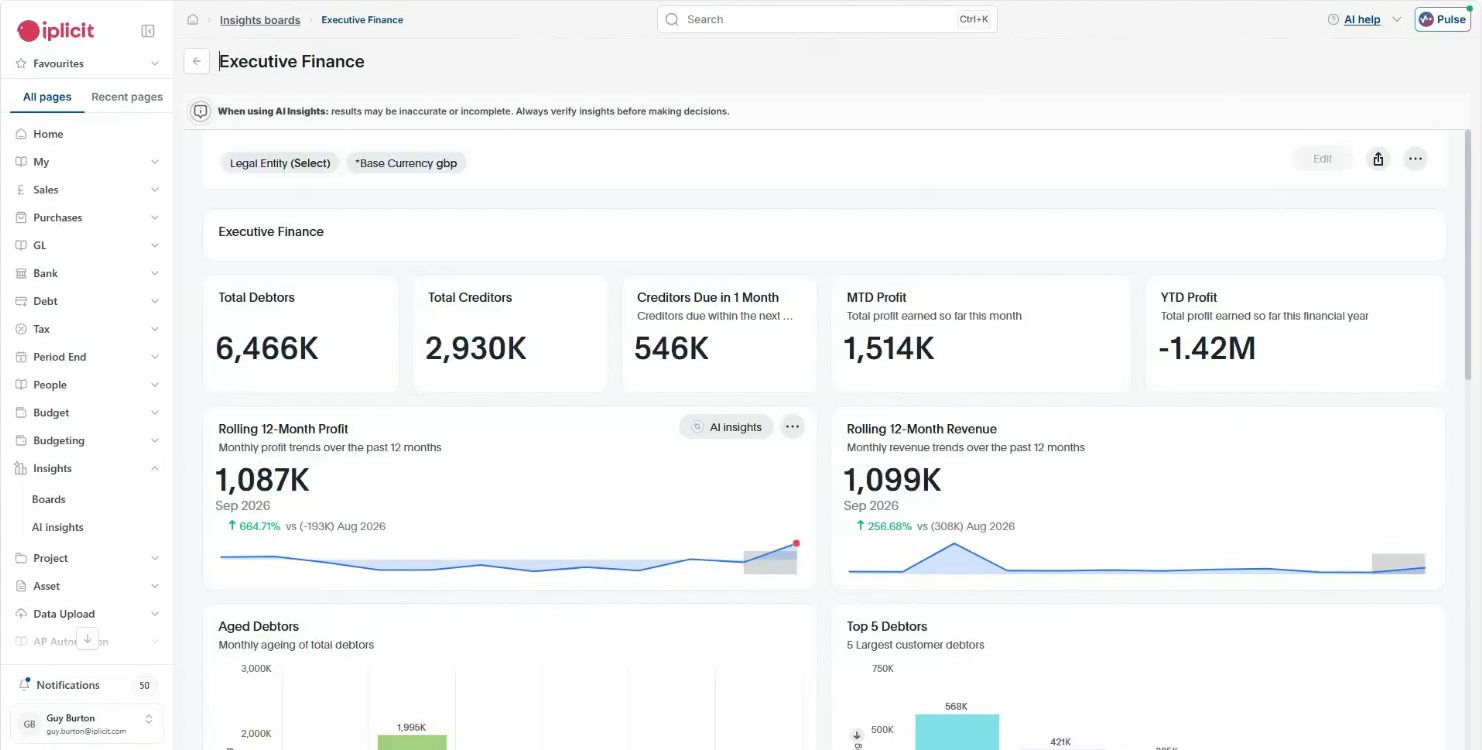
Built for UK mid-market organisations, iplicit covers multi-entity consolidation, as many reporting dimensions as you need and approvals, which are three of the places groups outgrow Xero. It keeps every entity in one database, so you can see one company or the whole group without switching between organisations.
You post an intercompany sale or purchase once, and the matching entry appears in the other entity. Automated consolidation runs across entities and currencies in one system, with intercompany handled in the system and drill-down to the source transaction.
Barwood Capital runs more than 30 active legal entities this way.
“Intercompany transactions are now automatically mirrored between entities.”
Jill Smith, Senior Finance Manager, Barwood Capital
Barwood now produces its consolidated fund reporting in the same system, too.
If you're moving from Xero, a functional consultant from our implementation team, or an accredited partner, configures iplicit and migrates your data. You could be live in weeks, and after go-live, our UK-based support team takes over.
Key features
- Financial year by entity: Each entity can have its own currency, tax settings and financial year.
- Local currency and tax by entity: Set each entity's currency and tax authority, then report in your group currency. Live exchange rates feed in automatically, and consolidated reports translate using closing, average or historic rates by account type, set up to match your group policy.
- Multi-level approvals: Route purchases and expenses through approval steps, with every action logged in the audit trail.
- Accounts payable automation: Capture supplier invoices automatically with AI invoice processing, then match them to purchase orders and goods received notes before approval.
- Bank reconciliation: Download bank statements automatically and match transactions with AI-powered matching.
- Excel add-in: Pull live iplicit data into Excel for the report packs your board already knows.
Pricing
iplicit offers transparent subscription pricing that scales with your users and entities, with fund accounting, multi-entity and multi-currency capability included rather than sold as extra modules.
Rating
Capterra UK: 4.6/5 (53 reviews)
Pros
- Every entity sits in one database, so there's no switching between organisations to build the group view.
- As many reporting dimensions as you need, where Xero limits you to two active tracking categories.
- A functional consultant from our team or an accredited partner runs your data migration, and UK-based support takes over after go-live.
Cons
- It doesn't automatically split one supplier invoice across several entities.
2. AccountsIQ
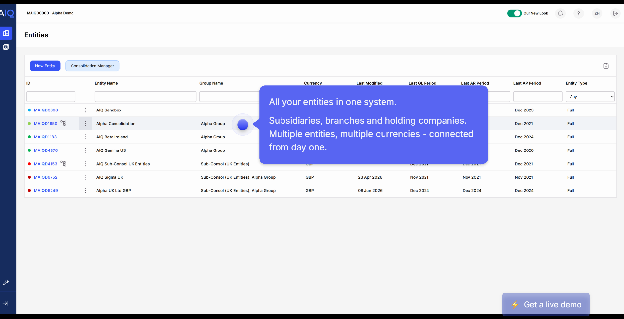
AccountsIQ is cloud accounting and financial management software for mid-market finance teams, with support based in the UK and Ireland. Its group model is a close match for an organisation leaving Xero, because each entity keeps its own books. The subsidiaries' figures roll up into a consolidation entity for group reporting.
Intercompany comes with a built-in control. A purchase invoice from another group company stays unposted until the receiving company accepts and codes it. That way, both sides agree before you consolidate.
Key features
- Layered consolidation: Consolidate at intermediate levels of your group before the results roll up to the parent entity.
- Central exchange rates: Set average and period-end rates once and apply them to every subsidiary.
- Excel and Power BI connector: Pull ledger data into Excel and Power BI from the Growth plan up.
- Assistive AI: Get AI suggestions on allocations, reconciliations and coding, with nothing posted until someone reviews and approves it.
Pricing
Plans start from €275 a month for Core, with Growth and Scale packages above it. Consolidation and intercompany management are listed under Group Accounting on all three plans.
Rating
Capterra UK: 4.6/5 (44 reviews)
Pros
- Intercompany purchase invoices wait for the receiving company to accept and code them.
- A published starting price gives you a budget figure before the first call.
- Support is based in the UK and Ireland, with an average response time of 27 minutes by AccountsIQ's figures.
Cons
- Core includes one entity and two users, so a group will need a bigger package.
- BI analysis is capped by plan, at two, four or six dimensions.
- AccountsIQ doesn’t publish consolidation timelines, saying they vary with your entities, currencies and reporting requirements.
3. Sage Intacct
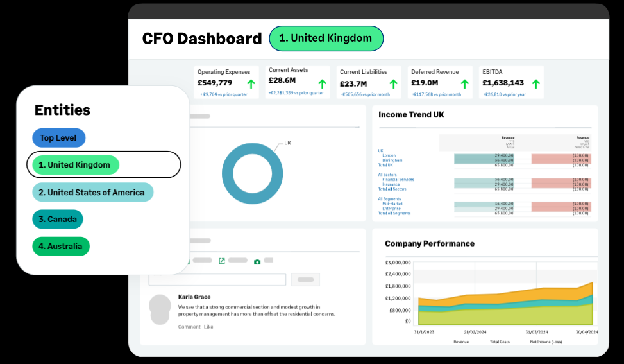
Sage Intacct is Sage's cloud finance software for growing and mid-sized organisations. Like iplicit, it keeps every entity in one database, and you manage them all with one login.
If you've outgrown Xero's tracking categories, look at how Intacct uses dimensions. Sage's own example is a business tracking three locations, five departments and five projects. In a traditional chart of accounts, that would need 75 account code combinations. Intacct handles those as dimensions you tag on each transaction. If budgeting is a big part of your job, Sage Intacct Planning gives you a dedicated planning module.
Key features
- Automated consolidation: Consolidate from two entities to hundreds, with eliminations based on your reporting requirements.
- Inter-entity accounts: Set up due-to, due-from and direct settlement accounts centrally for transactions between entities.
- Multi-currency consolidation: Bring entities that trade in different currencies into one group view.
- Ownership structures: Consolidate by ownership level and auto-generate non-controlling interest for part-owned subsidiaries.
Pricing
Intacct plans start from £1,200 a month, excluding VAT. The final price is built from your users, modules, entities and integrations. Implementation, data migration and training are quoted separately. The lighter Sage Intacct Essentials also starts from £1,200 a month, and supports up to four entities.
Rating
Capterra UK: 4.3/5 (718 reviews)
Pros
- Every entity shares one database and one login.
- Dimensions keep a multi-site, multi-department chart of accounts short.
- Essentials publishes a monthly price, so you can budget before the first call.
Cons
- Modular pricing means the total depends on every module you add.
- Sage pitches Essentials at organisations with 20+ employees and over £2 million in revenue, so small groups fall below its target.
- Essentials stops at four entities and leaves out global consolidations. A growing group may need full Intacct, which is priced on request.
4. Microsoft Dynamics 365 Business Central
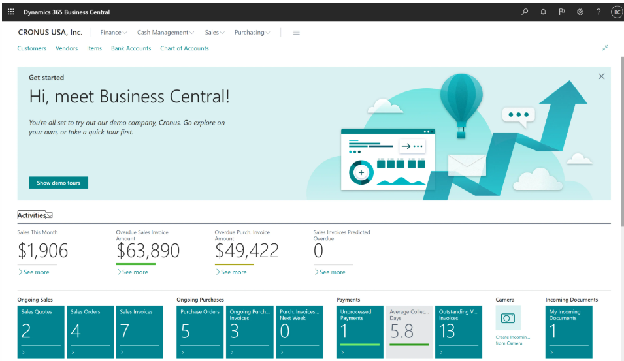
Business Central is Microsoft's cloud ERP for small and mid-sized businesses. It's the natural option to look at if your group already runs on Microsoft 365.
Consolidation works differently from iplicit or Intacct. You transfer each company's ledger entries into a separate consolidation company, and Microsoft's own documentation says eliminations are a manual process. That's fine for a group that closes quarterly, but it's extra work if you want group figures every month.
Key features
- Intercompany postings: Send sales documents to another group company, where they arrive as purchase invoices.
- Many companies per environment: Run up to 300 companies in one Business Central environment.
- Unlimited dimensions: Tag transactions with as many dimensions as you need, and filter anywhere by two global ones.
- Consolidation exchange rates: Set up exchange rates for any company whose accounts are in a different currency from the consolidated company.
Pricing
Microsoft publishes UK prices per user, paid yearly and excluding VAT. Essentials costs £61.50 per user a month, and Premium costs £84.60.
Rating
Capterra UK: 4.1/5 (209 reviews)
Pros
- It'll feel familiar to teams who already work in Outlook, Excel and Teams.
- Published per-user prices make the licence cost easy to estimate.
- It covers operations like inventory and job costing alongside finance, if you need them.
Cons
- Consolidation eliminations are a manual process.
- Every finance user you add raises the licence bill.
- Changing a global dimension later means updating every entry already posted with it, which can be time-consuming.
5. Xledger
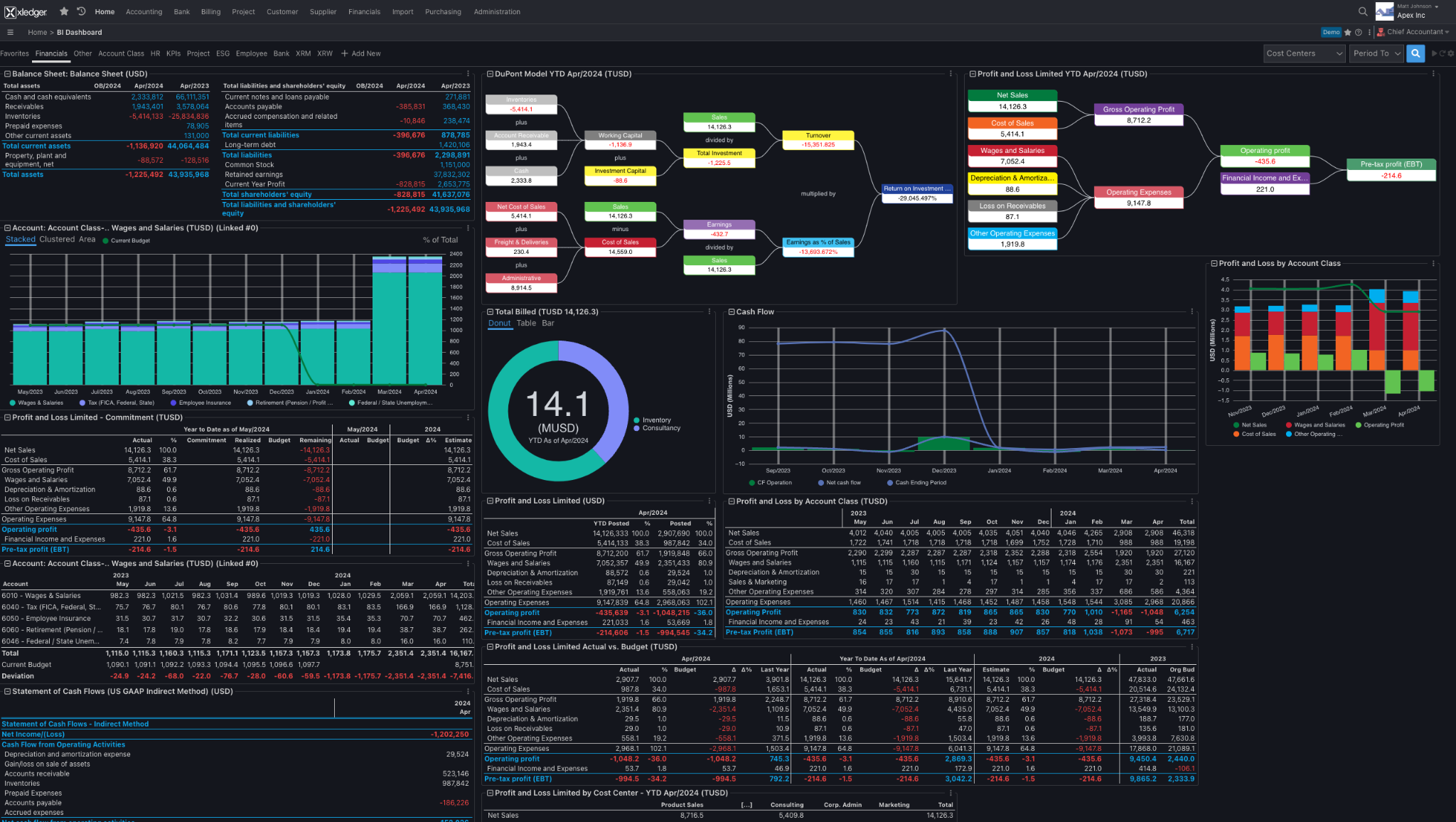
Xledger is cloud finance software for mid-market and large organisations. For a group with a long list of entities, its hierarchical structure is the main reason to look. Consolidation happens inside the system, in real time.
Intercompany works through that same structure. You can post both entities' journal lines in one journal, or send a sales invoice between entities inside Xledger.
Key features
- Group-level records: Maintain common suppliers and customers once for every entity.
- Single-screen approvals: Approve purchase invoices from all entities in one screen.
- Multi-level consolidation: Consolidate at several levels of your group structure.
- Open API: Connect your other systems through Xledger's open API.
Pricing
Xledger sells a monthly subscription with a one-off implementation fee. There's no public pricing, but you can get a pricing guide on request.
Rating
Capterra UK: 4.5/5 (12 reviews)
Pros
- Group reporting doesn't need a separate tool, because consolidation runs inside Xledger.
- Every implementation gets a PRINCE2-certified project manager and an accountancy-trained consultant.
- Reports and dashboards let you drill into live data across the group.
Cons
- There's no public pricing, so you'll need a conversation before you see numbers.
- Xledger targets mid-market and enterprise organisations, so a two-company group sits at the small end of its market.
- It has a smaller UK review base than the larger names here, with 12 reviews on Capterra UK.
6. Oracle NetSuite
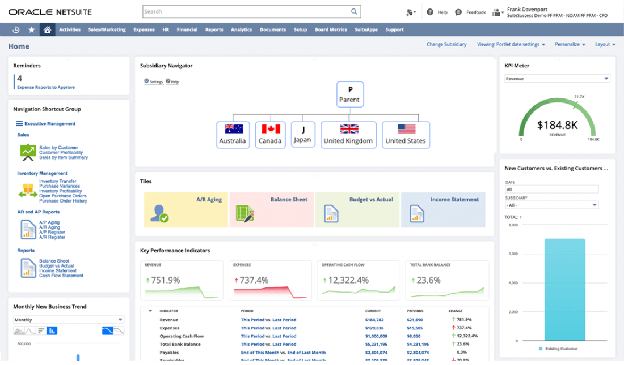
NetSuite is Oracle's cloud ERP suite. Its OneWorld edition runs multiple subsidiaries, business units and legal entities from one system. It's the closest fit on this list for groups with subsidiaries in several countries.
For intercompany trading, NetSuite identifies and matches the transactions on both sides, posts the elimination entries automatically and settles the intercompany accounts. Each subsidiary can keep its own chart of accounts. NetSuite posts every local transaction to the matching parent account at the same time.
Key features
- Multi-book accounting: Keep more than one set of books when accounting rules or tax codes differ between parent and subsidiaries.
- Currency management: Trade in more than 190 currencies, with exchange rates updated daily.
- Country tax and reporting: Meet tax and reporting requirements in more than 100 countries.
- Role-based dashboards: Give leaders a group view with drill-down to each subsidiary.
Pricing
NetSuite is licensed annually. The fee is made up of the core platform, optional modules and the number of users. Consolidation is available with the OneWorld and Multi-Book modules. There's also a one-time implementation fee.
Rating
Capterra UK: 4.2/5 (2,082 reviews)
Pros
- OneWorld adjusts for local currency, language and tax at subsidiary level.
- You can add CRM and ecommerce modules to the same system if you want more than accounting.
- An always-on audit trail lets you drill down to the transaction behind any number.
Cons
- Consolidation is available with the OneWorld and Multi-Book modules, so check your quote includes both.
- You pay an annual licence plus a one-time implementation fee, with no public price list.
- For a UK-only group trading in pounds, much of its international depth will go unused.
How we evaluated these Xero alternatives
We assessed each system against the problems groups run into on Xero:
- Whether every entity lives in one ledger, or separate books get reported on together
- What happens when one company trades with another, and whether the second side posts itself
- How consolidation handles eliminations and currency translation
- How many reporting dimensions you get, and on which plan
- How approvals and the audit trail work across entities
- What moving off Xero involves, from data migration to who runs the project
- How pricing works, from per-user licences to quotes per organisation
Approvals deserve a close look. Xero’s bills have a single approval step, so check how each alternative handles layered sign-off.
How to choose a Xero alternative
Start by counting how many companies you run and how often they invoice each other. If you run one company, or a few that rarely trade, a group system solves problems you don’t have yet. There are also good reasons not to switch accounting software when your setup still works. If you do need one, check these five things in every demo:
- Where consolidation happens: Ask whether every entity sits in one ledger, or whether each company’s books roll up into a separate consolidation entity. With one ledger, there’s no separate consolidation entity to maintain. With a roll-up, someone runs a consolidation step every period.
- How the second side of intercompany posts: Some systems create the matching entry for you. Some hold it until the receiving company accepts and codes it, and some leave you to key it. Automatic posting saves the keying, and an acceptance step gives the receiving company a check before anything posts.
- Eliminations and overseas subsidiaries: Ask whether eliminations post automatically or are entered by hand each period. If you have subsidiaries abroad, ask which exchange rates the system uses to translate their results, and whether it applies them automatically.
- What the quoted plan includes: Check how many dimensions, approval steps and entities come with the plan you’re quoted, not the top tier. A lower starting price often means tighter limits, so compare like with like.
- Who runs the move, and what the first year costs: Ask whether the vendor’s own team or a partner runs the implementation, and ask for a first-year total that includes it. Per-user licences, modules and one-off implementation fees all change the number.
Check out this finance software evaluation checklist to prepare for your demos. For the wider market, see the guide to the best accounting software for multiple entities.
Which Xero alternative is right for your group?
That depends on how much of your month goes on work between your companies, like intercompany recharges, reconciling the balances and building the group report.
If you run one company, stay on Xero. Two or three companies that rarely trade with each other may only need a reporting tool on top of Xero for now, such as Syft.
Groups whose companies trade every month, with consolidation still in Excel, are where one platform for the whole group starts paying for itself. For a UK group, start with iplicit and AccountsIQ.
Beyond those two, the right pick follows the shape of your group. Sage Intacct and its planning module suit finance teams that spend much of the month on budgeting and forecasting. Business Central fits groups already standardised on Microsoft 365 that want operations alongside finance, as long as you’re ready to do eliminations by hand. Xledger is built for a long list of entities with shared suppliers, and NetSuite covers groups with subsidiaries in several countries and an ERP budget.
Our guide to changing your finance system covers each stage of the move. When you’re ready to see your own group in iplicit, book a demo with our UK team. Or take the three-minute Quick Tour first.
Can I have multiple businesses under one Xero account?
Can I have multiple businesses under one Xero account?
Yes, one Xero login can open several organisations, and you switch between them by clicking the organisation name. Each organisation is still a separate set of books with its own subscription, though. Group reports have to be built outside the ledger, in Excel or a reporting tool like Syft. If you'd rather run every company in one place, see how multi-company accounting works in iplicit.
Who is Xero’s biggest competitor?
Who is Xero’s biggest competitor?
For a single small business, Xero is usually weighed against other entry-level packages like QuickBooks and Sage. For a group of companies, the comparison moves to systems that keep every entity in one place, like iplicit, AccountsIQ, Sage Intacct, Business Central, Xledger and NetSuite.
Is there a cheaper option than Xero?
Is there a cheaper option than Xero?
For one company, other entry-level packages compete closely on price, so compare plans like for like. For a group, compare totals rather than plans. Each Xero organisation needs its own subscription, so five companies on Grow come to £195 a month before VAT, before you add a reporting tool or count the time spent consolidating in Excel. Weigh that total against one system for the whole group.
Why do accountants prefer Xero?
Why do accountants prefer Xero?
Xero gives accountants their own partner programme, which has 250,000 accountants and bookkeepers. Partners get a free Xero subscription for their practice, and Silver partners and above also get practice management tools. If your accountant manages your Xero organisations, bring them into the decision early. They'll need access to whichever system you choose.