
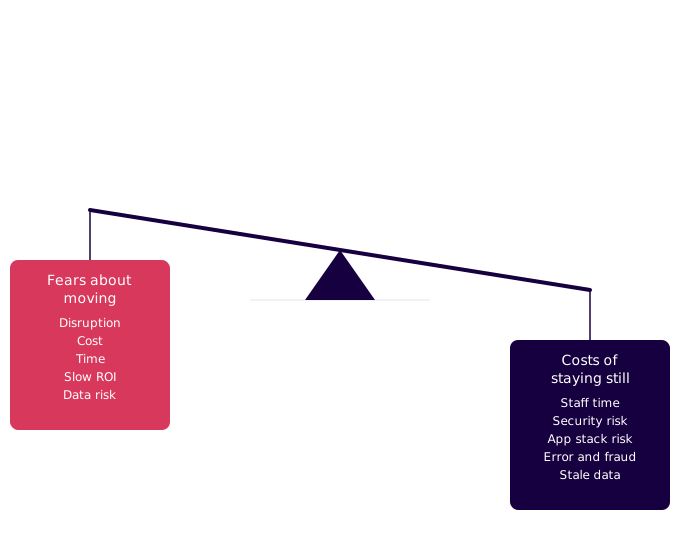
Cost, disruption, time, slow ROI and fear of losing data are the five reasons organisations most often give for staying with an old accounting system. All these are valid concerns – but measured against the true cost of doing nothing, they don't necessarily hold up as reasons to avoid switching. This article explains why – and what a well-planned switch involves.
The short version:
- Sticking with an old or entry-level accounting system usually costs more than switching does, once you count server fees, duplicate licences and the staff time lost to manual work.
- Outdated finance systems make it harder to recruit and keep good staff, who expect the same ease of use at work that they get from modern apps at home.
- Manual processes increase the risk of errors and let fraud go unnoticed more easily, while a patchwork of bolted-together apps can break down as soon as one part changes.
- Without real-time financial data, leaders make decisions later and with less confidence, which weakens credit control, cost management and overall strategy.
- The five most common objections to switching – cost, disruption, time, ROI and data risk – all have practical answers once you look at them closely.
Nobody changes accounting software for fun. It is disruptive, it takes time, and it can feel safer to leave a system alone once it is bedded in, however clunky it has become.
It’s natural to be cautious about moving systems – but such hesitation is often based on an incomplete picture. iplicit's 2024 research among 1,000 finance decision makers in medium-sized organisations found five reasons organisations most often give for staying with an old or entry-level accounting system: disruption, cost, time, slow return on investment and fear of losing historical data.
Each of those concerns is about the cost of switching – although they don’t take into account the cost of staying still. This article sets out the five most common objections, what happens when you weigh them up properly and the risks of leaving an outdated finance system in place.
The five reasons organisations hesitate to switch accounting software
These were the five key objections to changing finance systems, according to iplicit’s research among decision makers at medium-sized organisations.
1. It's too disruptive
Most finance teams are not short of work, so changing systems while the old one is still keeping the lights on feels like a risk. The research found 24% feared the project would distract from core responsibilities, a fifth were not convinced the outcome would be worth the pain and 17% said the process itself was too complicated.
Reality: Disruption is manageable and not inevitable. Give the project realistic time, do it at the right time of year and bring in outside help if you need it. Done this way, the day-to-day work of the finance team can carry on uninterrupted.
2. It's too costly
Cost is the easiest reason to give for not acting on any project – and 23% of decision makers in our study named expense as a barrier to changing finance systems.
Reality: The key question is not "What does switching cost?", about "What does switching cost compared with staying as we are?". Staying still has its own price, which includes:
- staff time spent on laborious manual processes, including data entry
- time spent manipulating spreadsheets instead of generating reports
- the cost of an on-premises server or a "hosted" cloud provider's fees
- paying for multiple software instances if you have more than one legal entity
- the cost of human error; and
- the cost of the staff talent you're losing or failing to attract because of clunky systems.
3. It's a big time sink
Time is often in shorter supply than money. Our survey found 21% of respondents citing a lack of internal resources as a reason for not changing finance system.
Reality: There's a risk of falling for the "haven't got time" paradox. If you’ve read Stephen Covey’s best-seller The 7 Habits of Highly Effective People, you might remember the story about the man who has spent hours trying to fell a tree with a blunt saw. Asked why he doesn’t sharpen the tool, he says: “I don’t have time to sharpen the saw. I’m too busy sawing.”
Switching finance systems does require an investment of time – but usually less than people expect. Systems built for big corporates can take months to implement, disrupting an organisation for over a year. But modern accounting software designed for mid-market organisations typically implements within a single calendar quarter, sometimes in a matter of weeks.
4. It takes too long to see return on investment
More than a quarter (27%) of decision makers in our research feared it would take too long to see a return on investment in new financial management software.
Reality: Modern finance systems don't carry the cost or disruption of the over-engineered corporate ERP systems that gave switching its reputation. Implementation costs are correspondingly lower, so ROI on accounting software can happen in months rather than years, especially where switching frees up substantial staff time.
5. I need my old data (and it'll cost a fortune to keep it)
This was the top concern in the research: 42% of respondents feared losing historical data when switching accounting software, and 32% cited the cost of a "right to use" licence just to keep viewing data in their legacy software.
Reality: Modern cloud-based accounting software offers stronger data security and accessibility than most legacy systems and migration can be smooth and phased rather than disruptive. Right-to-use licences, which can cost more than the old software itself, are unnecessary. Past data can be imported into the new system in a read-only view, available whenever you need it and exportable again if you ever choose to switch systems in future.
The risks of not changing
Staying with an old finance system is not a neutral choice. It carries risks of its own.
There's a cost to working with old systems. Legacy systems cost money in easily quantifiable ways, including server hosting or multiple licences for the same software. But they also cost you in harder-to-calculate ways, via the time and effort spent on tasks that could be reduced or automated.
Clunky systems frustrate people. People expect a smooth, intuitive experience from the apps on their phones and home computers, so outdated, user-unfriendly finance software demoralises staff, drives them away, and makes an organisation a less attractive prospect for new talent than employers running modern systems.
Data is less secure in outmoded systems. An on-premises finance system risks physical damage or a security breach to your most sensitive data. Security fixes and software updates aren't applied in the background without extra work from your IT team, unlike with true-cloud systems.
App stacks can be unstable. Many organisations bolt an entry-level accounting system onto a collection of third-party apps to get work done. That arrangement is a risk once it grows complex. Ownership of an app can change, an update to one can break the whole set-up and technical problems become harder to trace.
Error is a likelihood and fraud is a risk. The more points where a person has to enter data or intervene in a transaction, the more scope there is for mistakes or, in some cases, dishonesty. Modern accounting software reduces these risks by cutting down on manual entry points.
Lack of real-time data. If leadership can't see management information until month-end processes are complete, the organisation is at a disadvantage. Good credit control, cost management and strategic decision-making all depend on a reliable, up-to-date financial picture, without it, leaders are flying blind.
How to switch with less disruption
A well-planned switch does not have to involve prolonged disruption to the day-to-day work of a finance team. The switch will go better if you consider a couple of key issues.
Timing: Reflect on the best time of year to make the change. While it’s natural to want to make a new start in a new financial year, that can also mean implementing when you have your hands full with those year-end processes. A quieter time, perhaps at the end of another like a VAT quarter, is worth considering.
Support: Consider bringing in external support or at least drafting someone from another team. This can help remove the burden of running the implementation project on top of your own full-time job.
Time and resources: If you commit the time and energy you realistically need to the process of designing, implementing and training in the new system, there’s no reason it shouldn’t go smoothly.
With the right system, the upheaval can be less severe – and can be over more quickly – than many people fear. iplicit’s cloud accounting software is designed for implementation within a single quarter, rather than disrupting an organisation for a year or more.
Where iplicit fits
Good cloud accounting software should make switching low-risk. It should preserve historical data and disrupt the life of an organisation as little as possible. iplicit is built around that idea, offering the key capabilities of big enterprise-level systems without their complexity.
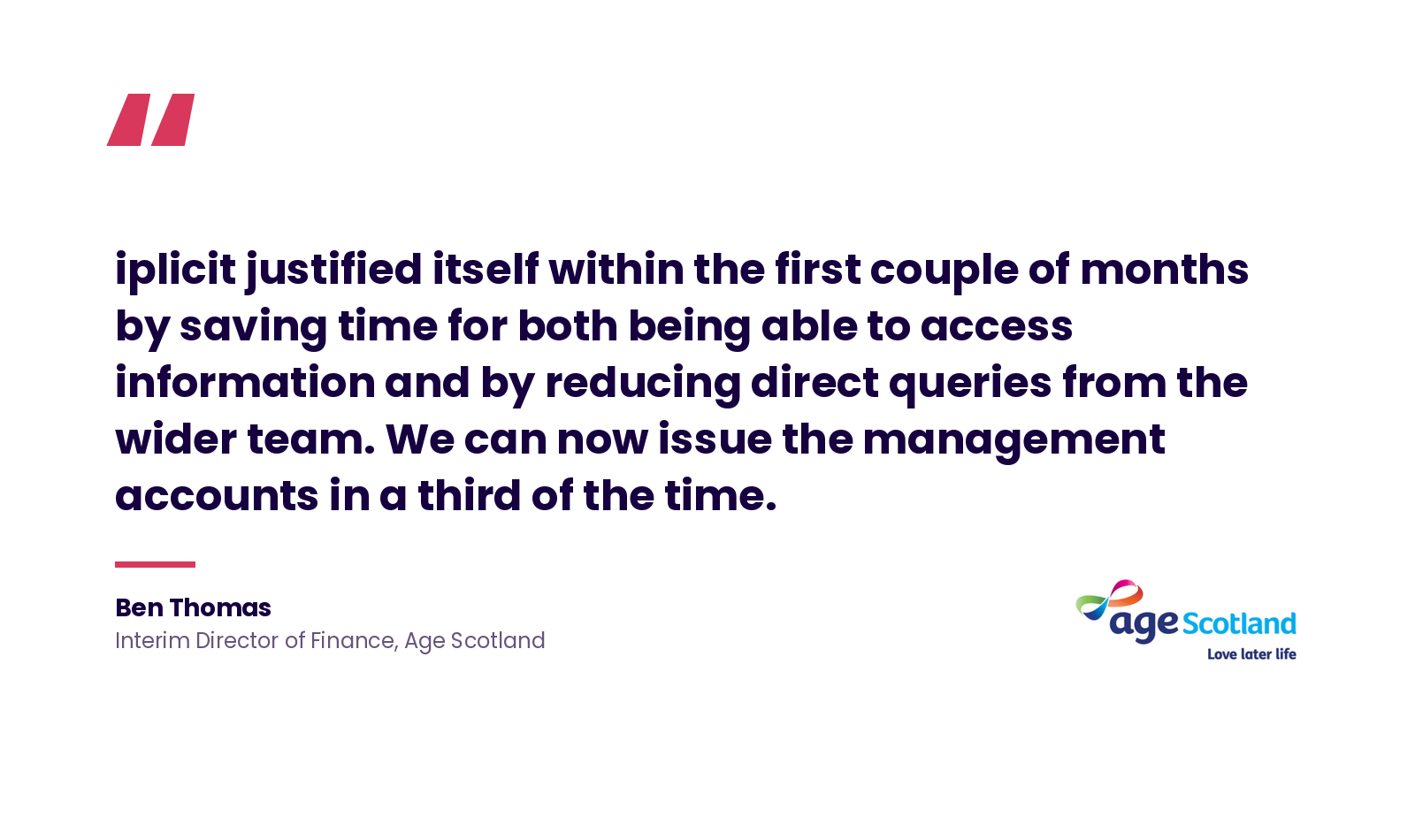
This approach helps customers see return on investment faster. At Age Scotland, Ben Thomas, Interim Director of Finance, said: “iplicit justified itself within the first couple of months by saving time for both being able to access information and by reducing direct queries from the wider team. We can now issue the management accounts in a third of the time.”
Historical data isn't a barrier. Past records import into a read-only view inside iplicit's cloud accounting software so nothing is lost and nothing locks you in if you ever want to export it again. Andrew Harris, Head of Finance at Calderdale College, found iplicit’s approach to data migration set it apart from other vendors. “Other vendors said they’d give us some templates to fill in,” he says. “But iplicit said: ‘Give us what you want uploading. We’ll do it and make sure it works.’ That made us think ‘These people are different’.”
The bigger risk is doing nothing
There are valid reasons to hesitate about changing systems – but the costs of switching need to be weighed against the costs of staying still. Once you count the hidden costs of an outdated system, cost, staff time, security, stability and visibility, the calculation tends to look different.
Disruption, cost and time can all be managed. The bigger risk is usually another year of manual work, security gaps and decisions made on stale data, while the switch you were putting off keeps getting more overdue.
Want to see what a modern finance system looks like in practice? Watch a quick tour of iplicit, or book a demo to talk through what switching would involve for your organisation.
What are the most common objections to switching accounting software?
The five most common objections are disruption to day-to-day work, the cost of the switch, the time it takes, uncertainty over return on investment, and the risk of losing historical data. iplicit's research among 1,000 UK finance decision makers found these five reasons come up more than any others.
Is switching accounting software as disruptive as some people say?
It does not have to be. Disruption usually comes from rushing the project or attempting it when you’re heavily committed to other work. Planning it at the right time of year, bringing in support and choosing software designed for quick rollout help keep day-to-day work running normally.
Why are finance teams worried about losing historical data when they switch systems?
Many legacy systems make historical data hard to access once you leave – and providers often charge a right-to-use licence for you to keep viewing it. Modern cloud accounting software avoids this by importing past records into a read-only view and letting you export your data again whenever you need to.
How long does it take to implement new accounting software?
Many corporate-style implementations could take a year or more. Modern cloud accounting software like iplicit can typically be implemented within a single calendar quarter and some organisations go live in a matter of weeks, without the long, disruptive rollouts that gave switching its poor reputation.
What are the risks of not upgrading an outdated accounting system?
Staying with an outdated system carries its own risks: wasted staff time on manual work, weaker data security, unstable third-party app stacks, more scope for error and a lack of real-time financial data that leaves leadership making decisions without a clear, current picture of the business.