
Multi-entity accounting is often complicated by fragmented data, error-prone intercompany transactions and time-consuming consolidation, especially when entities run on different software systems. This article looks at what makes multi-entity accounting so hard, what iplicit’s research into 1,000 finance decision makers revealed about the toll it takes, and how standardisation, centralisation and automation in modern cloud accounting software make it easier – illustrated by customers including A-One Insurance Group, The Recruitment Group and ellenor.

The short version
- Multi-entity accounting is hard. It involves pulling together data from operations with different ledgers, different reporting requirements and sometimes different software systems.
- 38% of finance decision makers told iplicit that having to log in and out of multiple instances of software was the biggest brake on efficiency in their teams.
- The key reasons multi-entity gets so difficult include fragmented data, complex intercompany transactions, onerous compliance standards, time-consuming consolidation processes and communication bottlenecks.
- Better systems help a lot – by standardising information, automating routine processes and centralising data in one place for an easy bird’s eye view of your organisation.
Introduction: When multi-entity accounting drains your efficiency
If your organisation consists of multiple legal entities, you’ll know how painfully complicated that can make the work of the finance department.
There are plenty of sound business reasons for setting up a multi-entity structure – but multi-entity accounting can be onerous for the finance team that has to pull together data from different sources and, often, different software systems.
This can drag down productivity. In research conducted for iplicit among 1,000 finance decision makers, 38% cited having to manage multiple instances of software as the single biggest cause of inefficiency in their teams.
Sarah Smith, Group Operations Director at A-One Insurance Group, previously ran the group’s nine companies on separate instances of Sage 50. “The pain we went through was horrendous,” she says. “Information wasn’t being consolidated. There were replication conflicts. We were driving the business blind.”
If unaddressed, the problem is likely to worsen with every entity you add.
Why is multi-entity accounting so complicated?
The different entities in your organisation are likely to have their own distinct operations, ledgers and reporting requirements. Fragmented data, the complexity of reconciling intercompany transactions and the laborious processes involved in consolidation can increase the workload of the finance team and make it hard to achieve efficiency.
Some of these challenges might seem familiar:
Data fragmentation
Financial information is often scattered across different entities, stored in different systems and organised in different ways. That can require the finance team to log in and out of different accounts in the finance software – or sometimes switch between entirely different systems. Reconciling all this information so you can report accurately and see complete accounting data in one place can be a nightmare.
Intercompany transactions
Every time money needs to move from one entity to another, you create an opportunity for mistakes and confusion. That’s the case whether a cost needs to be shared between entities or one company needs to charge another for its stock or services. Even if these debits and credits are recorded accurately, the task of reviewing and checking them is a burden – and chasing down one error can require hours of detective work.
Regulatory compliance
If your entities operate across multiple territories or sectors, the picture gets still more complex. You’ll have different currencies, tax regimes and compliance regulations to deal with – all of which makes it even harder to bring data together for group reporting.
Consolidation complexity
Creating consolidated financial statements can be like putting together a jigsaw with hundreds of pieces, some of which might turn out to be from a different puzzle. Checking those intercompany transactions, reconciling different accounting standards and accurately presenting an accurate group financial position can suck up hours of precious time at every month-end.
Communication bottlenecks
Coordinating data and decisions requires quick and clear communication. Gaps, delays and different ways of working can all spread confusion.
Narinder Uppal recalls accounting for four entities as Finance Director of The Recruitment Group, with a Sage system that could only open one entity at a time. “As a complex business, if we had an intercompany transaction, sometimes our accountants would do one side of the transaction and forget to do the other,” he says. “And when we were doing a month-end reconciliation, everyone would be scratching their heads.”
What iplicit’s research revealed
The pressures of multi-entity accounting the hard way are a serious drain on efficiency for many organisations – and can contribute to long hours and stress.
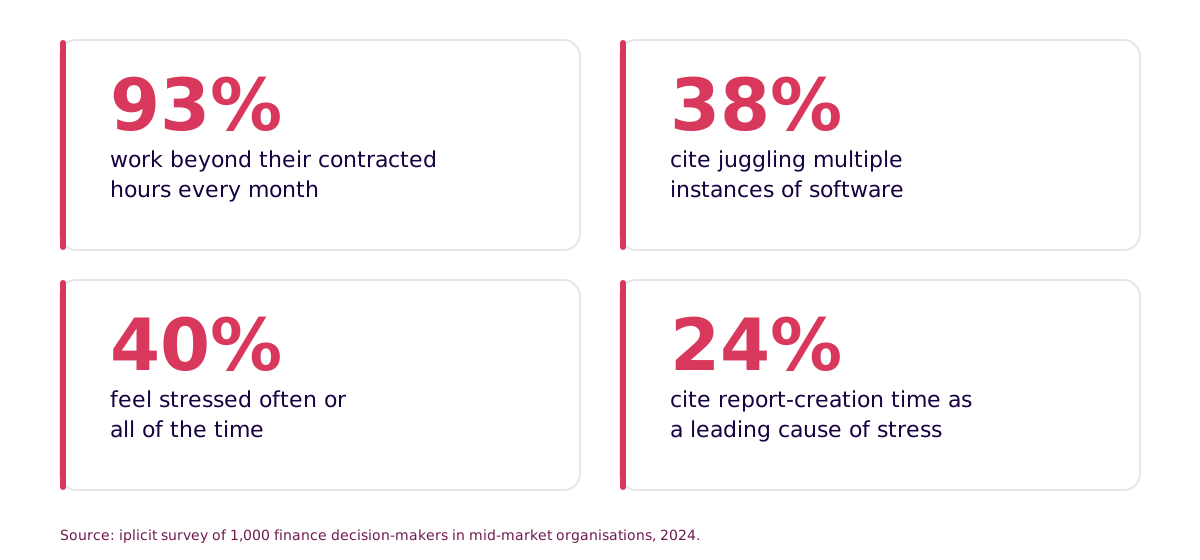
iplicit carried out research among 1,000 finance decision makers in mid-market organisations in 2024. The results were striking:
- 93% admitted to working beyond their contracted hours each month, while 40% felt stressed often or all the time.
- The time taken to create reports was one of the top causes of stress, cited by 24% of respondents.
- Having to access and manage multiple instances of software was cited as one of the top causes of inefficiency by 38% of respondents. A similar percentage complained of spending too much time managing data in spreadsheets.
Harder work won’t solve these challenges. The solution lies in more efficient systems.
How can you make multi-entity accounting quicker and easier?
No matter how organised you and your team are, the solution to these problems has to involve systems. Modern cloud accounting platforms help you tackle the unique challenges posed by multi-entity accounting.
Standardisation
A standardised chart of accounts across entities ensures uniformity and consistency in financial reporting, simplifying data analysis and keeping errors to a minimum.
Centralisation
Cloud-based finance software gives you one central system of record, offering a bird’s eye view of the entire organisation – and allowing you to zoom in to examine individual transactions in different entities.
Automation
The automation features in cloud accounting software cut down the repetitive work for any organisation – and these benefits are compounded where multiple entities are involved. As well as automating everyday work like accounts payable, bank reconciliation and approval workflows, more capable systems can take care of intercompany transactions too. When one entity’s account is debited, the corresponding credit in another entity follows without manual input, reducing the scope for errors and speeding up reconciliation.
Easier consolidation
Financial consolidation is much smoother with cloud-based accounting systems. With intercompany eliminations applied automatically, you can easily see the aggregated group position at the push of a button.
Real time collaboration
Cloud technology allows teams across entities to see up-to-date reporting and collaborate in real time, removing bottlenecks and swiftly getting complete management information into the right hands.
Data security and access control
Modern software offers robust security, including customisable access controls for different job roles. Everybody sees only the data they’re authorised to have, however complex the group gets.
Where the old way falls short
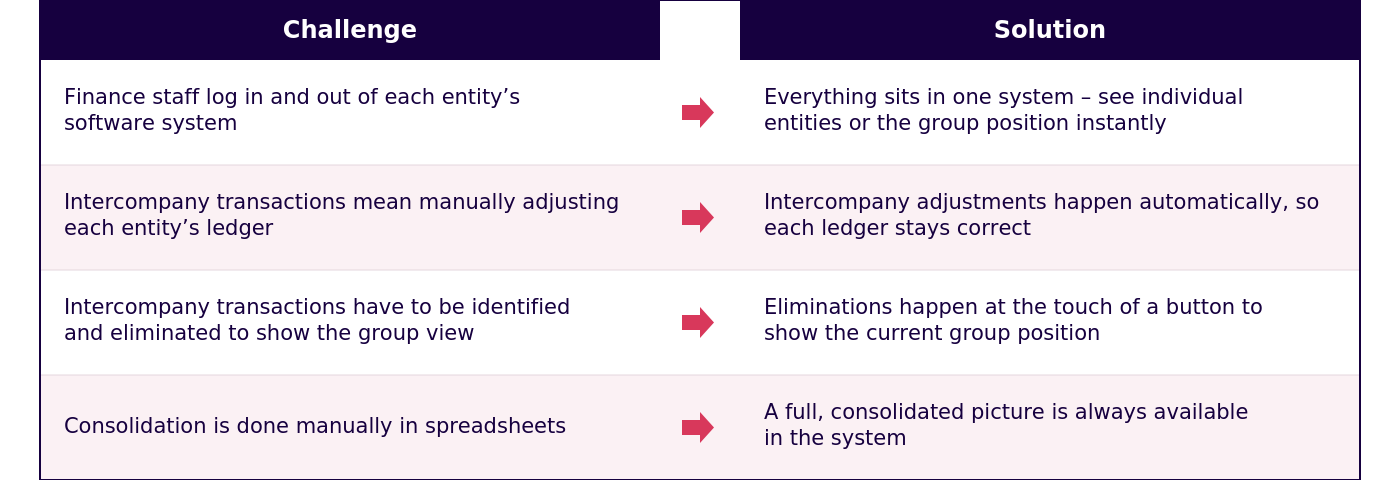
iplicit handles the challenges of multi-entity accounting by providing a single platform for the whole group’s accounts, with automations to take care of the error-prone intercompany processes.
Internal sales and charges are balanced and eliminated automatically, so a transaction in one entity triggers the corresponding adjustment in the other. Entity-level and group reports are pulled from the same underlying data, so consolidated accounts are available without the need for extensive manipulation in Excel. Multi-dimensional reporting by company, division and cost centre is available when you need it. And when your organisation expands – whether by growth or acquisition – iplicit makes it simple to add more entities without a lot of expensive consultancy support.
“The ability to run consolidated accounts at the touch of a button turns a previously daunting task, where normally a lot of data extraction and manipulation is required, into something very straightforward,” Narinder Uppal says of his experience at The Recruitment Group.
Sarah Smith of A-One Insurance says: “We’ve been able to consolidate all the businesses at once so we can grab very realistic and up-to-date snapshots at a moment’s notice. And most importantly, we know it’s reliable.”
Conclusion: Changing the role of the finance team
Without the right systems in place, every extra entity added to your organisation’s structure can multiply the challenges that the finance team has to deal with.
Systems that simplify or remove much of the manual work can not only increase efficiency but profoundly change the role of the finance team. With less time spent checking for errors, there is more scope to focus on extracting valuable insights from the data.
Besa Lane, who previously used Sage 50 to handle three entities as Head of Finance for the hospice charity ellenor, sums up this change of focus: “Before, I was spending a lot of time in spreadsheets, trying to get things right and eliminate mistakes. But now we have more valuable reporting that helps strategic decision making, so I’m spending more time on risk management and strategic analysis.”
iplicit helps multi-entity organisations like yours reduce manual work and produce the reports you need. You need just three minutes to take a tour of the software.
What makes multi-entity accounting so complicated?
What makes multi-entity accounting so complicated?
Multi-entity accounting gets complicated because each entity often has its own ledgers, reporting requirements and sometimes its own software system. Fragmented data, error-prone intercompany transactions, regulatory compliance across territories and time-consuming consolidation all add to the workload as more entities are added.
What is an intercompany transaction?
What is an intercompany transaction?
An intercompany transaction is any transfer of money, stock or services between different entities within the same group, such as one company charging another for shared costs. Recording both sides of the transaction accurately is often manual and error-prone, and chasing down a single mistake can take hours.
How does cloud accounting software simplify multi-entity accounting?
How does cloud accounting software simplify multi-entity accounting?
Cloud accounting software simplifies multi-entity accounting by standardising the chart of accounts across entities, centralising data in one system and automating intercompany adjustments and eliminations. This gives finance teams a single, consolidated view of the group without the manual reconciliation spreadsheets used to require.
How does iplicit handle multi-entity accounting?
How does iplicit handle multi-entity accounting?
iplicit runs a whole group’s accounts on a single platform, automatically balancing and eliminating internal sales and charges so a transaction in one entity triggers the matching adjustment in another. Entity-level and group reports are pulled from the same underlying data, so consolidated accounts are available without manual work in spreadsheets.