
A month-end process of 10 days or more is normal for finance teams but not inevitable. By challenging the myth that it needs to take that long, resisting the impulse to add to headcount and reducing their reliance on Excel, finance teams can achieve big time savings.
The short version
- Many finance teams report month-end lasting 10 days or more
- Three myths can hold teams back: that it needs to take that long, that the solution is to hire more people and that Excel is essential to the process
- Automating manual tasks can save days every month and release the finance team for more strategic work

If month-end close occupies your finance team for around half the following month, that doesn’t make you an outlier. In fact, it’s about normal. However, it’s not inevitable.
A poll held during an iplicit webinar found 41% of participants were spending 10-14 days on their month-end close, while almost a third were taking longer than that. “It’s not exceptionally long but of course it feels slower,” said James Bowers-Lee, iplicit’s Solutions Consultant Manager. “You’re already half way through the month before you’re getting those numbers out.”
The event, Your Month-End is Broken: Don’t Accept a 10-Day Close, sought to tackle three key myths about month-end. Those were that it inevitably takes 10 or more days, that throwing more people at it will make it faster and that Excel has to be a big part of it. James laid out a process for working out why your month-end is taking so long and how it could be quickened.
How long does month-end take?
Most finance teams take longer than 10 days to close the month, according to a poll taken at iplicit’s webinar. It found 41% were spending 10-14 days on their month-end close, while 29% were taking longer still. More than a quarter (26%) were taking 6-10 days and 3% were achieving 1-5 days.
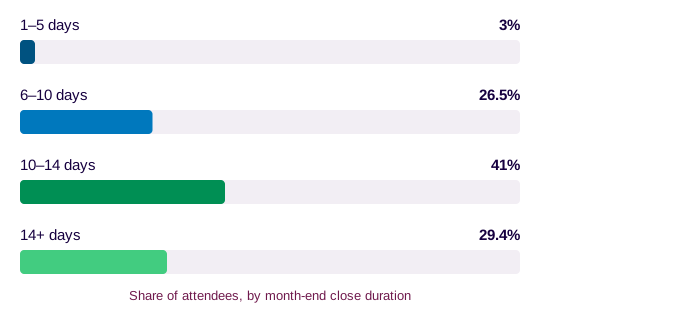
It's an unscientific sample, skewed towards people already interested in speeding up their month-end close, but it matches what iplicit sees regularly. James described a 10-day close as normal. “It’s common but it’s not inevitable and it’s not something you just have to live with because that’s finance,” he said.
Myth 1: Month-end takes at least 10 days
Many finance teams assume a 10-day-plus close is simply a fact of life. James says that's usually because they've grown used to working around a handful of manual processes:
- Bank statements are downloaded in Excel and reconciled by hand against transactions in the ledger.
- Intercompany transactions have to be posted twice – as a debit in one entity and a credit in another – with information copied and pasted from one system to another.
- Journalling the accruals “gets left until last because everything else takes priority”.
James suggested finance systems should have a bank feed that imports transactions automatically and matches them against what’s in the system. Intercompany entries should be posted once to generate the matching entry in the corresponding entity, with no manual reconciliation. Accruals can also be automated each month once the original transaction is posted.
“Put these together and teams are going from a three-week close to under a week,” he said. “It’s not just one single process that solves this. It’s compounding the removal of manual processes.”
Myth 2: More people means a faster close
It might seem like common sense that hiring more people would speed up processes. “When the close is slow, the instinct is to add headcount,” said James. But he pointed out that directing more people at manual processes is an inefficient approach to the problem.
He highlighted two areas where automation makes the difference.
- Incoming invoices can be captured and coded automatically, then sent for approval, without the need for manual data entry.
- In credit control, reminders can be sent out automatically, based on how overdue an account is, with no need for mail merges and drafting emails.
Myth 3: Excel is just a part of finance
Excel use is so firmly rooted in finance teams that it’s “almost treated as a law of nature”, said James. “Who’s got an Excel report or sheet called ‘V1_FINAL’ or ‘V5_FINAL_DEFINITELY_THIS_ONE_DONT_DELETE’? We’ve all seen it,” he said. But while everyone uses Microsoft’s spreadsheets, it’s not the most efficient tool for tasks such as:
- Calculating deferred revenue, depreciation and payments. These can be applied automatically by the finance system, in line with the rules you lay down.
- Consolidation of multi-entity accounts. A unified system allows you to see the current picture in real time, either by individual entity or by eliminating intercompany transactions to view the group picture.
“Excel will always have a place. I’m not saying rip it out – and in fact, we’ve got live links directly to Excel," he said. "But let’s do the heavy lifting in the finance system. Let’s speed up those processes, reduce risk and error and save time at month-end.”
Where iplicit comes in
It is possible to cut days and even weeks from month-end processes with a finance system that can automate much of the work. James cited the experience of Awen Cultural Trust, where Head of Finance Maria Goddard reported cutting the work of 7-8 days to five after switching to iplicit. “It’s not huge, it’s not a headline-grabbing transformation, but that’s exactly why I like it. It’s what actually happens when you take the manual work out of month-end close," he said.
Some iplicit customers have achieved more dramatic results, with Walking With the Wounded saving 15 days a month. James invited finance teams who are taking 10-14 days to “imagine what it would be like at six, seven or eight days”. “Think of the time you’d have back and the work you could do strategically outside that,” he said.
You don’t need more people or more to-dos
Speeding up month-end is very possible without adding to headcount. “Month end doesn't have to take 10 days and it definitely doesn't need more people to get there faster. Reconciliation, invoice processing and Excel are the three places where finance teams consistently lose time, over and over, regardless of size, sector or other factors,” said James.
“The way out isn't a bigger team or a longer to-do list. It's getting that time back by automating the manual work sitting behind month end. Let’s automate it.”
See it for yourself
Watch the full webinar to see in detail how iplicit can automate processes and save days at month-end. Or book a demo to see how iplicit could work for your organisation.
How long should month-end close take?
How long should month-end close take?
Many finance teams take 10 days or more to close the books each month, but that is not a fixed limit. A poll of finance professionals found over 70% took 10 days or longer, yet organisations that automate reconciliation, invoice processing and calculations such as deferred revenue routinely close in five days or less.
Why does month-end close take so long?
Why does month-end close take so long?
Manual work is usually the cause, not company size or sector. Bank reconciliation done by hand, intercompany entries copied and pasted between systems, and accruals left until last because everything else takes priority are the three places finance teams consistently lose time at month-end.
Does hiring more staff speed up month-end close?
Does hiring more staff speed up month-end close?
Not on its own. When a close is slow the instinct is to add headcount, but directing more people at manual processes such as invoice entry and reconciliation is inefficient, and automating those processes shortens the close far more reliably than hiring for them.
How can finance teams shorten month-end close without hiring?
How can finance teams shorten month-end close without hiring?
Automate the three biggest manual drains: bank reconciliation, intercompany postings and invoice processing, rather than adding headcount. iplicit customers such as Awen Cultural Trust and Walking With the Wounded have cut month-end close by several days, with one saving as much as 15 days a month.