
Rapid growth and new investment put pressure on every department – but finance often gets left behind as it struggles on with entry-level tools like Xero or QuickBooks. Outgrowing your finance system slows reporting, increases the risk of error and can even affect how investors value your organisation. Here's what growing companies need instead.

The short version
- Rapid growth and outside investment put new pressure on finance teams but finance rarely gets the same tooling budget as sales or operations.
- Entry-level systems like Xero and QuickBooks work well for small, single-entity organisations but often struggle with the demands of higher volumes, more entities or greater investor reporting.
- Staying on an outgrown system creates three key risks: more manual work, less accurate reporting and, in the worst case, a lower valuation.
- A finance system built for scale gives real-time reporting, automation and multi-entity or multi-currency support, without the cost and delay of a full enterprise ERP rollout.
Fundraising and rapid growth are exciting but they demand a lot of the finance team. Sales and operations tend to get investment to keep pace but finance is often left to cope with the same entry-level software it started out with.
As transaction volumes climb and reporting demands multiply, basic accounting software – augmented by spreadsheets – cannot keep up. The result is more manual work, more errors and less time for the analysis investors want to see. This article explains why finance teams get squeezed during periods of rapid growth, the three biggest risks of ignoring it, and what features a growing organisation should look for in a finance system.
Why finance teams struggle to keep up with rapid growth
When a company raises funding and scales quickly, every department feels the pressure. Finance often bears that pressure with the least support.
Spending on tools and new hires tends to be focused on other parts of the organisation. The finance team is often expected to manage rising transaction volumes, more legal entities and more demanding investor reporting using the same entry-level system, such as Xero or QuickBooks, that served the organisation when it was smaller.
To understand why this happens, it helps to look at how much earlier and how much faster companies are now raising money. Seed-stage funding in particular has changed shape: according to Crunchbase, more than half of all US seed dollars in 2025 went into rounds of $10 million or more, even as the number of seed deals fell from its 2021-2022 peak. So fewer companies are getting funded but those that do are raising much larger, much earlier rounds than seed-stage startups once did.
Amid that kind of growth, the day-to-day workload of the finance team increases and other teams place more demands on the department. Sales and account management need visibility into billing. The operations team needs to log time and expenses against projects or check credit control status. Financial information needs to be shared more widely across the organisation – but that’s hard to do when there's been no investment in the finance system.
Finance is left running basic software and working around its limitations by using a growing collection of spreadsheets, often losing hours each week to answering internal queries instead of doing higher-value work.
The three risks of outgrowing your finance system
Staying on an entry-level finance system after rapid growth creates three key risks: it costs the finance team more time, it reduces the accuracy of reported numbers and in the worst case, it can affect the valuation investors are willing to put on the organisation.
Risk 1: More time lost to manual work
Manual tasks take a growing toll on a finance team's efficiency, especially complex ones like revenue recognition or multi-currency consolidation. This burden increases as the organisation grows and transaction volumes rise.
Things tend to get especially difficult once an organisation starts trading across two or more legal entities or countries, or once customer numbers pass a certain threshold. Past that point, manual work and human error both increase, taking still more time to resolve. That leaves less time for the FP&A work investors expect, often forcing the organisation to hire additional resource just to keep pace.
Fast-growing cyber security specialist SEP2 found its needs too complex for Xero and decided “the pain of moving to another platform would be less than the effort of making the existing system work a bit longer”. Heating and ventilation business Contract Energy Management found tracking 10,000 projects brought Sage 50 “to a standstill”.
Risk 2: Less accurate reporting
Inaccurate data is a problem for any organisation but it's especially risky for a funded one. Investors expect accurate, up-to-date reports and board packs, even as growth targets and the underlying numbers change quickly.
When the relevant data sits in spreadsheets with multiple tabs of VLOOKUPs, or has to be pulled from several entities in several currencies, producing a reliable report becomes difficult. Finance teams, and the decision-makers relying on them, need real-time access to accurate data to keep up.
Risk 3: Reduced valuation
Valuations are based on forecasts as well as historic performance, so data accuracy is critical. Ask any finance professional who has been through a fundraise about the late nights spent pulling reports and building forecasts from multiple spreadsheets, exports and formulas.
Investors are aware of the risk that errors in any one of these sources pose to their return on investment, so any doubt over the numbers can directly affect the valuation an organisation achieves. Investing early in better finance technology can give investors more confidence in the numbers.
What to look for in a finance system as you scale
A finance system built for a growing, funded organisation needs to do more than record transactions. It needs to give the finance team real-time visibility, cut manual work through automation and scale across entities and currencies without a costly, drawn-out implementation.
Fast-growth, funded organisations upgrading from entry-level systems should look for:
- Real-time reporting: accurate reporting that's easy to interrogate and flexible enough to handle changing requirements as new investors come on board.
- Process automation: automation across reconciliation, revenue recognition and other repetitive tasks, to reduce workload and human error.
- Spend control: spend management functionality that gives finance direct oversight of cash burn, a critical concern for any funded organisation.
- An open platform: integrations with the other key systems the organisation already runs, so finance isn't manually re-entering data from other tools.
Large ERP systems can offer these features but they typically cost significantly more than the entry-level systems they replace, and can take months or, in some cases, years to implement.
Where iplicit fits
Large ERP systems can deliver the reporting and automation a growing finance team needs, but they tend to cost more and take many months to implement. iplicit is built for organisations at exactly this stage: mid-market companies that have outgrown entry-level software but do not need enterprise complexity.
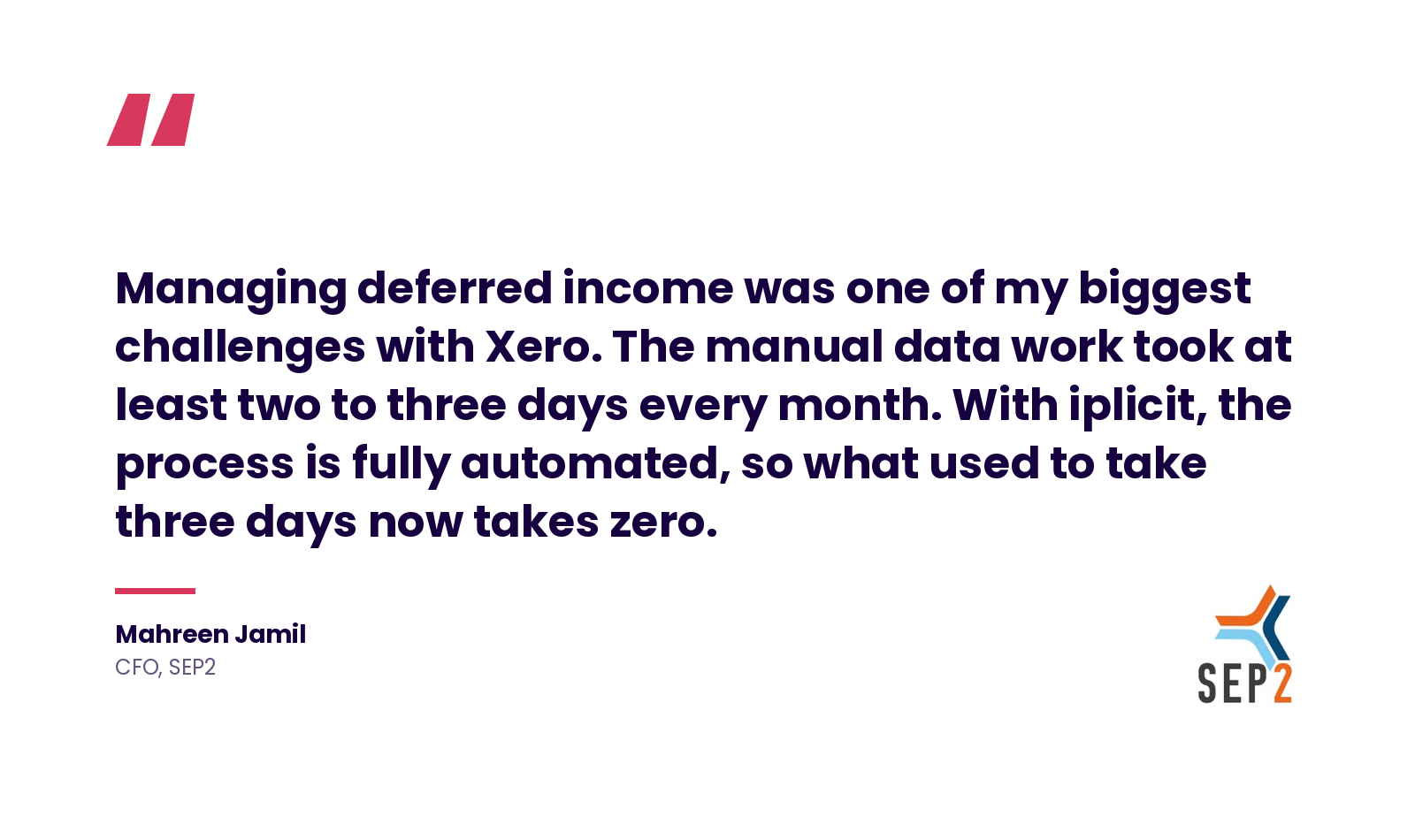
For organisations still relying on spreadsheets to manage deferred revenue or multi-entity consolidation, that manual work can be eliminated. SEP2 found that deferred income processing that used to take two to three days a month with Xero now takes no time at all, since it's fully automated in iplicit.
Multi-entity and multi-currency reporting is a similarly common pain point for growing organisations. iplicit's accounting consolidation software is built to consolidate across entities and currencies in real time, rather than through manual spreadsheet work. du Boulay cut report preparation from three weeks to under one week after switching, and Dawn Capital cut its monthly reporting time in half, freeing the team for higher-level analysis instead of data-gathering.
Because iplicit is designed specifically for mid-market organisations rather than scaled down from an enterprise product, it can typically be implemented in weeks rather than the months or years a large ERP rollout takes, removing one of the biggest barriers that stops growing organisations from upgrading sooner.
The bottom line
Growth and outside investment makes the work of the finance team even more important than it was before. When finance is left on the same entry-level system that got the organisation started, the result is more manual work, more risk of error and, in the worst cases, a lower valuation than the business deserves.
Upgrading early, before these problems multiply, gives the finance team the time back to work on the analysis investors are looking for – and can give the investors more confidence in the numbers.
To see how iplicit works for a fast-growing organisation, you can take a three-minute tour or book a demo to see it applied to your own needs.
What features should a growing company look for in a finance system?
A finance system for a growing company needs real-timereporting, automated processes like bank reconciliation and consolidation andthe ability to handle multiple entities or currencies as the organisationexpands, all without the cost or delay of a full enterprise ERP implementation.
What's the difference between entry-level accounting software and a system built for scale?
Xero and QuickBooks are built for small, single-entityorganisations with simple reporting needs. Once a company adds entities,currencies or detailed investor reporting requirements, these entry-levelsystems demand growing amounts of manual work and spreadsheets to fill the gapsthey leave behind.
Why does rapid growth put so much pressure on finance teams specifically?
Rapid growth increases transaction volumes, adds reportingcomplexity and raises expectations from investors and other departments, all atonce. Finance teams often do not get the same investment in tools as sales oroperations, so the gap between workload and capacity grows quickly.
How do you know your finance team has outgrown its current system?
Look out for signs such as month-end close taking longerwith every cycle, growing reliance on spreadsheets to fill reporting gaps, andfinance staff spending hours each week answering ad hoc queries from otherdepartments instead of on analysis and forecasting.
How quickly can a growing company implement a new finance system?
iplicit can typically be implemented in a matter of weeksrather than the months or years a large ERP system requires, because it ispurpose-built for mid-market organisations rather than a cut-down version ofenterprise software designed for far bigger companies.