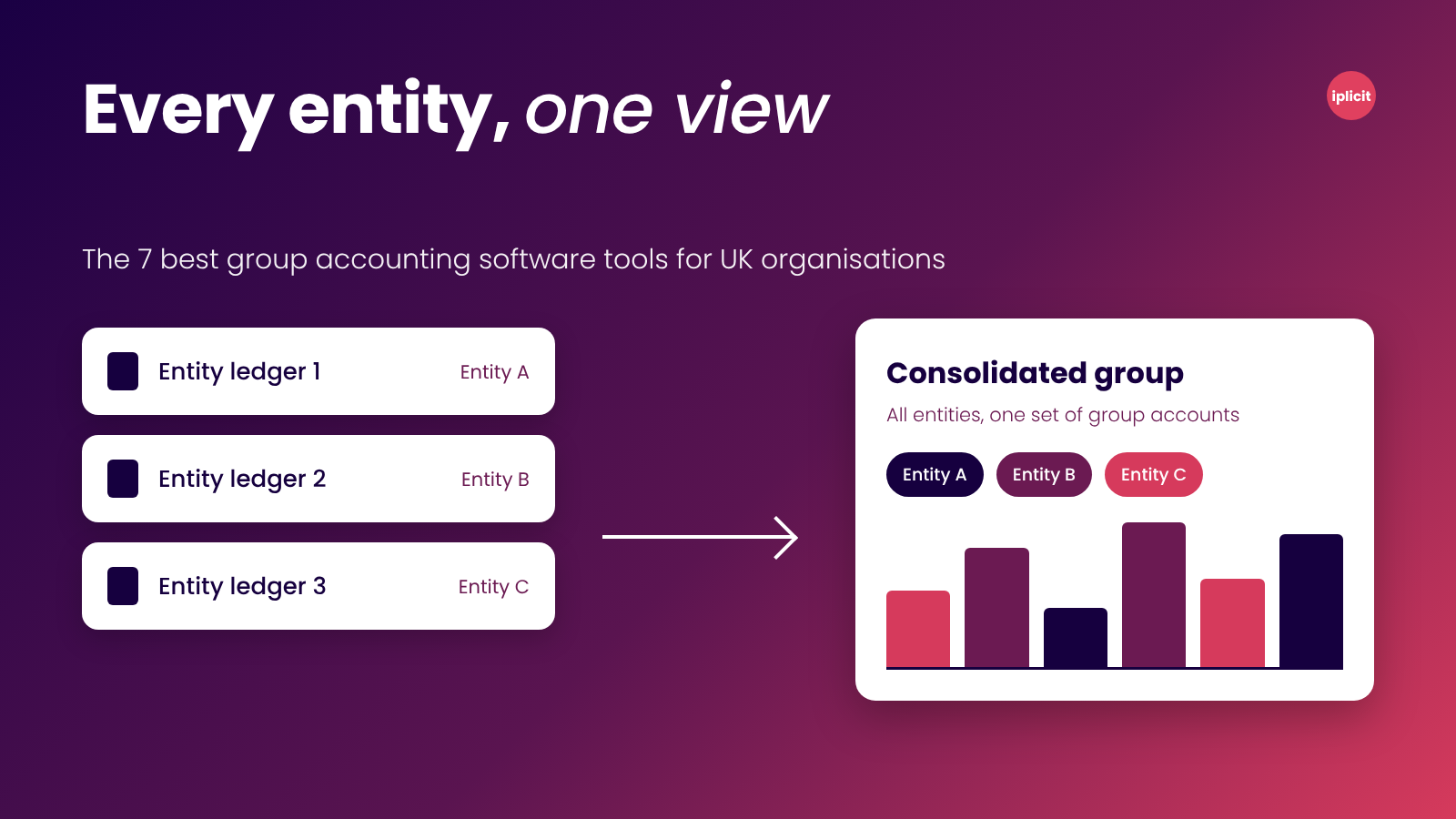
Sage Intacct is a finance-first platform with strong reporting and multi-entity capability. NetSuite is a broader ERP that bundles financials with inventory, CRM, and order management.
Sage publishes a starting price for Intacct. NetSuite is quote-only and covers more of the business. In both, group consolidation comes through a separate module.
For UK groups, iplicit includes consolidation as standard. Here’s a quick table that compares the three:
Need to choose between Sage Intacct and NetSuite?
If you’re evaluating enterprise finance software and have narrowed down your options to NetSuite and Sage Intacct, this article is for you.
Here, we’ll review and compare both platforms based on factors that matter for a UK multi-entity finance group. By the end, you’ll be able to decide which of the two best fits your organisation.
Why listen to us?
At iplicit, we work with UK mid-market finance teams that have outgrown entry-level systems. Dawn Capital, a venture capital firm, cut its management reporting time by 50% after moving to iplicit. Gurvinder Sandhu, their Financial Controller, says iplicit sped up the firm’s reporting timeline significantly.
We know the features a platform needs to run consolidated reporting well, and we based this comparison on those criteria.
Sage Intacct vs NetSuite: detailed comparison
Sage Intacct
Best for: Mid-market finance teams that want reporting depth without committing to a full ERP
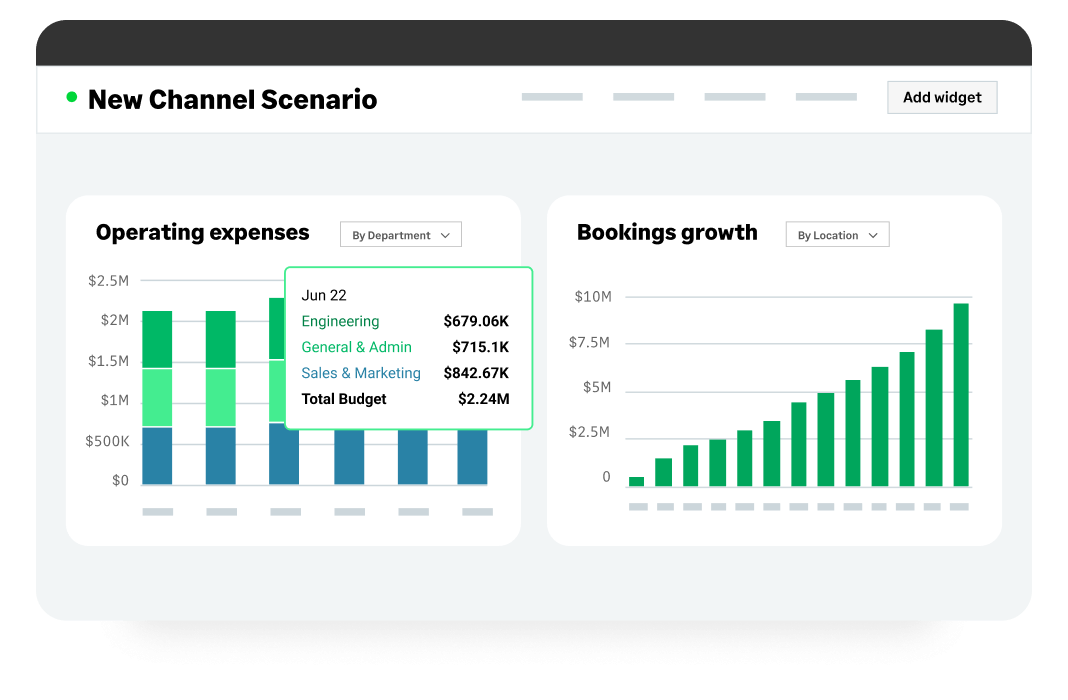
Sage Intacct is a cloud financial management platform built specifically for the finance function. So, it doesn’t cover operations, supply chain, or CRM. If you want in-depth accounting and reporting without paying for features you won’t use, Intacct is built for that.
One of its standout features is the dimensions-based general ledger. You can tag transactions with standard dimensions (department, location, project, customer and others) plus user-defined dimensions without expanding your chart of accounts. This makes multi-entity reporting more flexible since you can analyse the same data in different ways from a single ledger.
Sage Intacct also has a marketplace with more than 350 integrations. If you need CRM, HR or expense management alongside your financials, you can add these through the marketplace.
In the UK, Sage says you work with Sage Intacct Professional Services or a certified implementation partner, who also supports you after go-live.
Key features
- Dimensions-based reporting: Tag transactions with standard and user-defined dimensions for flexible reporting across entities, departments, and projects
- Multi-entity consolidation: Run multiple entities from one platform with consolidated dashboards and reporting
- Marketplace integrations: Connect to 350+ third-party applications through the Sage Intacct Marketplace
- Automated revenue recognition: Handle complex revenue schedules in compliance with IFRS 15 and ASC 606
- Contract and subscription billing: Automate recurring invoicing, contract renewals, and usage-based billing
Key limitations
- Implementation and post go-live support come from Sage Intacct Professional Services or a certified partner, so the experience depends on who you work with
- No native inventory, CRM, or order management modules. You’ll need separate tools for those
- The dedicated planning and analysis module, as well as the consolidation module, are charged as add-on costs
Pricing structure
Sage’s UK pricing page states that Sage Intacct pricing starts from £1,200 per month, excluding VAT. Your custom quote depends on the modules you pick, your user count, and your reseller’s terms. You’ll sign an annual contract and pay a one-time implementation fee.
Pros
- Financial reporting with flexible dimensions that adapt to your organisation’s structure without a rigid chart of accounts
- A published starting price (from £1,200 per month, excluding VAT) gives you a budget anchor before you talk to sales
- Finance-focused depth without the weight of a full ERP that you’re unlikely to fully use.
Cons
- Your implementation and support experience depends on the partner you choose
- No native CRM, inventory, or operations modules, so you’ll have to run and integrate multiple separate systems
NetSuite
Best for: Organisations that need financials, inventory, CRM and order management in a single platform.
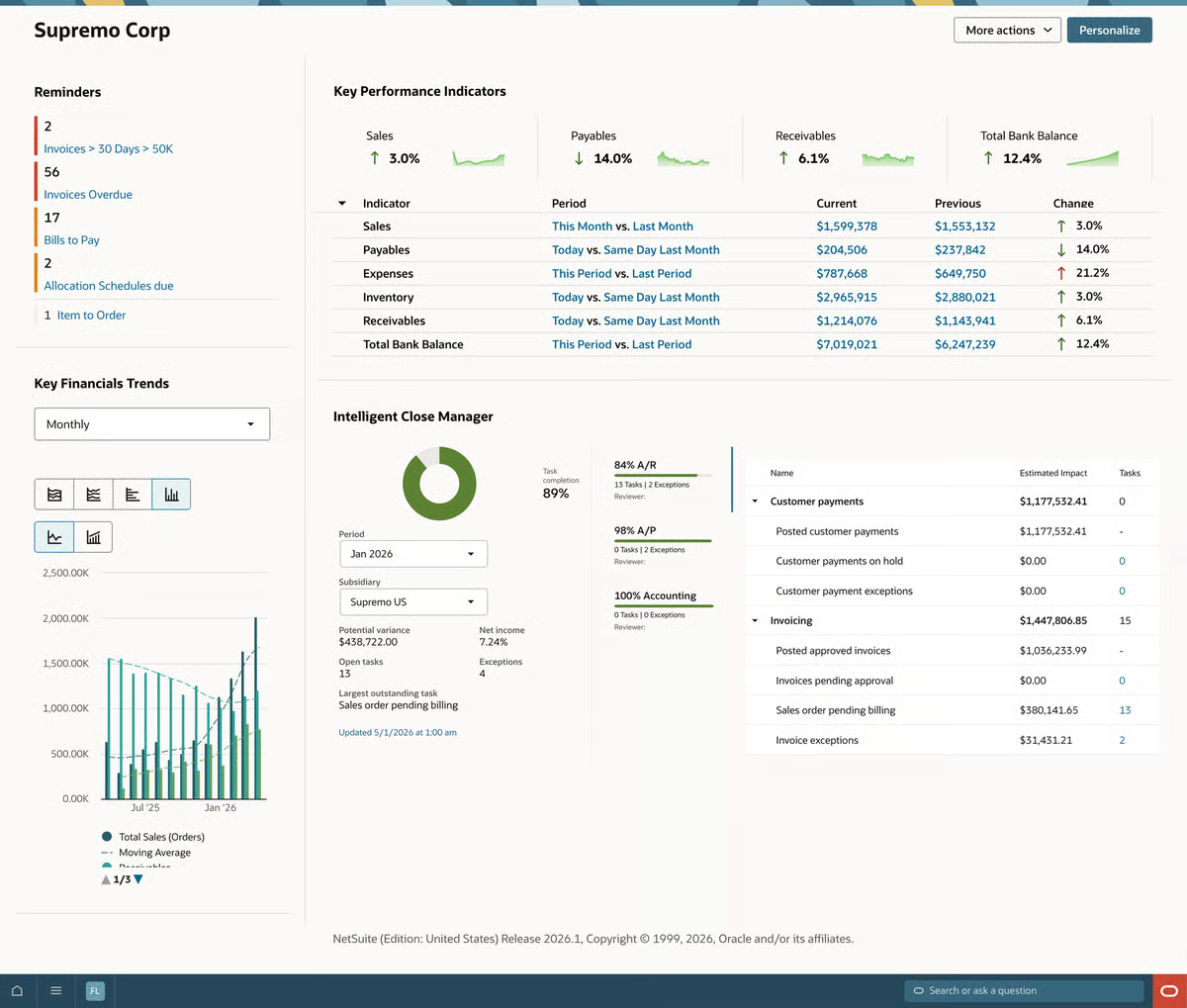
NetSuite is Oracle’s cloud ERP that bundles financial management with inventory, CRM, order management, procurement and ecommerce. If you need all these functions under one roof, NetSuite is one of the few platforms that delivers them natively.
For multi-entity organisations, NetSuite OneWorld manages subsidiaries across countries, currencies and tax jurisdictions. It supports over 190 currencies and 27 languages, making it suitable for organisations operating across borders.
NetSuite’s breadth means a larger project. Oracle doesn’t publish prices, so you can’t compare cost with Sage Intacct until you have a quote, and a full ERP rollout covers more modules than a finance-only implementation.
Key features
- OneWorld multi-entity: Manage subsidiaries across countries with live consolidation, intercompany eliminations, and multi-currency support
- Full ERP suite: Financials, inventory, CRM, order management and procurement in a single system with no third-party integration needed
- SuiteAnalytics: Build custom reports, saved searches and dashboards across every module in the platform
- SuiteCommerce: Native ecommerce integrated with inventory and order management for organisations selling online
- SuiteFlow and SuiteScript: Customise workflows and extend the platform through scripting and automation
Key limitations
- No published pricing, so you won’t know your quote until you’ve been through a sales process
- MTD for VAT filing runs through Oracle’s International Tax Reports SuiteApp, which has to be installed and set up
- Implementation covers more modules than a finance-only system, so plan for a larger project
Pricing structure
NetSuite doesn’t publish pricing. It issues custom quotes that vary by module count, user numbers, data volume, and contract length. You’ll also pay a one-time implementation fee.
Pros
- A single-platform ERP that covers financials, inventory, CRM, and operations without needing you to bolt separate tools together
- OneWorld handles global multi-entity across 190+ currencies with live consolidation
- Deep customisation through SuiteScript and SuiteFlow for organisations with technical needs
Cons
- Pricing isn’t available until you engage sales
- Implementation takes considerable time, budget, and internal resource dedication.
- MTD for VAT needs the International Tax Reports SuiteApp installed
iplicit: a third option when consolidation is the main requirement
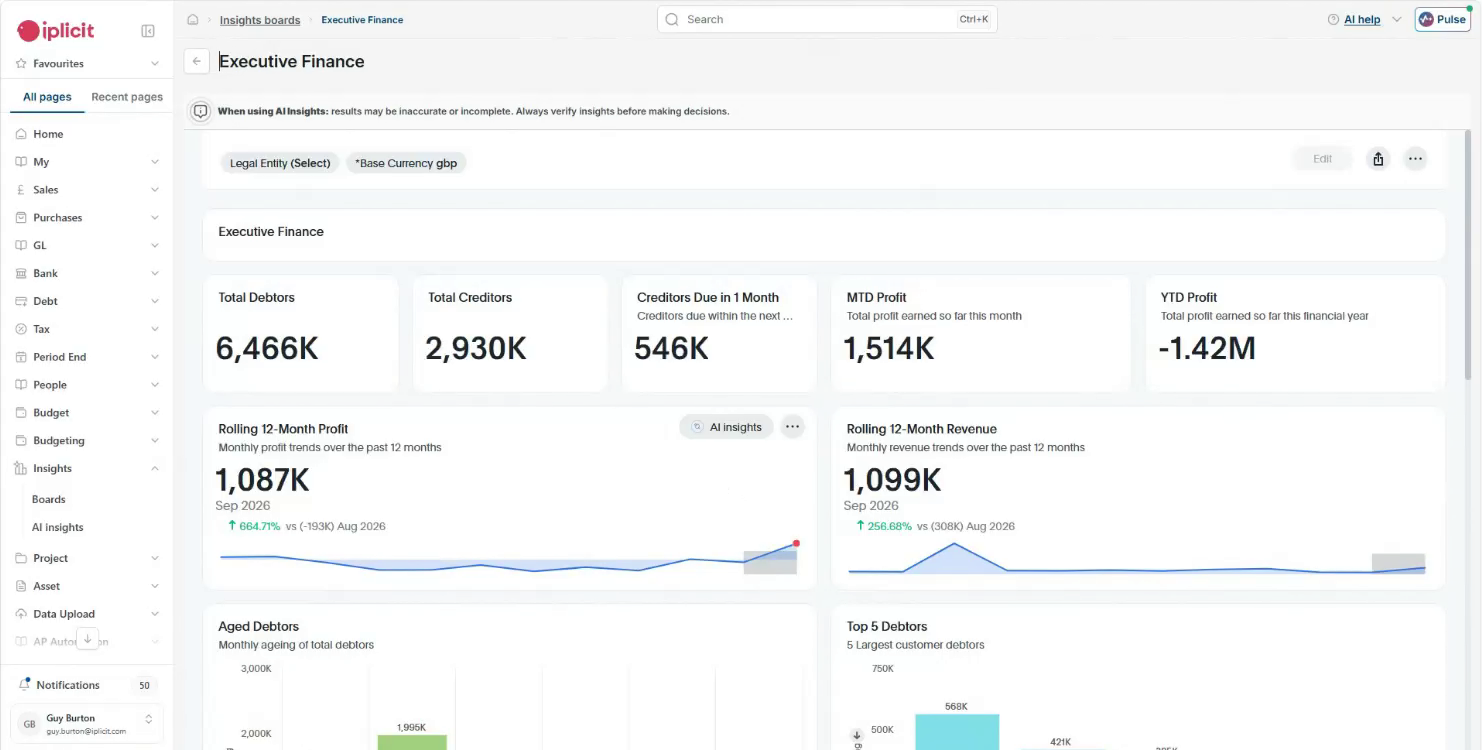
Sage Intacct and NetSuite both handle multi-entity accounting. In both, group consolidation comes through a separate module (Sage Intacct’s consolidation subscriptions and NetSuite OneWorld). If that capability is the main reason you’re considering them, iplicit includes it in its core subscription. See our guide to other Sage Intacct alternatives.
iplicit is a cloud finance platform designed around multi-entity groups. On iplicit, consolidation, intercompany automation and flexible reporting dimensions are included in the subscription rather than sold as extra modules.
Where Intacct gives you a set of standard dimensions plus user-defined ones, iplicit gives you flexible reporting dimensions. And where NetSuite requires OneWorld licensing for subsidiary consolidation, iplicit includes consolidation in the subscription. Plus, iplicit has a dedicated UK-based support team.
iplicit is best for UK multi-entity groups that need consolidated reporting and intercompany automation without committing to a full ERP rollout.
Key features
- Group consolidation: Consolidate across entities and currencies in one system, with intercompany handled in the system and drill-down to the source transaction
- Flexible reporting dimensions: Analyse transactions at the level of detail your CFO needs
- Intercompany automation: Record an intercompany transaction once and iplicit creates the matching entry in the other entity, with eliminations handled for you.
- Excel add-in: Pull live iplicit data into Excel with formulas that refresh on demand, so your team can work in a familiar tool.
- Configurable approval workflows: Route documents through multi-step approvals with a full, searchable audit trail
- Direct UK support: If you need support, you’ll speak to someone on our UK team who knows the product and your setup.
Key limitations
- No dedicated planning feature or FP&A module like that of Sage Intacct. Budgeting and FP&A capabilities are less extensive than dedicated planning tools
- Not a full ERP. Stock and inventory run through an integration with Cin7, and you’ll need a separate CRM
Pricing structure
Transparent subscription pricing that scales with your users and entities, with fund accounting, multi-entity and multi-currency capability included rather than sold as extra modules. Book a demo or take a quick tour to get a quote based on your entity count and users.
Pros
- Consolidation, intercompany automation and flexible reporting dimensions are included rather than sold as extra modules
- Annual subscription. See our licence agreement for full terms
- Implementation: up and running in weeks, not months
Cons
- No dedicated planning module, and budgeting is less extensive than dedicated planning tools, including for FP&A
- No built-in stock module (iplicit integrates with Cin7) and no CRM
Sage Intacct vs NetSuite vs iplicit: feature comparison
Choose the right platform for your organisation
One is a finance system. The other is a whole ERP. Decide how much of the business you want to buy.
The right choice between Sage Intacct and NetSuite depends on what you need beyond core financials. If you want deep financial reporting and multi-entity capability without a full ERP, Sage Intacct is the better fit. But if you need financials, operations, and CRM in one platform, NetSuite offers that breadth.
And if your main reason for evaluating these tools is consolidated reporting across a UK group, it’s worth comparing how each vendor packages consolidation.
Another option is iplicit, which offers multi-entity accounting, intercompany management and group reporting as standard features, and is up and running in weeks, not months.
To see how iplicit handles multi-entity accounting, intercompany transactions, and reporting, take a Quick Tour or request a demo.
Does Sage Intacct support Making Tax Digital?
Does Sage Intacct support Making Tax Digital?
Yes. Sage Intacct supports MTD for VAT natively in the UK. You can file VAT returns directly from the platform. NetSuite files MTD VAT returns through its International Tax Reports SuiteApp, which has to be installed and set up first.
Does NetSuite have more features than a mid-market finance team needs?
Does NetSuite have more features than a mid-market finance team needs?
Yes, if your organisation only needs financial management and reporting. You won’t benefit from features like inventory, CRM and procurement. A finance-focused platform is better for that situation. But if you need operations and financials in one system, NetSuite is the better fit.
Which offers better UK-based support? Sage Intacct or NetSuite?
Which offers better UK-based support? Sage Intacct or NetSuite?
Sage Intacct customers work with Sage Intacct Professional Services or a certified implementation partner, which also supports them after go-live, so the experience depends on who you choose. NetSuite support comes from Oracle and its partners. If support from the vendor’s own UK team matters to you, iplicit offers that.
Which is a better fit for UK charities and not-for-profits?
Which is a better fit for UK charities and not-for-profits?
Both platforms can support charity accounting, but they suit different needs. Sage Intacct offers fund accounting and grant tracking, while NetSuite’s multi-entity capabilities cater to larger charities operating across multiple jurisdictions. However, UK charities that need SOFA-aligned reporting and group consolidation don’t necessarily need an enterprise-level tool. Use our finance software evaluation checklist to assess how each fits your requirements before making a choice.