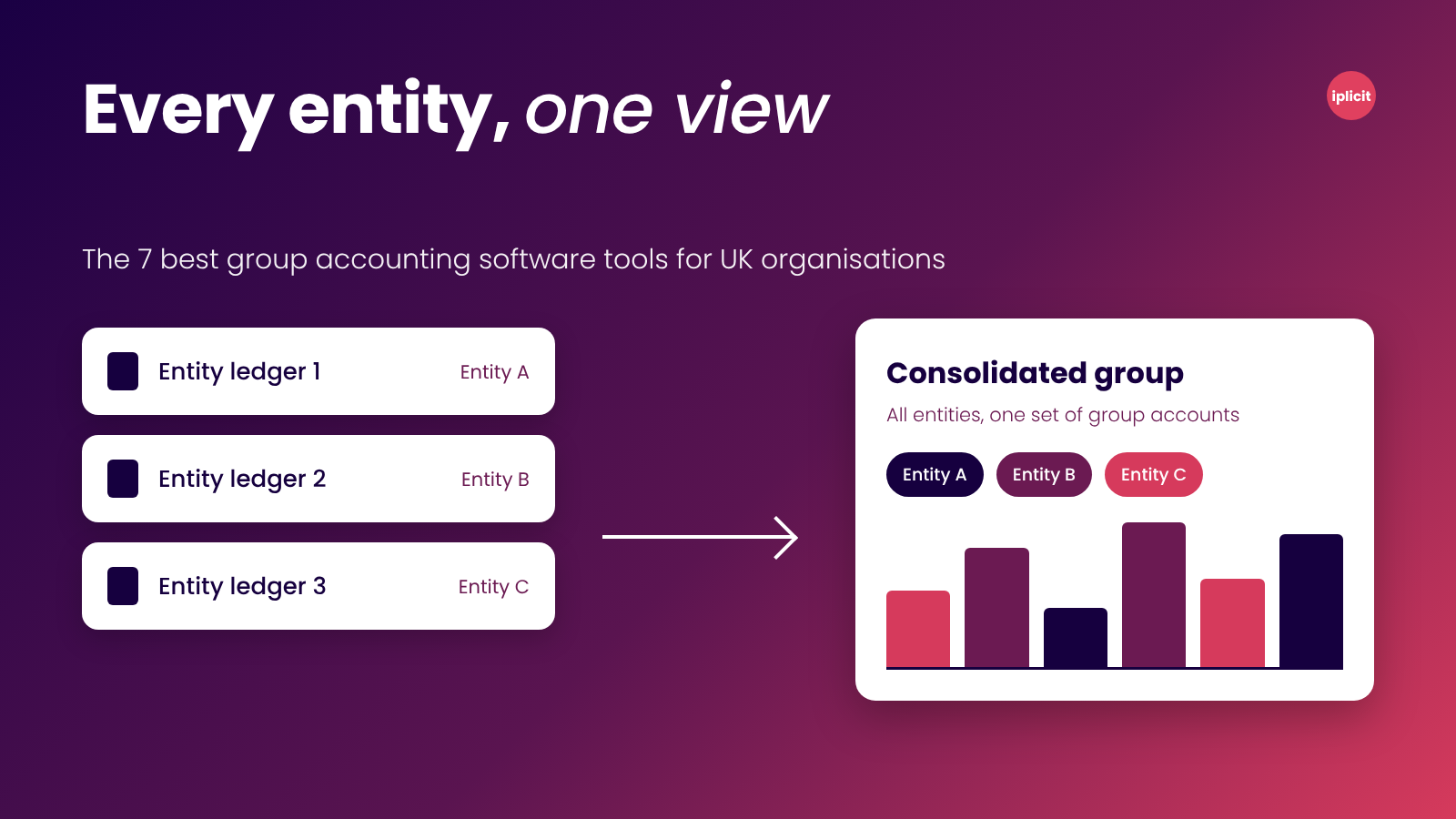
Quick summary
Sage Intacct’s pricing starts from £1,200 a month (excluding VAT) for just the base subscription. Your total fee depends on the modules you add, how many users and entities you need, and your implementation scope. Sage doesn’t publish a full UK price list, so you’ll need a tailored quote from Sage or a Sage Intacct partner. If the modular pricing makes Sage Intacct less attractive, consider iplicit, where multi-entity, multi-currency and consolidation aren’t sold as separate modules.
Your final Sage Intacct cost depends on your setup
Sage’s UK pricing page states that Sage Intacct is priced from £1,200 a month, excluding 20% VAT. That figure gives you a floor to work with. It isn’t your actual subscription cost.
Your final quote depends on the modules you need, the number of users you have, how many legal entities you run, and how complex your setup is. And that’s before you add support fees or implementation costs.
If you’re running two to six entities with five to ten finance users, the annual subscription alone will likely land well above that starting point.
This guide breaks down all the components of Sage Intacct’s pricing so you can build a realistic budget before requesting a quote.
Why trust this article?
At iplicit, many organisations evaluate our platform alongside Sage Intacct and choose us because of our pricing model and functionality. For example, Business & Human Rights Resource Centre evaluated iplicit, Sage Intacct, and other platforms and still chose iplicit as the best fit and most intuitive.
“We got demonstrations of all the systems, and they would’ve all done the job. But there was a certain elegance and intuitiveness that we liked about iplicit’s cloud accounting software platform for non-profits. I also needed to find a system that would be as labour-light as possible, in order to save costs.”
Graham Mackay, Chief Operating Officer, Business & Human Rights Resource Centre
We understand how Sage Intacct works and how it’s priced because of our work migrating and supporting customers like this. This article is based on that knowledge.
Sage Intacct pricing at a glance
How Sage Intacct’s pricing works
Sage Intacct uses a modular, subscription-based pricing model. You start with a core financials package and add modules, users and entities based on your needs. There’s no fixed, published price list for the UK, so every organisation gets a tailored quote.
Here are the three things that drive the cost:
- Modules. The core financials package covers the general ledger, accounts payable, accounts receivable, cash management, order management, and purchasing. Everything else is an add-on module that is charged separately. That includes multi-entity consolidation, revenue recognition, project costing, inventory management, and multi-currency. Each module you add raises your annual subscription fee.
- Users. Sage Intacct’s UK base subscription includes three full users and a 10-pack of employee users. Full users get access to the complete system. Employee users have limited access for tasks like expense submissions and approvals. If you need more of either type, they’re priced separately.
- Entities. If your organisation runs multiple legal entities, you’ll need the multi-entity and global consolidations module. Under it, each additional entity adds to the quote. And if you have complex intercompany requirements or use multiple currencies, those will increase the module’s cost.
What the base subscription includes
Every Sage Intacct deployment starts with the core financials package. According to Sage's UK pages, it covers six areas:
- General ledger
- Accounts payable
- Accounts receivable
- Cash management
- Order management
- Purchasing
Sage also highlights dashboards and reporting, dimensions (custom tagging for transactions), and Sage Copilot (natural-language queries) as part of the platform. Whether they’re in the base subscription or need a specific edition depends on your quote or contract.
Sage Intacct Essentials is a lower-tier edition of Sage Intacct. It is aimed at growing organisations and includes budgeting, audit trails, AI invoice processing, up to four entities and up to five business users. The full Sage Intacct enterprise software adds revenue recognition, fixed asset management, global consolidations and project costing, with support for unlimited entities.
What costs extra
Beyond the core price, each of these modules has a separate cost:
- Global consolidations, including intercompany transactions and eliminations. You’ll need this if you run more than one entity and want consolidated reporting.
- Revenue recognition. Automates deferred revenue schedules. It’s particularly relevant for SaaS, subscription, and professional services organisations.
- Project costing, including timesheets and expenses. It tracks costs and profitability by project, and it’s useful for professional services and construction.
- Inventory management. Handles stock tracking and valuation within the platform.
- Multi-currency. You’ll need this if your organisation transacts or reports in more than one currency.
- Advanced project billing. Extends the project costing module with more complex billing scenarios.
- Salesforce integration. A pre-built connection between Sage Intacct and Salesforce CRM.
- API and platform services. Gives you access to the Sage Intacct API for custom integrations.
Sage doesn’t publish individual module prices on its UK site. For that, you’ll need a quote.
Implementation and go-live costs
Sage Intacct’s implementation is quoted and billed separately from the subscription. In the UK, Sage scopes and quotes Sage Intacct itself and also works through a network of accredited partners. Whoever delivers it will scope your project, migrate your data, configure the system, and train your team.
What affects the cost
- The number of entities you have matters
- The volume of historical data you need to migrate
- The complexity of your chart of accounts
- The number of integrations you need (payroll, CRM, expense management)
- Whether you’ve got custom reporting or workflow requirements
Timeline
Implementation timelines depend on scope, so ask for a dated project plan with your quote. Simpler single-entity setups sit at the shorter end. Multi-entity, integration-heavy projects take the longest.
What Sage publishes
Sage’s UK pricing page doesn’t publish an implementation figure. It says implementation, data migration, and training are quoted separately from the software licence, so treat any number you see elsewhere as a guide. And get a written quote that separates implementation from the subscription so you know exactly what this will cost you.
Contract terms and billing
Sage Intacct is a yearly subscription in the UK, billed quarterly or annually. Sage says annual and multi-year agreements can come with discounted rates, depending on your modules, number of users, and contract length.
A few things to check before you sign:
- Renewal terms. Ask whether the contract auto-renews, what notice period applies, and whether the renewal price is fixed or subject to an uplift.
- Mid-term changes. Sage says you can add modules, users or entities as your needs evolve. Ask what happens to the cost if you need to remove any before renewal.
- VAT. All published Sage Intacct prices for the UK exclude 20% VAT. Factor this in when you’re comparing to platforms that quote VAT-inclusive figures.
The costs Sage doesn’t publish
- Ongoing support. Sage’s UK pricing page says support fees are quoted separately from the subscription. What you’ll get for support (response times, a named account manager, strategic reviews) varies by partner and by what you’re willing to pay.
- Integrations beyond the marketplace. Sage Intacct has a marketplace of pre-built integrations. But connecting it to a system that isn’t on the marketplace, or building a custom integration through the API, adds cost. Sage doesn’t publish a price for API access, and the build itself is quoted separately.
- Training and change management. Your partner will include some training in the implementation. But if your team is large or spread across multiple entities, you’ll likely need additional sessions. So, budget for them.
Who Sage Intacct suits, and where it gets expensive
Sage Intacct is a solid mid-market accounting platform with deep functionality in areas like revenue recognition, project costing, and multi-currency. It suits UK organisations that need those specific modules, have the budget for a modular build, and are comfortable working with a partner for implementation and support.
But Sage Intacct gets expensive fast, especially when your main requirements are the add-on modules, rather than the core system.
For example, a UK organisation with three entities that needs multi-currency, consolidated reporting and project costing has to buy several modules on top of the base. Each additional module raises the annual cost, and implementation through a partner adds another high one-off cost.
If your setup is simple, say you run a single entity on core financials with a small team, Sage Intacct Essentials is the entry tier and should meet your needs. And if you don’t really need revenue recognition or deep project costing, you can check out platforms that include multi-entity and multi-currency capability rather than selling them as extra modules.
How iplicit handles pricing differently
Sage lists dimensions among Sage Intacct’s core modules and places global consolidations in the full product rather than Essentials. With iplicit, multi-entity, multi-currency and consolidation capability aren’t sold as extra modules.
Instead, iplicit uses subscription pricing that scales with your users and entities. Fund accounting is part of the subscription too. You can read the full licence agreement before you talk to us.
To see the difference in practice, look at RRC International. The UK training provider runs multi-currency operations and chose iplicit over Sage Intacct. They were live within three months, with consolidation and multi-currency handling built into the subscription rather than quoted as extras.
“We went with iplicit for a couple of key reasons. Firstly, we were able to get deep into the detail of what we wanted from iplicit. With Sage Intacct, Sage has its process for doing things and you felt it was harder to step out of that process and get them to do something different. The team at iplicit were much more flexible in the way they dealt with our requirements.”
“The other reason was that our excellent IT guys here were impressed by the iplicit system. They thought it was very modern and that our front-end system could be adapted to easily talk to iplicit. And they felt there would be fewer issues with iplicit as we grew and changed in the future.”
Andrew Fox, Head of Finance, RRC International
Where iplicit isn’t the right fit: Sage Intacct goes deeper than iplicit in a few areas. These include dedicated FP&A, advanced project billing, and inventory management. For stock, iplicit has an optional stock control module and a Cin7 integration. If you need more depth, Cin7 can run your inventory while iplicit stays your financial system of record.
P.S.: To learn more, read this detailed comparison of Sage Intacct alternatives that goes beyond pricing.

Where to go from here
If you’re currently budgeting for Sage Intacct, request quotes from at least two UK partners. That way, you can compare their subscription, implementation, and support costs side by side. You can also use our finance software evaluation checklist to compare Sage Intacct like-for-like with two other finance software options.
And if the modular pricing and multiple add-on costs leave you hesitant, check out how iplicit, whose subscription includes consolidation, dimensions, and approvals as standard, compares. To do that, book a demo of iplicit or start with the Quick Tour to see the platform at your own pace.
How much does Sage Intacct cost per month in the UK?
How much does Sage Intacct cost per month in the UK?
Sage’s UK pricing page lists Sage Intacct from £1,200 a month, excluding 20% VAT. That’s the base subscription only. You’ll pay more once you add the modules, users and entities your organisation needs. Implementation and support fees are also quoted separately on top.
Is Sage Intacct pricing negotiable?
Is Sage Intacct pricing negotiable?
The final price is always a tailored quote, from Sage or an accredited partner. Sage says pricing can include discounted rates when you choose an annual or multi-year agreement, with the saving depending on your modules, number of users, and contract length.
What is the difference between Sage Intacct Essentials and the full edition?
What is the difference between Sage Intacct Essentials and the full edition?
Sage Intacct Essentials is aimed at growing organisations with simpler requirements and includes core financials, budgeting, audit trails, and AI invoice processing for up to four entities and five business users. The full edition adds revenue recognition, fixed asset management, global consolidations, and project costing, with support for unlimited entities. The full edition better suits those with multi-entity, multi-currency, or project-heavy needs.
Does Sage Intacct include multi-entity consolidation?
Does Sage Intacct include multi-entity consolidation?
Not in the base subscription. Global consolidations, which include intercompany transactions and eliminations, is an add-on module. If your organisation runs more than one entity and needs consolidated reporting, that module will be included in your quote.
How long does Sage Intacct implementation take in the UK?
How long does Sage Intacct implementation take in the UK?
It depends on complexity, and Sage doesn’t publish typical durations. A straightforward single-entity setup with limited data migration sits at the shorter end. Multi-entity deployments with several integrations, large data sets, and custom reporting take the longest. Implementation is scoped and costed as part of your quote.