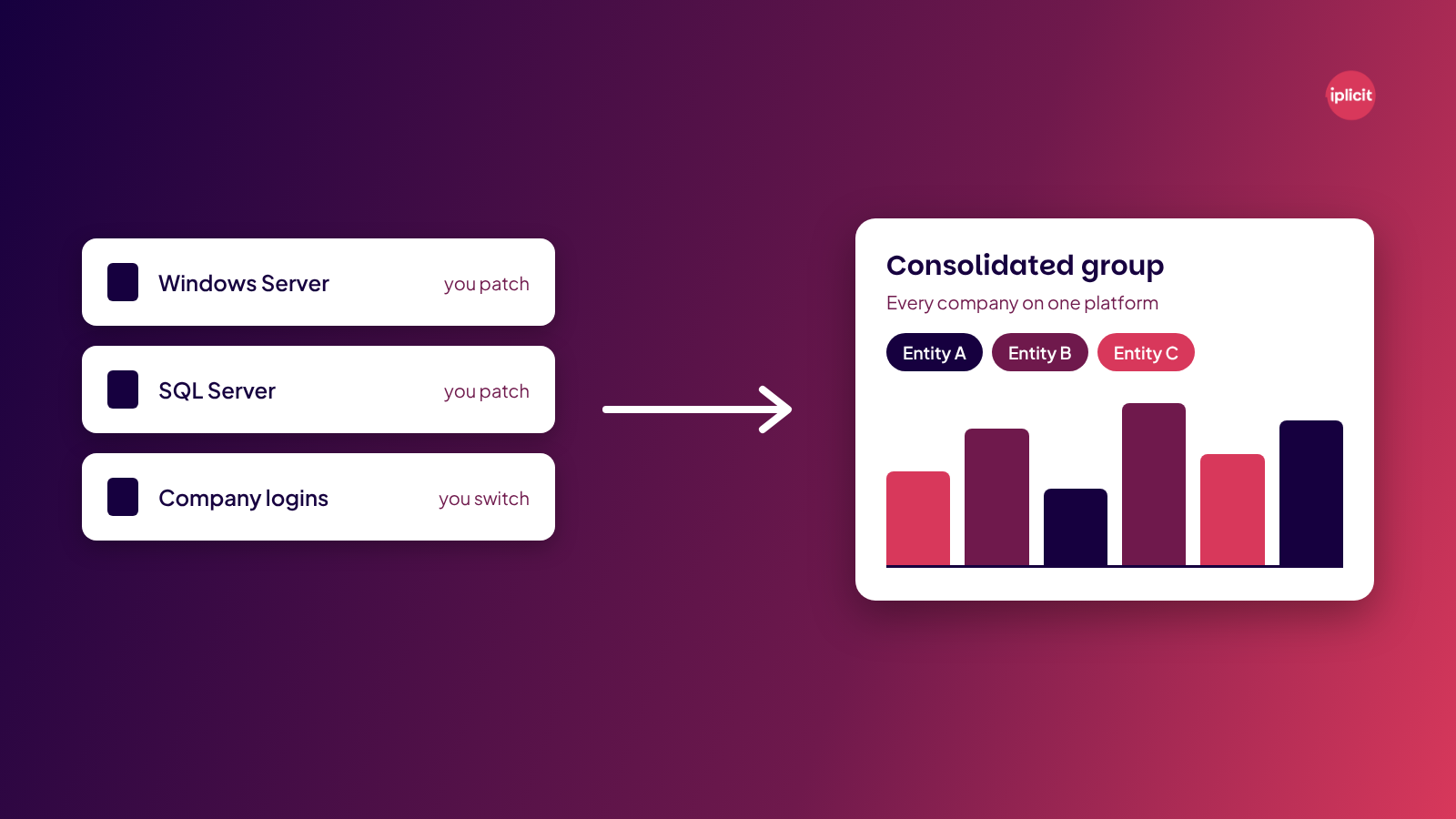
If you're leaving Pegasus Opera, the three strongest alternatives are iplicit, Sage 200 and Microsoft Dynamics 365 Business Central. For groups that consolidate several Opera companies, iplicit is the closest fit because every company sits on one platform, with intercompany and eliminations handled in the system. Sage 200 suits stock-heavy organisations, and Business Central fits if you also need manufacturing.
| Tool | Best for | Starting price |
|---|---|---|
| iplicit | Groups running several Opera companies | No public pricing, quoted per organisation |
| Sage 200 | Organisations built around stock and orders | No public pricing, quoted by Sage or a partner |
| Microsoft Dynamics 365 Business Central | Manufacturers replacing Opera's MRP module | £61.50 per user per month (Essentials, paid yearly) |
Opera's support dates now follow Microsoft's
If your Opera 3 system runs on SQL Server 2016, Pegasus stopped supporting it on 14 July 2026. As its Software Requirements Guide puts it, “support from Pegasus Software will end when Microsoft extended support ends.”
Windows Server 2016 follows in January 2027, then SQL Server 2017 in October 2027. If you're on any of those versions, staying with Opera means an upgrade project, and leaving means a migration. So before you commit to either, it's worth asking which system should take over the jobs Opera does today.
This guide compares seven Pegasus Opera alternatives on multi-company accounting, stock and orders, payroll and hosting.
Why listen to us?
The Grand Theatre Blackpool came to us from an ageing on-premises server. The theatre went live five weeks after starting, running its three companies, catering subsidiary included, in one system. London fit-out contractor du Boulay left an on-premises system too. It used to allow three weeks for its reports, and now it prepares them inside a week.
“We had an on-premises server that was end-of-life; it could have fallen over at any time and we’d have lost everything. There’s a lot of inter-company work. iplicit makes that a lot easier by consolidating everything together.”
Mark Preston, Finance & Business Manager, The Grand Theatre Blackpool
Leaving Opera is the same kind of change. You're taking a multi-company finance system off a local server and putting it in the cloud. That experience shaped this list, so each alternative is judged on how well it takes over the jobs Opera does for you today.
What is Pegasus Opera?
Pegasus Opera is a UK accounting and business management system from Pegasus Software, a trading name of Infor (United Kingdom) Limited. Opera 3, the current version, is modular. Its modules cover finance, supply chain management, payroll and HR, CRM, document management, contract costing and manufacturing MRP.
Opera 3 comes in two editions. SQL SE runs on Microsoft SQL Server, while Standard uses a Visual FoxPro or SQL Server database. You can run Opera on your own Windows server or in Pegasus Business Cloud. Either way, Pegasus sells and supports it through a network of partners.
Why seek alternatives to Pegasus Opera?
If you host Opera yourself, three issues are worth weighing before you decide whether to stay.
1. Pegasus support ends when Microsoft's does
Pegasus tests Opera on Microsoft products that are still in mainstream support. Once a product moves to extended support, Pegasus supports Opera on it only until Microsoft's support ends. So you’re tracking those dates on top of patching and backing up the server.
If you're on Opera 3 Standard with SQL Server, you've got the least room to manoeuvre. Standard's only supported full editions are SQL Server 2016 and 2017. Microsoft's extended support for SQL Server 2017 ends on 12 October 2027. After that, if you're staying on Opera with SQL Server, you'll have to move to Opera 3 SQL SE.
2. Moving to Opera 3 SQL SE is a migration too
Before the migration, Pegasus requires a health check on your company data, because SQL SE applies stricter database rules. The migration then creates a new company in SQL SE, and linked companies have to move together.
If you're still on Opera II, you'll need to migrate to Opera 3 first. Either way, you're facing data checks, testing and a cutover date. So it's worth pricing that project alongside a move to another system.
3. Each company needs its own login and a consolidation step
Each Opera system holds up to 36 companies. To report on them as a group, Opera consolidates their nominal ledgers into a main nominal ledger. In SQL SE, that's a scheduled task, and Pegasus's task scheduler guide recommends running it out of working hours. So your team switches between company logins for day-to-day work, and someone has to manage that consolidation step every month.
7 best Pegasus Opera alternatives
| Tool | Multi-company and consolidation | Stock and orders | Payroll | Best for | Starting price |
|---|---|---|---|---|---|
| iplicit | One system across entities and currencies, with intercompany and eliminations handled in the system | Through the Cin7 integration | Separate product, such as BrightPay | Groups running several Opera companies | No public pricing, quoted per organisation |
| Sage 200 | Subsidiaries post balances to a parent company | Built in, with warehouse, traceability and bill of materials | Payroll integration options | Organisations built around stock and orders | No public pricing, quoted by Sage or a partner |
| Microsoft Dynamics 365 Business Central | Entries transferred to a consolidated company, with manual eliminations | Built in, with manufacturing on Premium | Imported from an outside payroll provider | Manufacturers replacing Opera's MRP module | £61.50 per user per month (Essentials, paid yearly) |
| AccountsIQ | Single-click consolidation, with exchange rates set centrally | Order-linked stock, in base currency only | Separate product, via integration | Multi-entity groups with modest stock needs | From €275 per month (Core) |
| Sage Intacct | Automated consolidation and eliminations, as an extended capability | Inventory as an extended capability | Separate product, via integration | Larger groups with budget for added modules | From £1,200 per month |
| Xero | One subscription per organisation, with no consolidation | Up to 4,000 finished items | Included for 1 to 10 people, on Grow and above | Single companies with simple needs | £18 per month (Ignite) |
| Access Financials | Consolidation across reporting currencies and different year ends | Stock control as an add-on | Payroll Management in every Evolve package | Finance and payroll from one supplier | From £10,508 per year (40 employees) |
1. iplicit
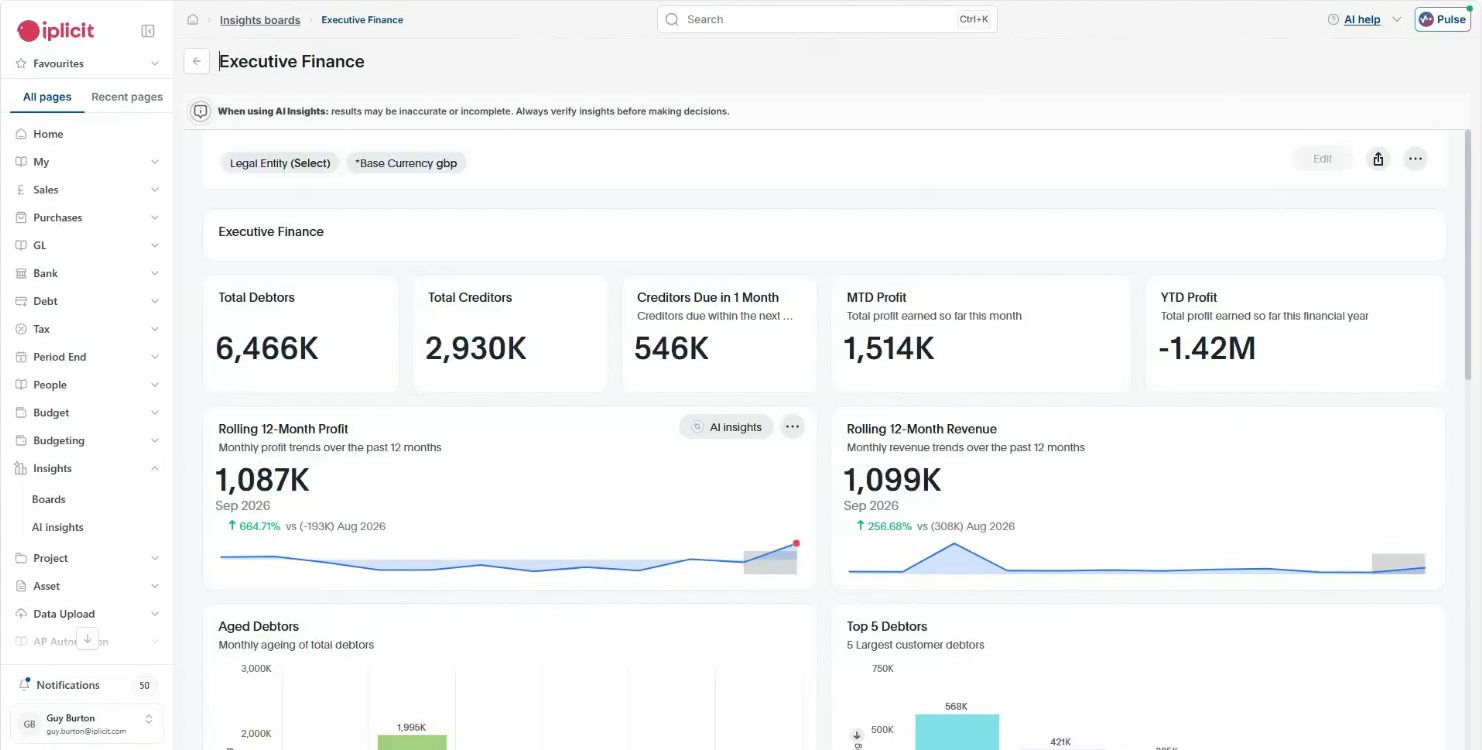
As cloud accounting software for UK mid-market organisations, iplicit puts multi-entity consolidation, as many reporting dimensions as you need and approvals in one platform. It consolidates across entities and currencies in one system, with intercompany and eliminations handled for you.
Sage 200 and Business Central both move figures into a parent or consolidation company as a separate step. That's much closer to how Opera works. At The Grand Theatre Blackpool, Finance and Business Manager Mark Preston noticed the difference. “There's no logging out and logging back into a different company like we had to do before,” he says.
With iplicit, the server comes off your hands too, the way true cloud accounting software should. Your data stays in Microsoft Azure’s UK South region, with encrypted backups in UK West.
Your project is run by iplicit’s implementation team or an accredited partner, and a UK-based support team takes over once you’re live. Your Opera history can be archived inside iplicit as a read-only record, so you can switch Opera off once you’re live. You could be live in weeks.
There are gaps, though. For stock and inventory, iplicit has a partner-delivered integration with Cin7, which runs your inventory while iplicit stays your financial system of record. Payroll runs in a separate product, such as BrightPay, connected through iplicit’s integrations. iplicit handles CIS through HMRC-recognised partner software (CIS Manager), so Pegasus CIS 5 users should check that fits, and it doesn't offer manufacturing bills of materials, so Opera MRP users will need another system.
Key features
- Automated intercompany: Record an intercompany transaction once and iplicit creates the matching entry in the other entity, with eliminations handled through its group accounting tools.
- Reporting dimensions: Report by department, project, fund or region in iplicit’s reporting tools without adding nominal codes.
- Live Excel add-in: Pull iplicit data straight into Excel to build your own reports.
- Approval workflows: Route purchases and expenses through multi-level approval workflows, with every action logged.
- Automated bank reconciliation: Pull in bank transactions and let AI matching reconcile them, leaving exceptions to check.
- Detect: Detect, included as standard, flags unusual transactions so your team can review them before they become problems.
Pricing
Pricing isn’t published on iplicit’s website. Each organisation gets its own quote.
Rating
Capterra UK: 4.6/5 (53 reviews)
Pros
- Every company sits on one platform, so there's no logging in and out of separate companies.
- Implementation is handled by iplicit’s team or an accredited partner, and your Opera history can be archived inside iplicit as a read-only record.
- Azure hosting in the UK takes server, SQL Server and Windows Server upgrades off your list.
Cons
- Stock and inventory run through the Cin7 integration, with iplicit as your financial system of record.
- Payroll needs a separate product, such as BrightPay, connected through an integration.
- CIS runs through integrated partner software (CIS Manager) rather than built in.
- There's no bill of materials, so Opera MRP users will need another system.
2. Sage 200
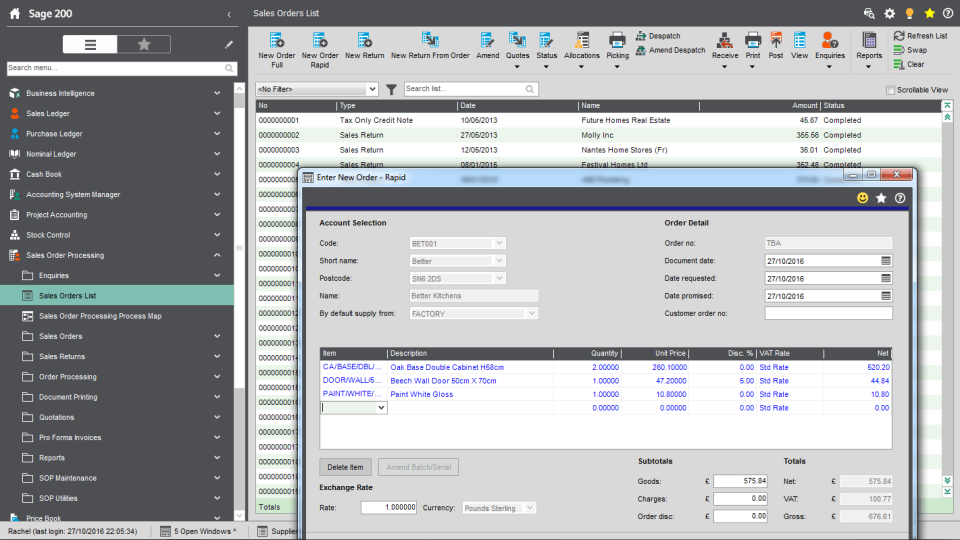
Sage 200 is Sage's business management software for growing small and medium organisations. Like Business Central, it keeps your Opera supply chain work in the same system as your ledgers. That covers stock, orders, returns, warehouse management, traceability and bill of materials. It's largely sold and supported through partners, much like Opera, so buying it will feel familiar.
Sage 200 comes in two editions. Standard runs its server side on Microsoft Azure, with the Sage 200 app on each PC. Professional suits a local install on your own servers. Sage Partner Cloud hosts Professional on an Azure virtual machine.
Consolidation works much as in Opera, with each subsidiary posting its nominal balances to a parent company as a single consolidation transaction. Standard needs every company on one base currency, so if yours differ, you'll need Professional.
Key features
- Microsoft 365 integration: Work with Sage 200 data in Outlook, Word and Excel 365.
- Business intelligence: Build custom dashboards and reports on your Sage 200 data.
- Banking integration: Connect your bank account directly to Sage 200.
- CRM and payroll options: Connect Sage CRM and payroll software to your accounts.
Pricing
Sage doesn't publish Sage 200 prices, so there's no public pricing. You'll get a quote from Sage or a partner.
Rating
Capterra UK: 4.3/5 (48 reviews)
Pros
- Stock, warehouse, traceability and bill of materials sit alongside your ledgers.
- Professional still runs on your own servers if you're not ready for the cloud.
- The partner-led model gives Opera users a buying process they already know.
Cons
- Group figures are only as fresh as the last consolidation each subsidiary posted to the parent.
- Standard can only consolidate companies that share one base currency.
- In Sage Partner Cloud, your partner handles the virtual machine's updates and security patches.
3. Microsoft Dynamics 365 Business Central
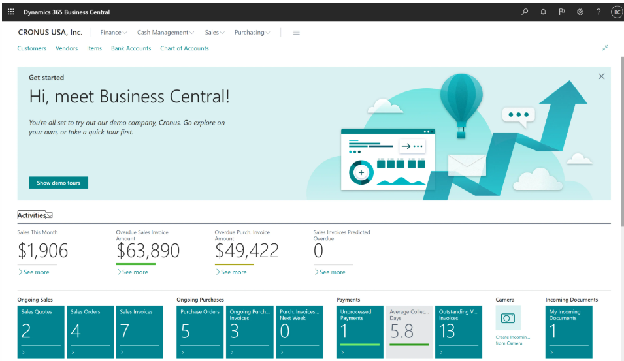
Microsoft Dynamics 365 Business Central is Microsoft's business management system, sold and set up through Microsoft partners. If you run Opera's Manufacturing MRP module, it's the closest match on this list. Both plans cover finance, purchasing, inventory, warehouse and project management, and Premium adds manufacturing and service orders.
For groups, you'll transfer each company's general ledger entries into a consolidated company set up just for reporting. Unlike iplicit or Sage Intacct, Business Central leaves eliminations as a manual step.
You can run it online or on your own servers. For payroll, you'll import an outside provider's file into the general journal.
Key features
- Intercompany documents: Enter an intercompany sales or purchase document once, and the partner company gets a matching one.
- Making Tax Digital for VAT: Prepare and submit VAT returns to HMRC from inside Business Central.
- UK VAT group management: Run a VAT group through Microsoft's UK extension.
- Extensions: Add functionality from Microsoft AppSource or partner-built extensions.
Pricing
Essentials costs £61.50 per user per month and Premium £84.60, both paid yearly and excluding VAT.
Rating
Capterra UK: 4.1/5 (209 reviews)
Pros
- Premium includes manufacturing, so Opera MRP users can keep production planning alongside finance.
- Published per-user prices let you estimate licence costs before speaking to a partner.
- You can choose between online and on-premises deployment.
Cons
- Consolidation eliminations are manual, checked through a report before you post them.
- Payroll stays with an outside provider, and you import its file to post wages.
- Per-user pricing means the licence bill grows with each full user.
4. AccountsIQ
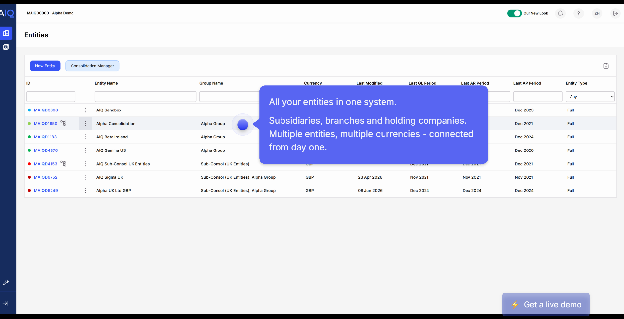
AccountsIQ is cloud accounting and financial management software for mid-market finance teams, built around multi-entity and multi-currency groups. Like iplicit, it's aimed at groups first. Each entity keeps its own structure, and you consolidate across entities and currencies in a single click, using exchange rates set centrally for the group.
An intercompany purchase invoice stays unposted until the receiving company accepts and codes it, which keeps balances matched. Stock moves at delivery on purchase and sales orders, but only in base currency. For payroll, you'll connect a separate product, such as BrightPay or Staffology.
Key features
- Purchase and sales order processing: Raise purchase and sales orders on the Growth tier and above.
- BI analysis: Analyse transactions by up to six dimensions on the Scale tier.
- Approval workflow: Route spending approvals through multi-step workflows from the Growth tier.
- Excel and Power BI connector: Pull AccountsIQ data into Excel and Power BI for your own reporting on the Growth and Scale tiers.
Pricing
AccountsIQ’s Core tier starts from €275 per month, and Growth and Scale are priced on application.
Rating
Capterra UK: 4.6/5 (44 reviews)
Pros
- Consolidates entities across currencies with a single consolidation run, with exchange rates set centrally.
- Unposted intercompany invoices stop mismatched balances before you consolidate.
- Its UK and Ireland support team quotes a 27-minute average response time.
Cons
- Core includes one entity and two users, so a group needs a higher tier.
- Stock is valued in base currency only, whatever currency the supplier or customer uses.
- Payroll needs a separate product connected through an integration.
5. Sage Intacct
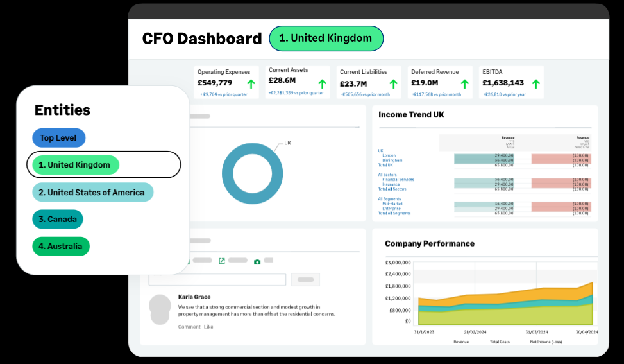
Sage Intacct is Sage's cloud financial management platform for growing and mid-sized organisations. If you run a larger Opera group, it brings every entity under one login. Like iplicit, it automates eliminations and group consolidation across anywhere from two to hundreds of entities through its consolidation accounting capability.
Intacct is modular, so inventory management, project accounting and revenue recognition are extended capabilities you add as needed. Payroll isn't among its listed capabilities, so you'd connect a separate product through the Sage Marketplace. At £1,200 a month, it's got the highest published starting price on this list.
Key features
- Entity setup: Set up a new entity without IT help by inheriting existing lists and charts of accounts.
- Inter-entity transactions: Set up due-to and due-from accounts centrally for transactions between entities.
- Multi-entity reporting: Zoom out to group dashboards, then back into a single entity's detail.
- Project costing and billing: Track project costs, time and expenses, and bill clients in one workflow.
Pricing
Sage Intacct starts from £1,200 per month, excluding VAT, support fees and implementation. Your quote depends on modules, users, entities and integrations.
Rating
Capterra UK: 4.3/5 (718 reviews)
Pros
- Handles large group structures, from two entities to hundreds, under one login.
- Revenue recognition, construction accounting and other extended capabilities are there if you need them.
- 350+ apps and business tools on the Sage Marketplace connect it to your other systems.
Cons
- The £1,200 monthly starting price excludes implementation and support.
- Inventory management is an extended capability, priced on top of core financials.
- The base subscription includes three full users, and each extra one costs more.
6. Xero
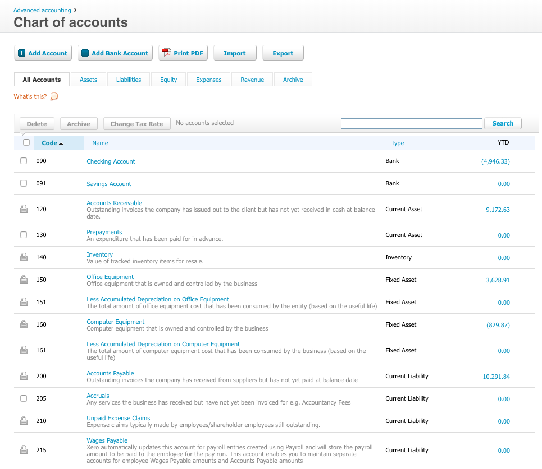
Xero is cloud accounting software sold on monthly plans, with no per-user licence fees. For a single-company Opera user with simple stock and a small payroll, it's the lightest option on this list. Grow includes payroll for one person and Ultimate for up to ten. Every plan also automates subcontractor CIS calculations, which matters if you use Pegasus CIS 5.
Xero stops being a good fit once you run a group. Each organisation needs its own subscription, and Xero says consolidated reporting isn’t currently planned. So unlike AccountsIQ or iplicit, it needs an add-on before a multi-company group can report as one.
Key features
- Multiple currencies: Invoice and pay in other currencies on the Comprehensive and Ultimate plans.
- Cash flow forecasting: See a 180-day cash flow forecast on the Ultimate plan.
- Projects: Track time and costs on projects for up to 10 users on Ultimate.
- Bill automation: Automate bill entry with smart document capture on Grow and above.
Pricing
Ignite costs £18 a month, Grow £39, Comprehensive £55 and Ultimate £70, all excluding VAT.
Rating
Capterra UK: 4.4/5 (3,332 reviews)
Pros
- Month-to-month subscriptions at published prices, with no long contract to sign.
- Payroll and CIS calculations come in the same subscription as the accounts.
- There are no per-user licence fees, though expenses, projects and payroll charge for extra users above each plan’s allowance.
Cons
- Each company needs its own subscription, with no native consolidation across them.
- Only two tracking categories can be active at once, which limits reporting by department or site.
- Inventory is capped at 4,000 finished items.
7. Access Financials
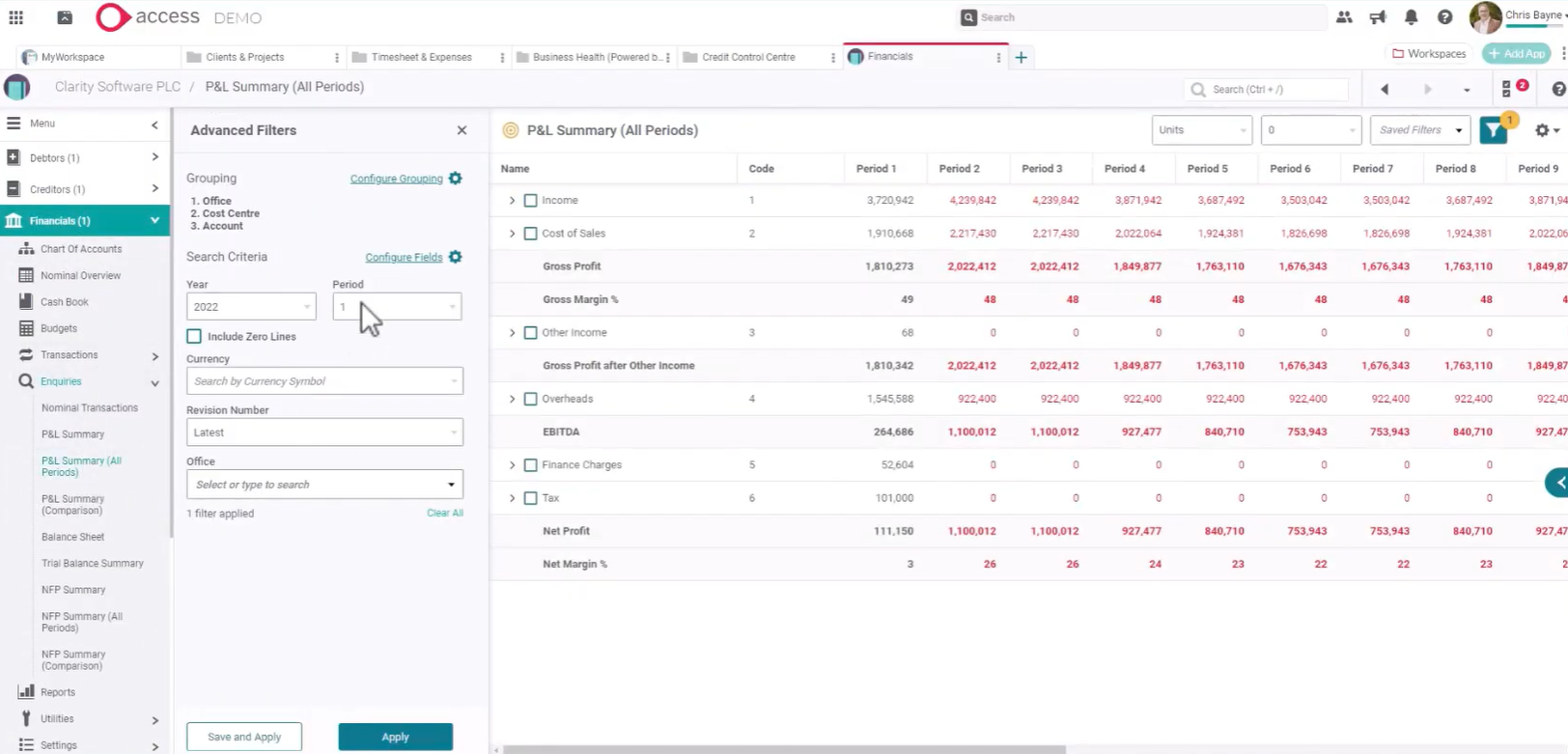
Access Financials is The Access Group's cloud accounting and financial management software. It's aimed at UK organisations with £2m to £200m turnover. If you run payroll in Opera, it keeps finance and payroll with one supplier. Every Access Evolve package includes Payroll Management. Since iplicit and AccountsIQ both connect to a separate payroll product, Access is simpler if you want one vendor for wages.
Its consolidation brings companies together across reporting currencies and different year ends. Onboarding runs through FlightPath, a remote-first service with a fixed-cost setup. Your data is hosted in a UK data centre.
Key features
- Credit control: Chase unpaid invoices automatically and manage receivables in one place.
- Cash flow forecasting: Model future cash positions and spot shortfalls early.
- Fixed assets: Track every asset from purchase to disposal.
- Interactive dashboards: Monitor KPIs and drill down to the data behind them.
Pricing
Access Financials starts from £10,508 per year for a company with 40 employees. Its Evolve packages are priced on application, based on employees, entities and transactions.
Rating
Capterra UK lists one review for Access Financials, too few for a meaningful rating.
Pros
- Every Evolve package includes Payroll Management, so finance and payroll come from one supplier.
- Consolidation handles different year ends and reporting currencies across companies.
- FlightPath onboarding comes at a fixed cost, so you'll know the setup fee before you start.
Cons
- Pricing follows your total employee numbers, so the cost grows as you hire, even outside finance.
- Stock control is an add-on to the core Evolve packages.
- Only the 40-employee starting price is published, so you'll need a quote to compare packages.
How we evaluated these Pegasus Opera alternatives
We checked every system against the jobs Opera does today, using each vendor's own website and documentation.
- Module coverage: Does it replace Opera's ledgers, stock, payroll, CIS and MRP, or need add-ons?
- Multi-company handling: How do consolidation, intercompany and eliminations work?
- Hosting: Who runs the servers, and do Microsoft support dates still apply?
- Migration path: Who implements it, and how much history comes across?
- Published pricing: What does the vendor's own site state, and what's left to a quote?
Once the demos start, this finance software evaluation checklist can help you line up vendors side by side.
How to choose a Pegasus Opera alternative
Start by listing every Opera module you use, then test each system on your shortlist against the points below.
- How group figures are produced: Check whether every company sits in one system, or whether each ledger is transferred into a parent or consolidation company. Separate company logins and a monthly consolidation step are what you’re replacing, so a system that works the same way only moves the work. If you run a single company, this matters far less than the points below.
- Where stock and orders live: Some systems keep stock inside the ledgers, while others connect a separate inventory product. If stock is the core of your Opera system, built-in stock saves you reconciling two systems.
- Payroll and CIS: Check whether payroll comes in the same subscription or through a connected product, and who supports that connection. If you use Pegasus CIS 5, ask the vendor to show a subcontractor deduction and a CIS return in the demo, because several systems here don’t offer CIS.
- Hosting and patching: Find out who runs the servers. With vendor-run cloud software, Microsoft’s support dates stop being your problem. With a partner-hosted virtual machine or your own server, those dates still apply.
- Migration and history: Ask who implements it (the vendor or a partner), how many years of history come across, and how linked Opera companies are handled. Pegasus requires linked companies to move together, and your new system should too.
Which Pegasus Opera alternative is right for you?
The right alternative depends on what your Opera system does most for you, whether that’s running a group, handling stock and orders, or paying your staff. If you run several Opera companies, iplicit is the right fit, because every company sits on one platform, with no logging in and out of separate companies. You can consolidate across entities and currencies in one system, with intercompany handled in the system and drill-down to the source transaction. AccountsIQ is the other group-first option, and Sage Intacct suits larger groups with the budget for its extended capabilities.
For stock-heavy organisations, Sage 200 and Business Central keep stock and orders alongside your ledgers, and Business Central Premium adds Manufacturing MRP. Access Financials keeps finance and payroll with one supplier. Xero suits a single small company, with payroll and CIS calculations in the same subscription.
Staying on Opera is a fair choice too, by upgrading to Opera 3 SQL SE or moving to Pegasus Business Cloud. Pegasus sells Opera on subscription through its partners, priced by quote. The piece on five good reasons for not switching accounting software covers when staying makes sense.
To see how your group would run in iplicit, book a demo, or take the Quick Tour first.
Is Pegasus Opera an ERP system?
Is Pegasus Opera an ERP system?
Yes, with the right modules. Pegasus describes Opera 3 as an accounting and business solution, and its Business Cloud page calls it a complete ERP. Alongside finance, you can add supply chain, payroll, CRM and manufacturing MRP. Because each module is bought separately, two Opera systems can cover very different jobs.
Which company owns Pegasus Opera?
Which company owns Pegasus Opera?
Pegasus Opera is an Infor product, because Pegasus Software is a trading name of Infor (United Kingdom) Limited. Pegasus sells and supports Opera through its partner network, so your licence, upgrades and support all come through a partner. That includes any move to Opera 3 SQL SE.
What is Pegasus Opera 3?
What is Pegasus Opera 3?
Pegasus Opera 3 is the current version of Pegasus Software’s accounting and business solution, sold and supported in the UK through Pegasus partners. It’s modular, so you add finance, supply chain, payroll, CRM, document management or manufacturing modules as you need them. It comes in two editions: SQL SE, which runs on Microsoft SQL Server, and Standard, which uses a Visual FoxPro or SQL Server database.
What is Opera 3 SQL SE?
What is Opera 3 SQL SE?
Opera 3 SQL SE (Server Edition) is the edition of Opera 3 that runs on Microsoft SQL Server. It supports versions up to SQL Server 2022 and applies stricter database rules than Standard. Moving across from Standard is a migration, which creates a new company in SQL SE.
What's the best cloud accounting software to replace Pegasus Opera?
What's the best cloud accounting software to replace Pegasus Opera?
For a group, iplicit, AccountsIQ and Sage Intacct are all built around multi-entity consolidation. Stock-heavy organisations should look at Sage 200 and Business Central. A single company with simple needs can switch to Xero, whose UK plans cost £18 to £70 a month.