
Quick summary
Oracle doesn’t publish a UK price list for NetSuite. Every licence is quoted individually, built from a base platform fee, per-user charges, optional modules, and a one-time implementation cost. Understanding each cost driver is the only way to budget realistically before your first sales call. If licensing the platform, modules and OneWorld separately makes NetSuite less attractive, consider iplicit, where multi-entity and multi-currency capability isn’t sold as extra modules.
There’s no price list for NetSuite online
You won’t find a NetSuite price anywhere on Oracle’s website. The site doesn’t state a starting figure, a per-user rate, or even a ballpark. And that’s because every NetSuite licence is built to order. Oracle quotes each customer individually, based on the modules they need, their user count, and number of entities.
If you’re a UK finance team trying to review NetSuite, you won’t be able to get a number without a sales call, but you can understand what determines your quote. This article covers how NetSuite pricing works and what drives the cost up. It’ll help you prepare for that first conversation with Oracle’s team.
Why trust this article?
At iplicit, we work with UK finance teams that compare several systems before they choose one. RRC International, a UK training provider that sells courses around the world, compared the systems it could switch to before choosing iplicit. It went live on schedule, and faster bank reconciliation now frees up a full day every month.
This article draws on that experience of helping organisations weigh up their options.
How NetSuite pricing works
NetSuite’s site explains the pricing simply. Your annual licence fee is determined by three main parts: the core platform, optional modules, and your user count. And there’s a one-time implementation fee for the initial setup.
So the first annual cost you’ll pay to Oracle has four contributing parts:
- Base platform licence. The core NetSuite ERP system itself.
- Module fees. Each additional module (Advanced Financials, Fixed Assets, etc.) is licensed and priced separately.
- User fees. You pay per user, and the rate depends on the user type.
- Implementation fee. A one-off cost covering data migration, configuration, and training.
The cost for all four varies by organisation, and that’s one reason Oracle doesn’t publish a single, general number. Your quote depends on what you need and how complex your setup is.
NetSuite pricing at a glance
| Cost driver | What Oracle publishes (UK) | What to ask for |
|---|---|---|
| Base platform licence | No price | The annual fee for the core platform on its own |
| Users | No price | A rate for each user type, quoted separately |
| Modules | No price | A fee per module, and what it costs to add one later |
| OneWorld | No price | How the charge changes with each subsidiary |
| Implementation | No price | A fixed-price quote with a scope document |
| Support | No price | What the basic level covers and what each paid level costs |
| Renewal | No price | Whether a multi-year contract includes an annual increase, and a cap on it |
The cost drivers UK organisations need to budget for
Seven factors shape your NetSuite bill. None of them have published rates, but understanding how NetSuite prices each one helps you negotiate a better fee.
Base platform licence
The base licence gives you the core NetSuite ERP that covers general ledger, accounts payable, accounts receivable, order management, and basic reporting. Every NetSuite customer pays for this, and it forms the foundation of your annual fee.
It’s one component of the annual licence fee, and the exact figure is set in your quote.
User types and seat count
The number of users is one of the three components of a NetSuite licence, so seat count matters. Ask whether staff who only submit expenses or view payslips can sit on a lower-cost self-service licence rather than a full one.
Every seat you add changes the fee, so count them carefully.
When talking to Oracle’s team, consider not only your finance team, who will likely be full-access users, but also the wider organisation who will need self-service access.
Ask Oracle to quote both user types separately so you can see exactly how much each category costs.
Modules
NetSuite treats optional modules as a separate component of the licence from the core platform. And since every module has different capabilities, their fees vary too.
For a UK mid-market finance team, the modules that are most relevant are Advanced Financials, SuiteAnalytics, and Fixed Assets. Each one adds a separate annual fee to your base licence’s fee.
The risk with modules is scope creep. You might start with core NetSuite and three modules, then discover six months in that you need Multi-Book Accounting for compliance. And with every addition quoted individually, your costs can increase rapidly.
OneWorld for multi-entity organisations
If you run more than one legal entity, subsidiary or charity within a group, you’ll need NetSuite OneWorld. It’s Oracle’s multi-entity layer that handles consolidation, intercompany transactions and multi-currency accounting across entities.
OneWorld is bought separately from the base NetSuite service, so it adds to the subscription. Ask how the charge changes with each subsidiary you add.
If you plan to add more entities over the next few years, ask for that growth to be priced in the quote.
Implementation partner fees
NetSuite charges a one-time implementation fee for the initial setup. The work is done by Oracle’s own services team or a certified implementation partner, and it’s quoted separately from the licence.
Implementation covers project management, system configuration, data migration, integrations with payroll or CRM, user training, and testing. Your exact implementation scope depends on how complex your setup is and how much historical data you’re bringing across.
A straightforward single-entity deployment is the quickest. A multi-entity organisation with custom workflows and several integrations will take longer. Either way, the partner fee is one-off, paid in the first year.
Before signing, ask your implementation partner for a fixed-price quote with a clear scope document. That protects you from budget overruns if the project takes longer than planned.
Support tiers
NetSuite includes a basic support package with every licence. If you need faster response times or a dedicated account manager, you have to pay for a premium support tier.
Oracle offers paid support levels above the basic one. Ask how each is priced and what response times it commits to, which matters if you’re running time-sensitive processes like month-end close.
For most UK mid-market organisations, the basic tier covers day-to-day questions. But if your team is lean and you can’t afford downtime during critical periods, scope in the premium support tier from the start.
Renewal uplifts and contract terms
Renewal pricing is the cost driver that’s easiest to overlook. Ask whether a multi-year contract includes an annual price increase and, if so, how much.
If it does, your year-two cost will be higher than year one’s, even if you don’t add a single additional user, module, or entity. Over a three- or five-year contract, those annual increases compound fast.
The way to manage this is to negotiate a cap on annual increases before you sign, so the base licence cost stays predictable for the full contract term.
What to budget for your first year on NetSuite
Without published pricing, building a first-year budget means working backwards from the cost drivers above. To do that, start by listing what you actually need.
How many full-access users? How many self-service users? Which modules does your finance team need from day one, and which can wait? Are you running a single entity or a group that needs consolidation?
Once you have answers to those questions, ask Oracle and at least one implementation partner for formal quotes. Get the annual base licence, module breakdown, user fees, OneWorld charge (if it applies), and implementation costs all itemised separately. That lets you see what each individual part costs.
And before you eventually sign, take these two practical steps. First, confirm whether the contract includes an annual increase and push for a capped rate. Second, ask what happens if you need to add users or modules mid-contract. Some organisations find that mid-term additions cost more than they would have at the initial negotiation.
Questions to ask before you sign a NetSuite quote
Ask Oracle or your implementation partner these seven questions before signing:
- What does the base licence cover? Ask which functions are in the core platform and which need a module.
- Which user types do we need, and how many of each? Ask for each type to be priced on its own line.
- Which modules are in the quote, and why? Ask what you’d lose by leaving each one out in year one.
- Do we need OneWorld, and how is it priced? Ask what happens to the charge when you add a subsidiary or a currency.
- Is implementation fixed-price? Ask who does the work, what the scope document includes, and what counts as a change request.
- What does support cost? Ask what the basic level covers and what each paid level adds.
- What happens at renewal? Ask whether the contract includes an annual increase, whether it can be capped, and what notice applies.
Get the answers in writing. A quote that itemises each of these is far easier to compare with another vendor’s.
P.S.: If you’re still comparing NetSuite with other finance systems, download our finance software evaluation checklist to compare three vendors side by side and assess how well each meets your organisation’s requirements.
A different model: how iplicit’s multi-entity software pricing compares
iplicit is cloud accounting software for UK mid-market organisations that have outgrown entry-level systems. We offer subscription pricing that scales with your users and entities. Fund accounting, multi-entity, and multi-currency capabilities are included in the subscription.
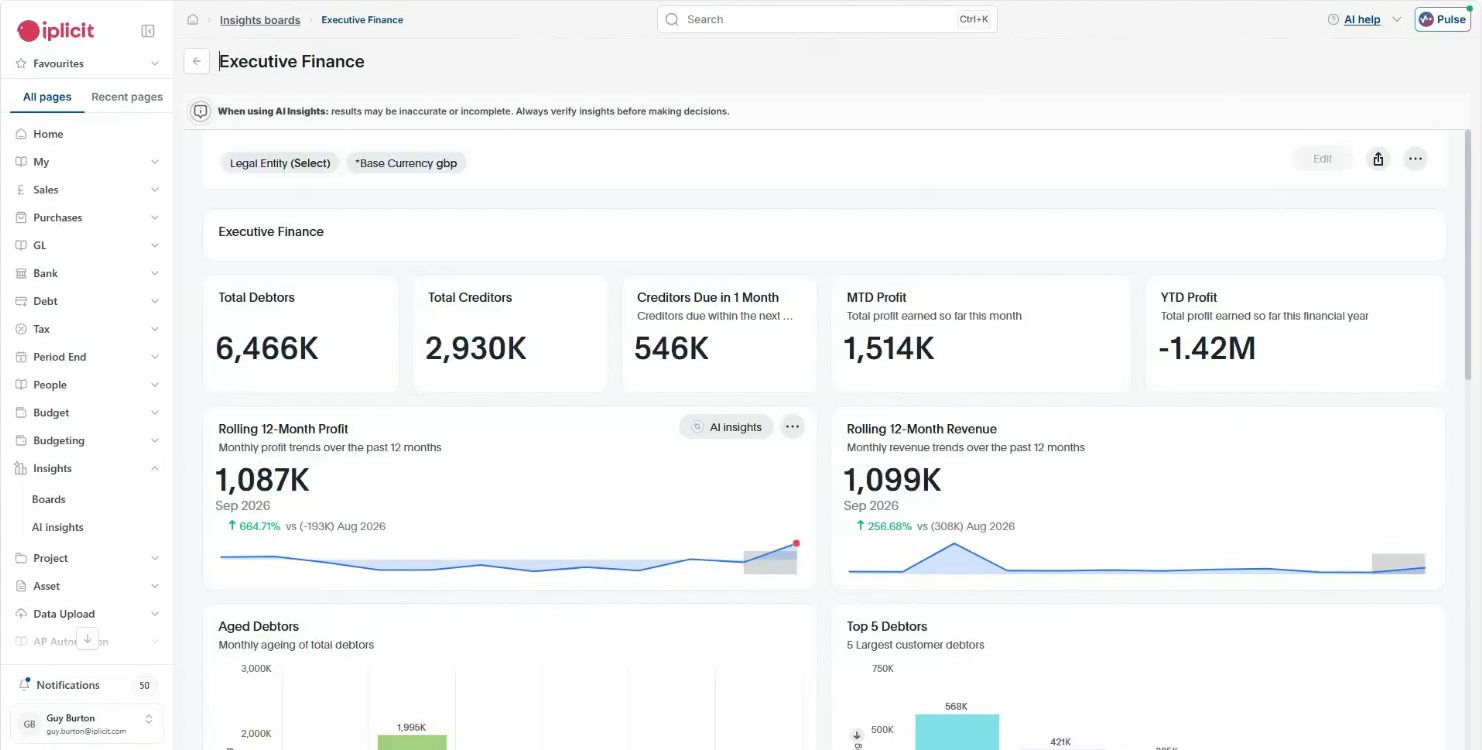
NetSuite licenses its core platform, optional modules and users as separate components, with OneWorld bought on top for multi-entity groups. With iplicit, multi-entity and multi-currency capability isn’t sold as extra modules. You also get flexible reporting dimensions.
iplicit doesn’t publish a price on its website either. You can read the licence agreement for full terms.
To see how iplicit handles multi-entity accounting differently from NetSuite, book a demo or take a Quick Tour of the platform.
Where iplicit isn’t the right fit: NetSuite is a full ERP, and iplicit is finance software. If you need manufacturing bills of materials, iplicit won’t cover it. For stock, iplicit has an optional stock control module and a Cin7 integration. If you need deep inventory management, Cin7 can run your inventory while iplicit stays your financial system of record. Budgeting and FP&A depth is another area where a larger suite may go further. And a single-entity organisation with simple reporting needs is unlikely to need either system.
Get a cost estimate for NetSuite before you reach out
If your organisation genuinely needs the full depth of an enterprise ERP, NetSuite can be the right investment. But don’t reach out without understanding what determines your price.
To do that, map your actual needs. That means user types, modules, entities, and integrations. Study how Oracle prices them, then get itemised quotes from Oracle and an implementation partner to see what each cost driver costs.
And don’t forget to negotiate a cap on annual uplifts and weigh the total cost of ownership against alternatives like iplicit that include multi-entity and multi-currency capability rather than selling them as extra modules.
If you’re still exploring accounting software options for your multi-entity UK organisation, our guide to changing your finance system is a good place to start. It covers the full process, from building the business case to going live.
Does Oracle publish NetSuite pricing in the UK?
Does Oracle publish NetSuite pricing in the UK?
No. Oracle doesn’t publish a UK price list or any public pricing for NetSuite. Every licence is quoted individually based on the modules, user count, and entity structure you operate. The only way to get a figure is to speak with Oracle or a certified NetSuite partner.
What is included in a standard NetSuite licence?
What is included in a standard NetSuite licence?
A standard NetSuite licence covers the core ERP platform. That means general ledger, accounts payable, accounts receivable, order management, and basic reporting. Anything beyond that, including Advanced Financials, Fixed Assets, and OneWorld for multi-entity operations, is licensed separately as an add-on.
Can you negotiate NetSuite pricing?
Can you negotiate NetSuite pricing?
Every NetSuite licence is quoted individually, so the terms are open to discussion. Ask for a cap on any annual price increase in a multi-year contract, and for user and module pricing to be itemised. Getting quotes from more than one implementation partner gives you bargaining power on the services side too.
How long does NetSuite implementation typically take?
How long does NetSuite implementation typically take?
It depends on scope. A single-entity deployment with standard requirements is the quickest. A multi-entity group with custom workflows, historical data and several integrations takes longer. Your implementation partner scopes the exact timeline during their discovery phase.
Is there an alternative to NetSuite for UK organisations?
Is there an alternative to NetSuite for UK organisations?
If you don’t need the full scope of an enterprise ERP, several mid-market alternatives to NetSuite exist. The right alternative to review depends on what you need. If your priority is consolidating across entities and currencies in one system, a platform like iplicit is built for that. This finance software evaluation checklist can help you compare your options.