Financial consolidation software helps multi-entity groups bring their financial data together for group reporting. Two main types exist: accounting systems with built-in consolidation and standalone tools that connect to your existing accounting software. Our top three picks across both types are iplicit, Sage Intacct and Joiin.
Quick comparison
Multi-entity accounting is tough without the right software
The average UK multi-entity finance group faces challenges their single-entity colleagues can’t relate to. And that’s because every entity that joins your accounting system brings its own transactions, financial records, and reporting requirements.
So, before long, month-end reporting that used to take a morning starts taking a week. Manual currency conversions add more days of work. And intercompany balances don’t tie up until someone has chased three sets of journals.
Consolidation software solves this problem, and it comes in two categories. One type replaces your accounting system entirely and consolidates from a shared ledger. The other connects to whatever you already use and pulls data together for reporting.
We reviewed five platforms in the first category and three in the second. Here’s how they fare, with each judged on consolidation depth, intercompany automation, multi-currency handling, and fit for UK teams.
Why listen to us?
At iplicit, we built cloud accounting software for UK multi-entity organisations. Our platform handles consolidation, intercompany automation, and multi-currency accounting in one system.
A-One Insurance Group moved from struggling to consolidate accounts across nine companies in Sage 50 to consolidating all nine in iplicit, with up-to-date profit and loss visibility across all its legal entities.
“The real-time reporting has been business-changing. We’ve been able to consolidate all the businesses at once so we can grab very realistic and up-to-date snapshots at a moment’s notice.”
Sarah Smith, Group Operations Director, A-One Insurance Group
Barwood Capital, which manages more than 30 active legal entities, now has intercompany transactions automatically mirrored between entities and can produce consolidated fund reports instantaneously.
“Intercompany transactions are now automatically mirrored between entities. Consolidated fund reporting can be produced instantaneously.”
Jill Smith, Senior Finance Manager, Barwood Capital
From building and continually improving iplicit, we know the features consolidation software needs to properly serve multi-entity teams. That first-hand perspective informs how we reviewed the tools in this guide.
What is financial consolidation software?
Financial consolidation software pulls the numbers from each of your legal entities and combines them into one set of group accounts. It handles the reporting steps you’d otherwise do manually in spreadsheets, including currency translation, intercompany elimination, and adjustments.
Some tools handle consolidation as one feature of a broader accounting platform. Others sit on top of your existing software and bring its data together for group reporting. The right choice depends on whether you want to replace your current setup or keep it.
Why financial consolidation software matters
Investing in financial consolidation software helps your multi-entity finance team:
- Save time: Instead of spending hours exporting figures from each entity, combining them in spreadsheets, reconciling balances, and making adjustments, consolidation software automates much of the process and saves you hours to days of manual work.
- Reduce the risk of errors: Copying figures between spreadsheets and manually calculating currency conversions or intercompany adjustments leaves room for mistakes. Consolidation software pulls data in automatically, eliminating manual data entry and reducing errors.
- Produce more accurate, up-to-date reports: Manual consolidation often takes so long that reports can be stale by the time they reach boards and finance leaders. Consolidation software speeds up the process, helping your team deliver reports while the figures are still current and relevant.
Standalone tools vs built-in tools: which should you choose?
The standalone route means less disruption, but less depth
If your entity-level accounting software still works well, a standalone consolidation tool can sit on top of it and pull everything together for group reporting. You avoid the cost and upheaval of migrating every entity.
However, you’re relying on data exports or API connections, so your consolidated view is only as current as the latest sync. You also won’t get intercompany posting within your accounting system, because the consolidation tool doesn’t control the underlying ledgers.
The built-in route means more upfront work, but more automation long term
An accounting system with built-in consolidation manages every entity on one platform so you can consolidate across entities in the same system without waiting for separate data exports or API syncs.
Intercompany transactions are also easier to manage because the system creates matching entries across entities when you record a transaction once. The trade-off with this option is migration. You have to move every entity’s books to a new accounting system, and that takes planning and dedicated time.
What often determines the choice
For a group with two or three UK entities on the same accounting platform, a standalone tool is often enough. You’ll get consolidated reports without changing your existing setup.
But as your group adds more companies or intercompany activity becomes more complex, the manual work a standalone tool can’t automate starts to add up. That’s often when groups consider moving to a single system.
Other organisations also choose a built-in tool to bring entities on different platforms into one accounting structure.
How we evaluated these software tools
To choose these tools, we looked at each tool’s consolidation depth, multi-currency handling, intercompany automation, pricing transparency, and G2 review data.
For the accounting platforms, we also assessed whether consolidation is built in or bolted on. And for the standalone tools, we checked how well they connect to common accounting systems and where their reporting limits sit.
The 8 best financial consolidation software tools
Group 1. Accounting systems with built-in consolidation
These platforms handle your day-to-day accounting and consolidation in one system so you won’t need a separate reporting tool.
1. iplicit
Best for: UK multi-entity organisations that want consolidation, intercompany automation and multi-currency accounting in one system.
iplicit treats consolidation as a core feature, not an add-on or a separate module. It then adds intercompany automation and multi-currency accounting, all running inside the same system your entities use for day-to-day accounting.
On iplicit, you consolidate across entities and currencies in one system, with intercompany handled in the system. Live exchange rates feed in automatically, and consolidated reports translate using closing, average or historic rates by account type, set up to match your group policy. And you can drill from any consolidated figure down to the source transaction.
For groups where entities invoice each other regularly, you record an intercompany transaction once and iplicit creates the matching entry in the other entity, with eliminations handled for you.
After adopting iplicit, Health Poverty Action saved six weeks on consolidating project balance sheets across its international entities, while reducing donor reporting time from three weeks to under two days. Excalibur Academies Trust also reduced bank reconciliation time from three weeks to one week after bringing its finance operations across 20 schools into iplicit.
“The big difference now is the confidence I have in the data coming from the system.”
Louise Kingscott, Director of Finance, Excalibur Academies Trust
Key features
- Automated consolidation: Consolidates across entities and currencies in one system, with drill-down to the source transaction.
- Multi-currency and multi-jurisdiction: Each entity can have its own currency, tax settings, and financial year, with live exchange rates feeding in automatically.
- Eliminations: Handled for you during consolidation, so intercompany activity doesn’t inflate your consolidated figures.
- Detect: Included as standard, Detect flags unusual transactions so your team can review them before they become problems.
- Excel add-in: Pull live iplicit data into Excel with formulas that refresh on demand.
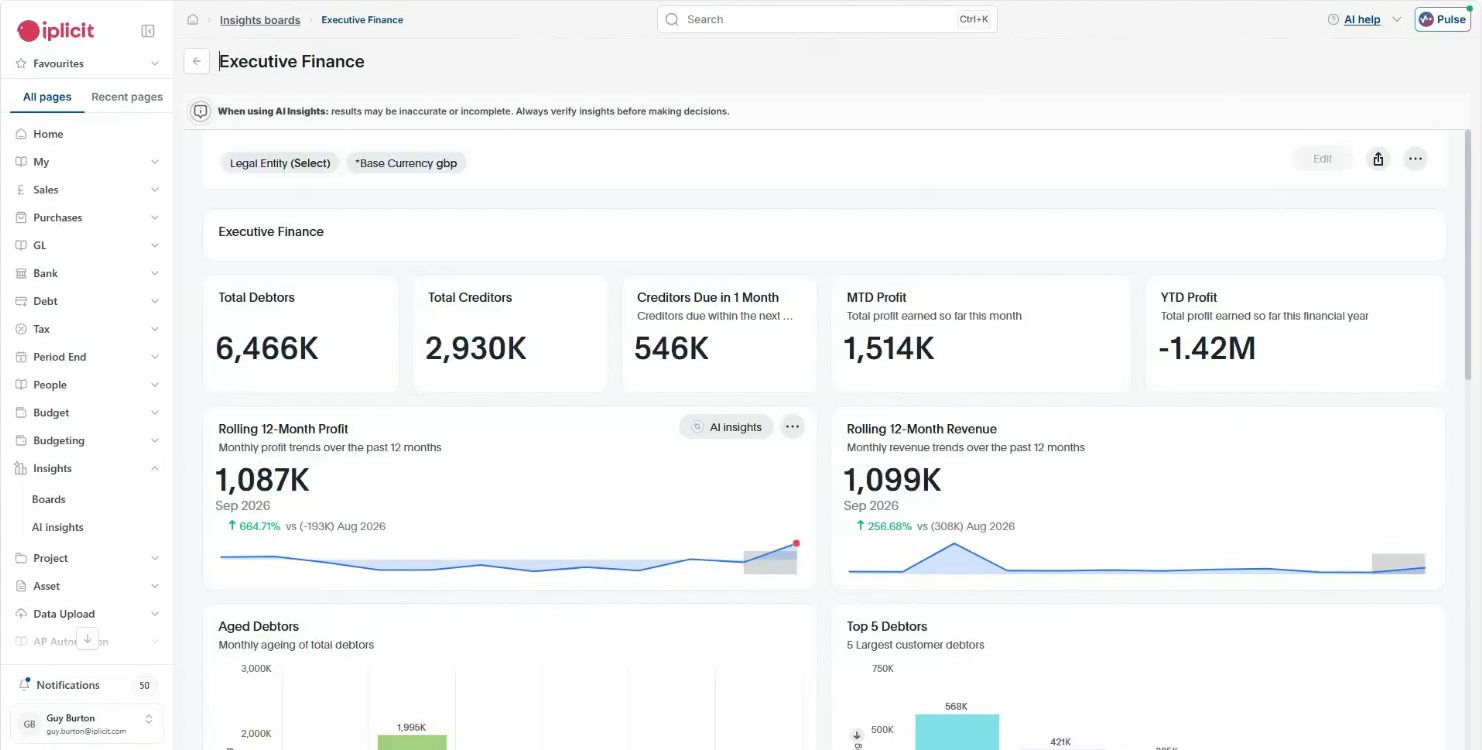
- iplicit Insights: Build your own dashboards and reports, with every figure traceable back to the source transaction. Every customer also gets the Executive Finance Dashboard as standard.
Pricing
iplicit offers transparent subscription pricing that scales with your users and entities, with multi-entity and multi-currency capability included rather than sold as extra modules. It’s sold as an annual subscription.
Pros
- Consolidation, intercompany automation, and multi-currency accounting handled inside one accounting system
- UK-based support team
- Every entity in one system, rather than periodic data pulls from separate ones
Cons
- No built-in stock or inventory module (integrates with Cin7 for stock management)
- Budgeting and FP&A depth is lighter than a dedicated planning tool
G2 rating
4.5 out of 5 (148 reviews)
2. Sage Intacct
Best for: Larger organisations that need deep dimensional reporting with consolidation.
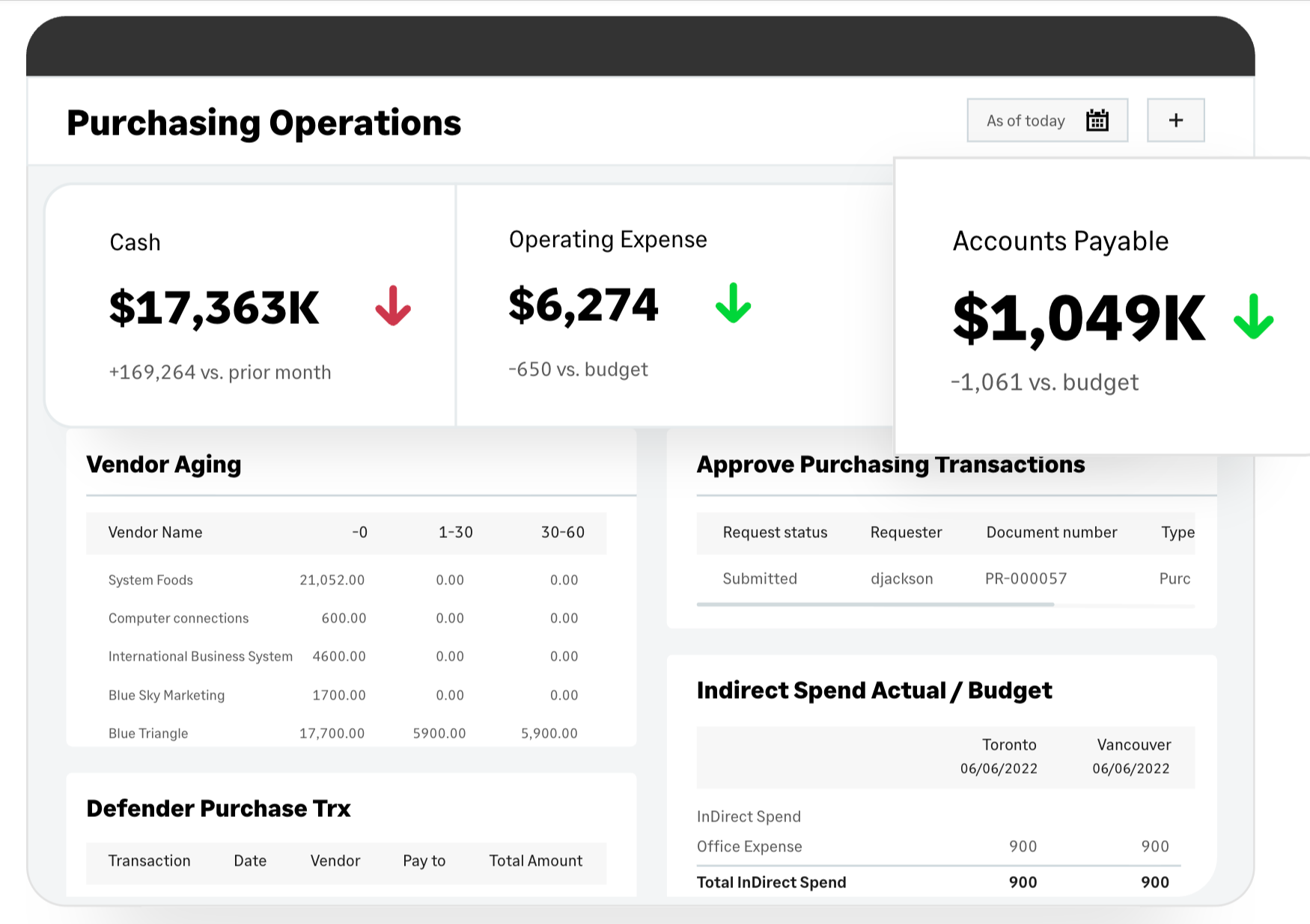
While most mid-market consolidation tools stop at entity-level roll-ups, Sage Intacct adds reporting dimensions. You can tag every transaction with a department, location, project, or custom category, then report across those dimensions at group level without restructuring your chart of accounts. This makes this software a strong fit for organisations with complex reporting requirements that go beyond straightforward entity consolidation.
The consolidation module handles multi-entity reporting, including currency translation and intercompany eliminations. For UK teams, Sage Intacct supports UK VAT and Making Tax Digital, helping your team manage VAT returns and meet HMRC reporting requirements within your accounting workflow.
Sage Intacct suits organisations that need detailed management reporting across a complex structure. However, its starting price of £1,200 a month and partner-led implementation may put it out of reach for smaller groups.
Key features
- Multi-entity consolidation: Consolidates data across entities with currency translation and intercompany eliminations.
- Dimensional reporting: Tags transactions with custom dimensions for detailed cross-entity analysis.
- Accounts Payable automation: Automates invoice processing, approvals, and payment runs.
- Statistical accounts: Tracks non-financial metrics alongside your financial data for richer reporting.
Pricing
Sage Intacct pricing starts from £1,200 per month, excluding VAT. Quotes come through Sage or its reseller partners and depend on modules, user count, and number of entities.
Pros
- Deep dimensional reporting across entities and departments
- Large partner ecosystem with UK-based implementation support
Cons
- Starting price of £1,200 a month, excluding VAT, before modules and implementation
- Implementation runs through Sage or a reseller partner
G2 rating
4.3 out of 5 (4,549 reviews)
3. AccountsIQ
Best for: Multi-entity groups that need built-in consolidation on a mid-market budget.
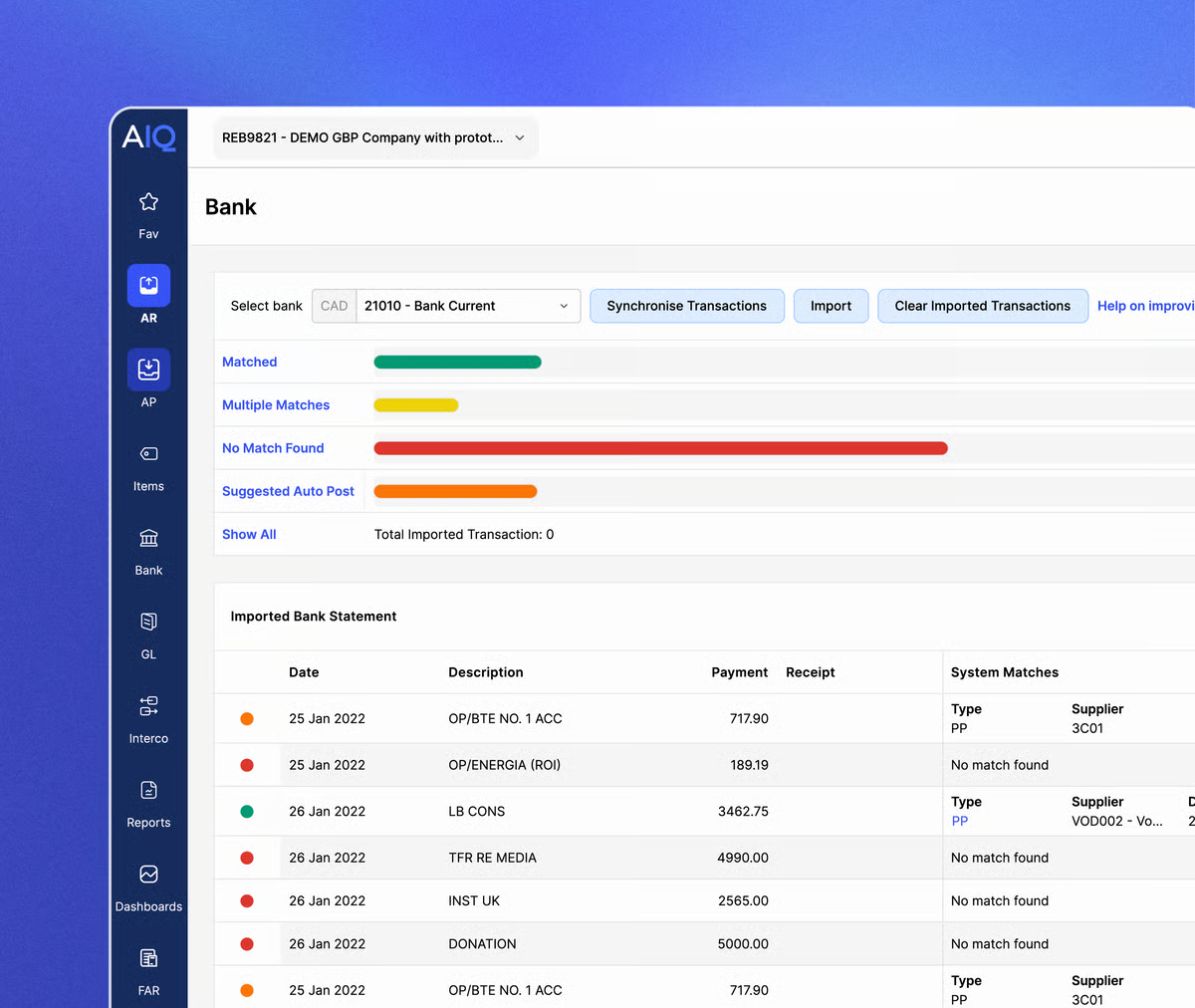
For multi-entity groups that need consolidation on a mid-market budget, AccountsIQ covers the core requirements without the cost of a full ERP. It’s popular with private equity portfolio companies and charities that report across several entities. On AccountsIQ, consolidation runs on the same platform where each entity’s books are kept.
It consolidates on the fly and supports multi-currency reporting. You’ll also get intercompany transaction management and automated eliminations. The Core plan covers a single entity, so multi-entity groups need a higher tier.
Key features
- Multi-entity consolidation: Consolidates across entities with live data and automated intercompany eliminations.
- Multi-currency conversions: Handles multiple currencies with exchange rate management across the group.
- Accounts Payable automation: Processes purchase invoices with automated coding suggestions.
- Customisable reporting: Builds reports across entities using a drag-and-drop report writer.
Pricing
Starts from €275 per month for the Core plan. Multi-entity and consolidation features are available on higher tiers.
Pros
- Consolidation built into the accounting platform rather than bolted on
- Good fit for charities and PE portfolio reporting
Cons
- Analysis dimensions and approval steps are limited on lower-tier plans
- Core covers a single entity, so groups need Growth or Scale
G2 rating
4.4 out of 5 (114 reviews)
4. NetSuite
Best for: Enterprises that need consolidation inside a full ERP suite.
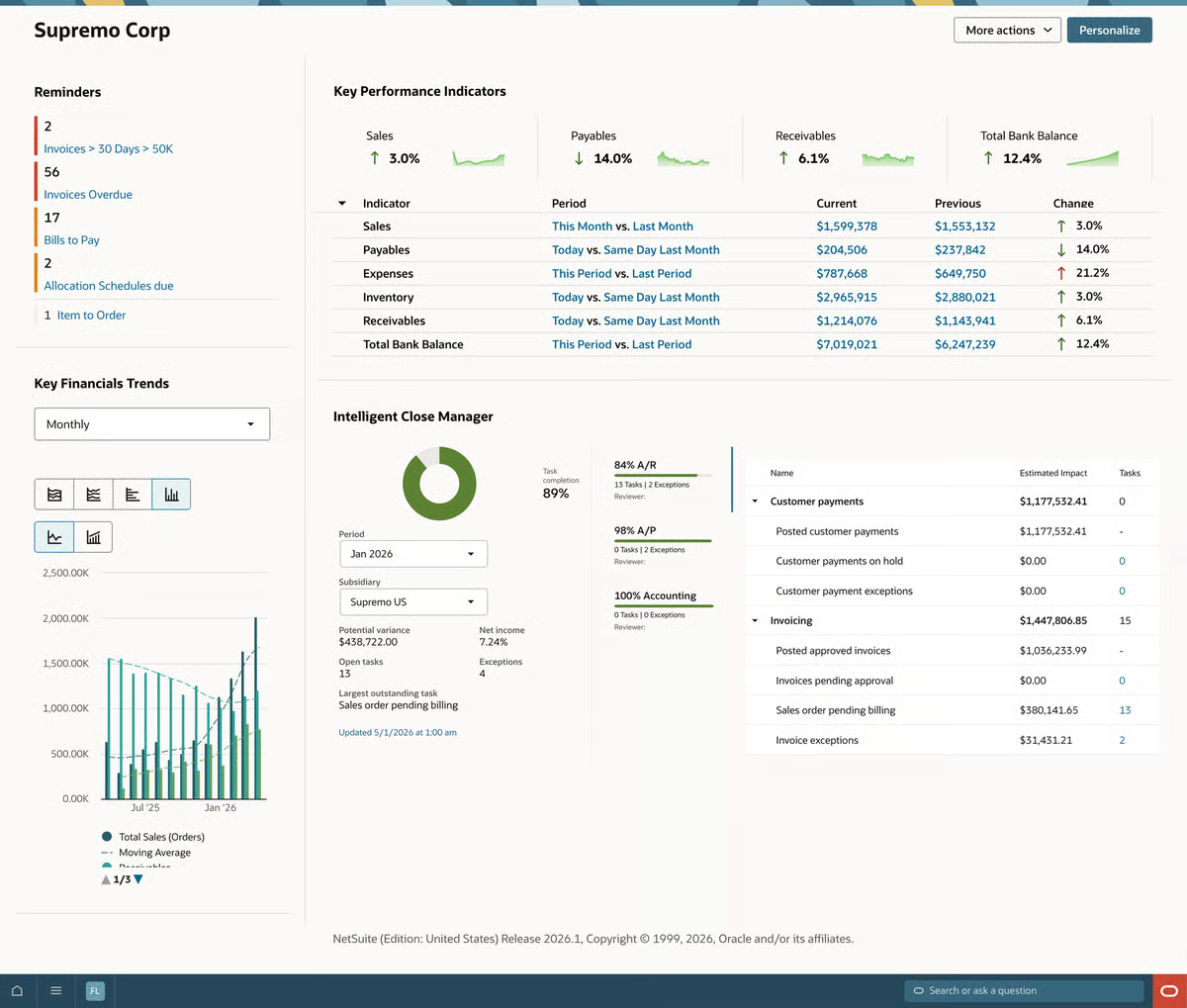
NetSuite is the option to consider when your group needs an ERP, not just an accounting system. Oracle’s OneWorld module handles multi-subsidiary consolidation alongside inventory, order management, and revenue recognition. Subsidiary transactions feed into the parent company’s consolidated financials, helping keep group figures up to date without relying on batch exports.
OneWorld handles currency translation, intercompany eliminations, and consolidated reporting. But it is a broad platform, and that breadth comes with complexity. Implementation tends to take a long time, and it can be an expensive choice if you are only going to use its accounting and consolidation features.
Key features
- OneWorld consolidation: Consolidates across subsidiaries with real-time currency translation and intercompany eliminations.
- Multi-currency management: Supports transactions and reporting in multiple currencies with automated revaluations.
- Role-based dashboards: Gives each user a customised view of consolidated and entity-level data.
- SuiteAnalytics: Provides reporting and analytics across the full dataset, including consolidated data.
Pricing
Not publicly disclosed. NetSuite uses a licensed subscription model with pricing based on modules, number of users, and entity count. You also pay a one-time implementation fee.
Pros
- Consolidation sits inside a full ERP covering inventory, order management, and revenue recognition
- Scales to handle very large, complex group structures
Cons
- Implementation timescales and costs can be significant
- Overkill for groups that only need accounting and consolidation
G2 rating
4.1 out of 5 (5,262 reviews)
5. Xledger
Best for: Organisations that want highly automated consolidation
Xledger focuses on automation depth. The platform handles consolidation, bank reconciliation, invoice matching, and approval workflows with minimal manual input. On Xledger, much of the month-end processing happens in the background rather than becoming a separate task you need to set aside time for.
It supports multi-entity consolidation, automated intercompany eliminations, and multi-currency accounting. If you adopt it fully, you’ll likely reduce your manual processing significantly.
There’s limited published pricing and independent review data available, so you’ll need to evaluate it yourself through a demo.
Key features
- Automated consolidation: Consolidates across entities with automated intercompany eliminations and currency translation.
- Workflow automation: Automates approval chains for invoices, expenses, and journal entries across entities.
- Multi-currency handling: Manages transactions and reporting in multiple currencies with automated revaluation.
- Automated bank reconciliation: Automatically matches transactions to reduce manual reconciliation time.
Pricing
Not publicly disclosed. Xledger uses a custom monthly subscription model with pricing available on request. There’s also a one-time implementation fee.
Pros
- High level of automation across accounting and consolidation workflows
- Significantly reduces manual month-end processing
Cons
- Pricing isn’t published, so you’ll need a quote
- Only 4 independent G2 reviews published, so peer validation is limited compared to more established alternatives
G2 rating
Too few public reviews for a reliable rating.
Group 2. Standalone consolidation tools
Compared to the first group, these tools don’t replace your accounting software. Instead, they connect to what you already use and pull the data together for consolidated reporting.
6. Joiin
Best for: Groups that want to consolidate reporting across existing accounting platforms
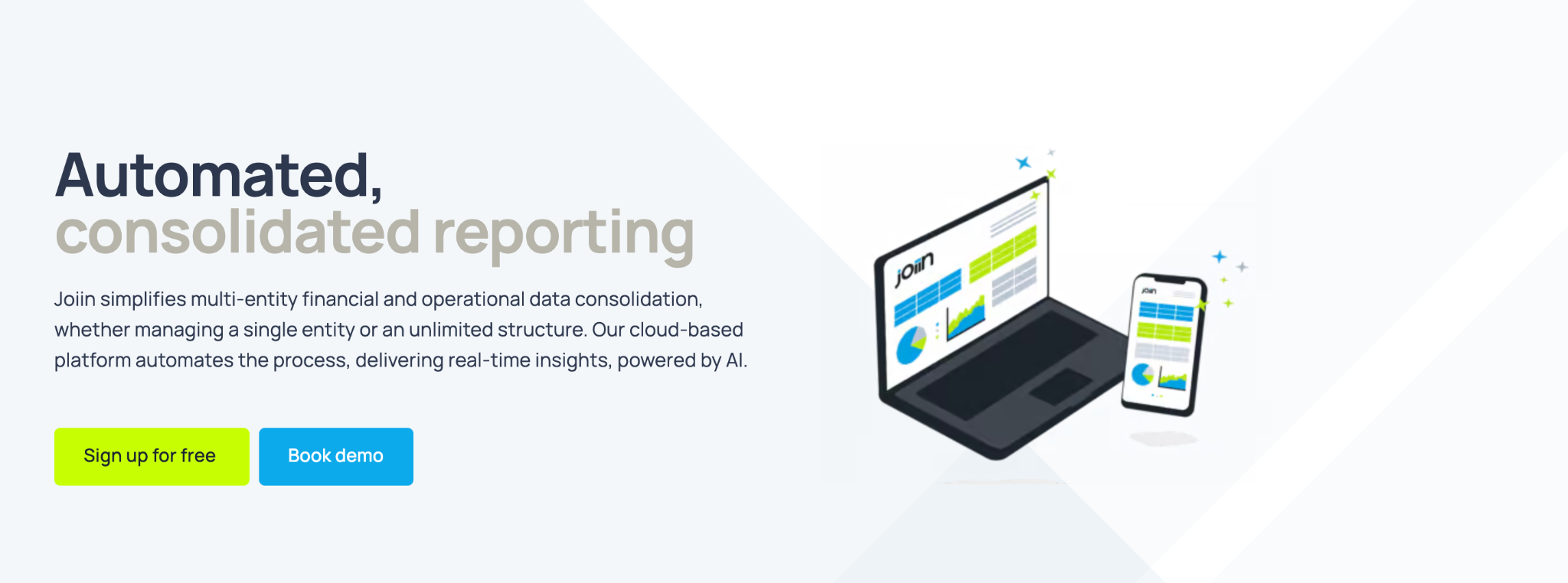
Joiin is a standalone consolidation and reporting tool that connects to your existing accounting software and pulls the data together for group reporting. It connects to Xero, QuickBooks, Sage, FreeAgent, and Excel, so it works even if your entities use different platforms.
Joiin doesn’t replace your accounting system. Instead, it sits on top of it, providing consolidated reports, multi-currency translation, and intercompany eliminations. At £20 per month for the starting Core plan, it’s the most affordable tool on this list. If you’re a small- to mid-sized group that wants consolidation without switching accounting software, the price alone makes it a great choice.
Joiin’s main limitation is depth. It is a reporting and consolidation layer, not a full accounting platform. So, you won’t get AP automation, AI invoice processing, or intercompany posting.
Key features
- Multi-platform consolidation: Connects to Xero, QuickBooks, Sage, FreeAgent, and Excel to consolidate your numbers across different accounting systems.
- Multi-currency translation: Translates entity data using closing, average, or custom rates for consolidated reporting.
- Intercompany eliminations: Removes intercompany balances and transactions from consolidated reports.
- Budget vs actual reporting: Compares consolidated actuals against budgets across the group.
Pricing
Starts from £20 per month for the Core plan (if billed annually) for a single connection. Higher tiers add more connections and features.
Pros
- Affordable entry point for small multi-entity groups
- Connects to multiple accounting platforms
Cons
- Reporting and consolidation only, with no accounting functionality
- Limited to the data your underlying accounting software provides
G2 rating
4.7 out of 5 (87 reviews)
7. Fathom
Best for: Finance teams that need consolidated reporting and KPI dashboards
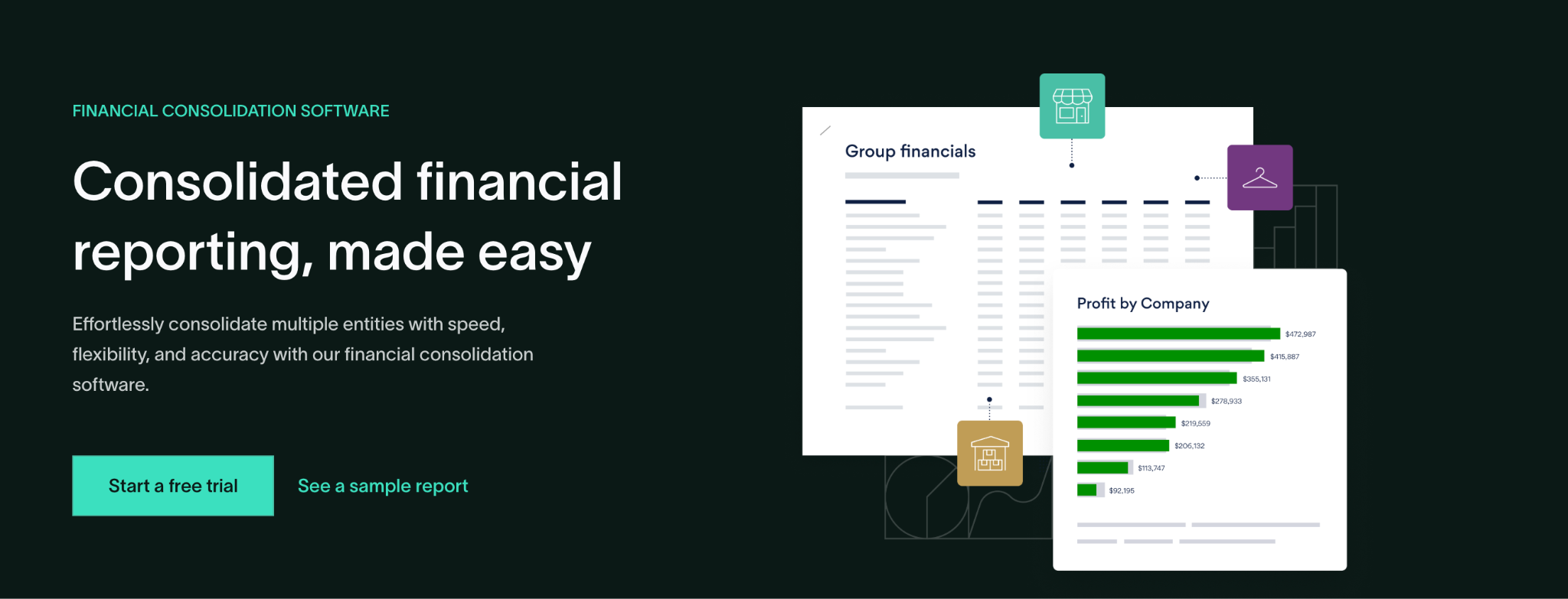
Fathom is a financial reporting and analysis tool that connects to accounting platforms like Xero, QuickBooks, and MYOB. It’s primarily a management reporting and KPI tool, but its consolidation features let you combine data from multiple entities into a single view.
If you want visual dashboards, KPI tracking, and consolidated reporting in one place, Fathom is a solid option. Its consolidation features support multi-currency reporting and intercompany eliminations. But like Joiin, it’s a reporting tool, not an accounting system. Plus, it uses a per-entity pricing model, which makes it expensive for groups with many companies.
Key features
- Consolidated reporting: Combines data from multiple entities into consolidated financial reports and dashboards.
- KPI tracking: Tracks and visualises financial and non-financial KPIs across the group.
- Multi-currency translation: Converts entity data for consolidated reporting using customisable exchange rates.
- Custom dashboards: Builds visual dashboards that combine consolidated and entity-level data.
Pricing
Fathom prices by the number of companies you connect, and consolidated groups are free to create. Enterprise plans cover 51 or more companies.
Pros
- Strong visual reporting and KPI dashboards across the group
- Connects directly to popular accounting platforms
Cons
- Pricing rises with each company you connect
- It’s a reporting tool, not an accounting system
G2 rating
4.6 out of 5 (178 reviews)
8. Lucanet
Best for: Mid-market and enterprise groups that need dedicated CPM
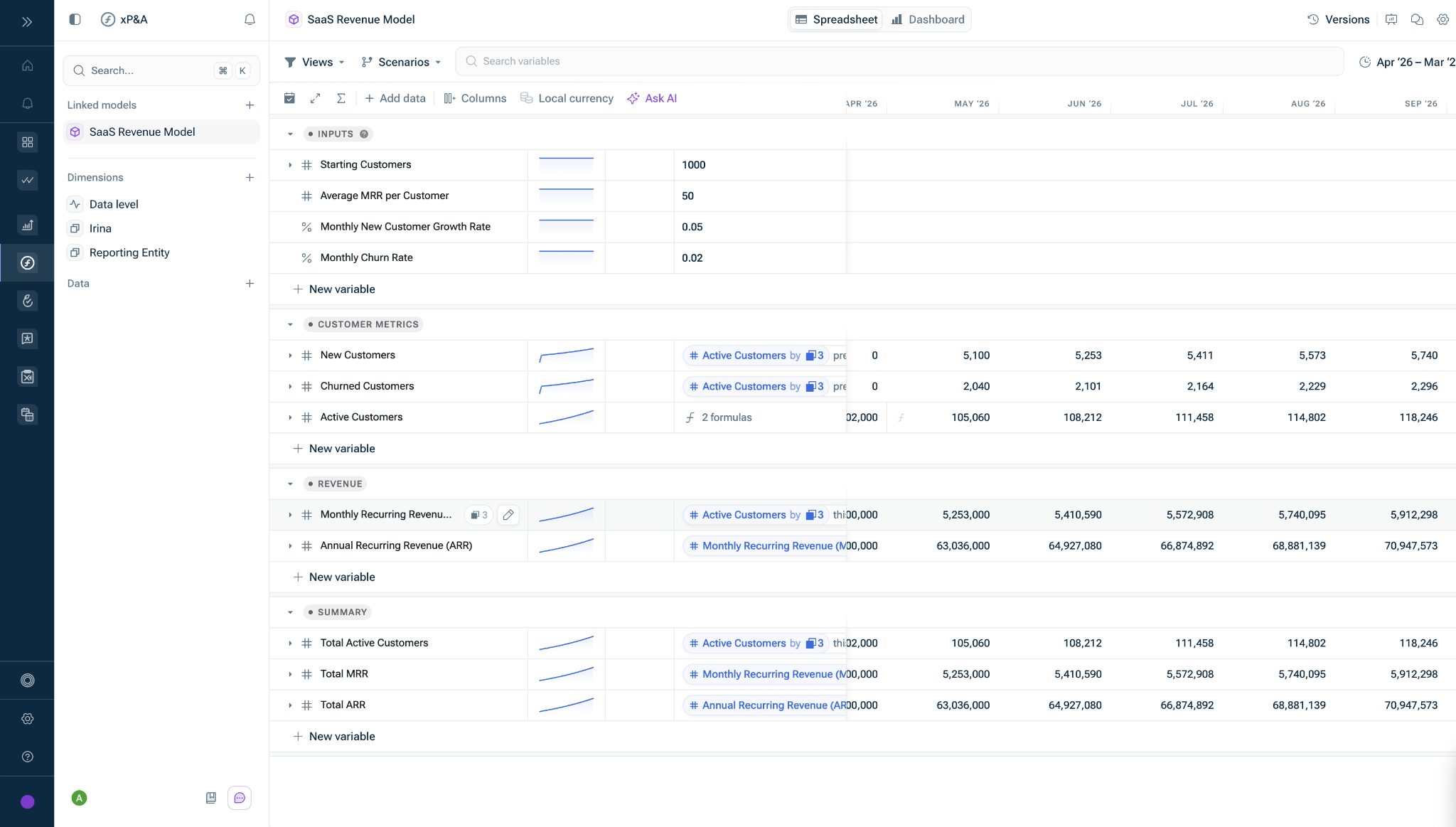
Lucanet is a dedicated corporate performance management (CPM) and financial consolidation platform used by mid-market and enterprise groups. It is headquartered in Germany, has offices across Europe, including the UK, and serves more than 6,500 customers.
Lucanet is built for organisations that need a standalone consolidation tool with the depth to handle complex group structures. It offers statutory consolidation, management reporting and financial planning in one place. It also connects to multiple data sources and ERP systems, so it can sit alongside the accounting software your entities already use.
For UK groups with European operations, Lucanet’s European footprint may be an advantage. However, it’s geared towards larger organisations, and pricing isn’t publicly available. You’ll need to speak to its sales team to understand the cost and assess whether that fits your budget.
Key features
- Statutory consolidation: Handles full statutory consolidation, including equity, debt, and capital consolidation steps.
- Multi-source data integration: Connects to ERP systems, accounting software, and spreadsheets to pull data into one consolidation model.
- Financial planning: Combines consolidation with budgeting, forecasting, and scenario planning in one platform.
- Audit trail: Provides a full audit trail from consolidated figures back to source data.
Pricing
Not publicly disclosed. Lucanet uses a custom pricing model with quotes available on request.
Pros
- Purpose-built for financial consolidation with statutory reporting depth
- Strong European presence with UK offices and support
Cons
- Enterprise-focused, which may not suit smaller UK groups
- No publicly available pricing
G2 rating
4.7 out of 5 (322 reviews)
How to choose the right financial consolidation software
The right tool depends entirely on your group’s setup and priorities. These questions will help you narrow it down.
Do you need a full accounting system or just consolidation?
If your current accounting software works well for each entity, you might just need a way to bring the numbers together. A standalone tool like Joiin or Fathom can do that job well.
But if you’re also already outgrowing your accounting software, iplicit or Sage Intacct gives you both accounting and consolidation in one system.
How many entities and currencies are you managing?
A group with two or three UK entities doesn’t have the same needs as one with 15 entities across several currencies. Simpler groups can get good results from a lighter tool. But more complex setups usually need a platform like iplicit with deeper consolidation rules, multi-currency translation, and intercompany handled in the system.
What’s your budget?
Standalone tools are the cheapest way in: Joiin starts from around £20 per month. Full accounting platforms are a bigger commitment, but they can also replace the cost of other software you’re paying for.
Consider the total cost of the software you are considering, including what you might save from the cost of your current accounting system and any manual workarounds.
How important is intercompany automation?
If your entities transact with each other regularly, manual intercompany matching and elimination is a serious time sink. Look for a tool like iplicit, where you record an intercompany transaction once and the matching entry is created in the other entity, rather than requiring separate journals and reconciliation in each entity.
Do you need audit-ready statutory consolidation?
If you need consolidation to produce audit-ready group accounts, you’ll need a platform with proper statutory consolidation steps, not just a reporting overlay. Lucanet and NetSuite fit that need.
Consider what your group needs most
The right choice depends on how much of your group’s accounting you want to automate. Consider your entity structure, intercompany activity, currency requirements, reporting needs, and the manual work you want to reduce. Also weigh the disruption of migrating your accounting against the limitations of keeping your existing systems.
And if you eventually settle on the need for consolidation, intercompany automation, and multi-currency reporting within one accounting system, iplicit brings these capabilities together in one cloud platform, without the complexity of a full ERP.
Book a demo to see how iplicit handles consolidation, or take a quick tour at your own pace.
Can you do financial consolidation in Excel?
Can you do financial consolidation in Excel?
You can, and many groups still do. But it’s all manual, so you have to handle data entry, formula links across workbooks, and hand-built elimination journals. That might be fine for a simple two-entity group using one currency, but errors multiply as you add more entities, currencies, and intercompany transactions. Consolidation software automates these manual steps and gives you an audit trail that a spreadsheet can’t match.
When do you need statutory consolidation software versus a reporting overlay?
When do you need statutory consolidation software versus a reporting overlay?
If your group prepares statutory consolidated accounts under FRS 102 or IFRS, you need software that supports required accounting adjustments, like investment eliminations, goodwill calculations, and non-controlling interests.
Tools like Joiin and Fathom can handle management consolidation and intercompany eliminations, but their statutory reporting capabilities differ. Fathom, for example, doesn’t produce audit-ready consolidated financial statements.
So, if you have complex statutory requirements, choose Lucanet and NetSuite. They offer deeper consolidation functionality. And for UK mid-market groups that mainly need consolidation and eliminations, iplicit handles those steps in one system. If your requirements are complex, check the detail with your auditors first.
What does migrating to a consolidation platform involve?
What does migrating to a consolidation platform involve?
A standalone tool like Joiin can be live in a day or two, because it connects to your existing software through an API. But moving to a full accounting system takes longer because you're migrating each entity’s chart of accounts, opening balances, and outstanding transactions.
With iplicit, your data is migrated and tested in a sandbox before go-live, and nothing goes live until you’ve signed it off. Implementation timelines scale with entity count and how much data you bring over, but with iplicit you’re up and running in weeks, not months.
What’s the difference between standalone consolidation tools and accounting systems with consolidation built in?
What’s the difference between standalone consolidation tools and accounting systems with consolidation built in?
A standalone tool connects to your existing accounting software and pulls the data together for group reporting. It doesn’t replace anything, so there’s less disruption. But you’re relying on data imports or API syncs, and you still need to manage intercompany transactions in each entity’s system separately.
An accounting system with built-in consolidation holds every entity on one platform, so intercompany activity, eliminations, and currency translation happen inside the system. But the downside is that you’re migrating all your entities to a new platform, which takes a lot of upfront work.
Is standalone consolidation software enough for a small multi-entity group?
Is standalone consolidation software enough for a small multi-entity group?
If you’ve got two to five entities on the same accounting platform, a standalone tool often covers what you need. You’ll get consolidated reporting, multi-currency translation, and basic intercompany eliminations without replacing your accounting software.
But if you’re already hitting limits with your accounting system, or your intercompany transactions are complex, a single platform will serve you better.