
At this year’s Digital Accountancy Show, the AI debate turned to whether finance teams can trust what the technology produces. For mid-market organisations – too complex for entry-level software, too lean for enterprise systems – four themes stood out: earlier warning of problems, fewer and better-connected tools, AI that people can check, and automation that lets a small team support a growing organisation.
The short version
- Mid-market finance teams need problems flagged as they happen, instead of in report pack that arrives weeks later.
- Every standalone tool a finance team adds means another login, more exporting and another version of the numbers to reconcile. Building around one connected financial core cuts that work down.
- Most accountants now use AI but that doesn't mean they fully trust it. In Karbon’s State of AI in Accounting Report 2026, 83% of respondents were concerned about data security.
- AI should sit around a deterministic ledger and flag issues that need human review.
- By automating tasks such as bank reconciliation, invoice capture and recurring journals, a small finance team can support a growing organisation without hiring at the same pace.
Walking the floor at the Digital Accountancy Show at ExCeL London last week, it was hard to miss how much the AI conversation has matured. A couple of years ago, the questions were about what AI might eventually do. This year they were more pointed, such as what can we trust, what does it actually change and who is accountable when it gets something wrong?
You could see it in the programme, with one of the headline sessions titled “AI you can rely on, workflows you can trust”. Another, “The AI myth”, made the case that bookkeeping matters more than ever, not less. Even the session reassuring people that AI won’t take their job came with a catch that someone using AI might.
Those questions are hardest for the organisations we often refer to as the ‘missed middle’. These mid-market organisations have outgrown entry-level accounting software. They often have several entities, currencies and approval layers to manage, but they have neither the budget nor the capacity to spend a year implementing a complex system designed for big corporates. Most handle all this complexity with a finance team of a handful of people.
What follows is our reading of the show through their eyes: four themes and what we think they mean for mid-market finance leaders and the advisers who work with them.
1. Reporting is no longer enough
Finance leaders tend to have a lot of reports to look at. What they are short of is warning. A month-end pack tells a finance director what happened – but often three or four weeks after the fact, by which point a margin problem or a cash squeeze has already done its damage.
The appetite now is for systems that flag issues as they emerge. You need to know about a looming budget overspend when the purchase order is raised, about a variance that needs investigating while the period is still open, and about a supplier invoice that doesn’t look right before it’s paid.
Larger organisations can put analysts onto all this. Mid-market teams can’t. Many are still exporting data to Excel, which they use to rework the numbers and build the reporting pack by hand, so even a simple question about where things stand can take half a day to answer. To produce that kind of analysis, you need live reporting that allows you to drill down from group level to an individual transaction, along with controls that raise exceptions at the point of entry rather than at the end of the month.
2. Fewer tools, better connected
The issue of tech stack sprawl came up again and again at DAS. The show’s headline session on trusted workflows put the emphasis firmly on the advantage of using purpose-built technology rather than ever more add-ons. Every new standalone tool promises to save time, yet each one means another login, more exporting and another version of the numbers to reconcile. Many finance teams now seem to spend as long moving data between systems as they do analysing it.
The mid-market feels this more sharply than most. Entry-level packages tend to struggle once there are multiple entities, intercompany transactions and consolidations to manage, so teams fill the gaps with spreadsheets and bolt-ons. Enterprise systems can cope with the complexity but they usually cost a lot, require lengthy implementations and enforce a level of rigidity that sits awkwardly with an organisation that’s still growing and changing shape.
Our view is that the answer lies in consolidating around a strong financial core. That means one platform where a group of three entities or thirty runs from a single login, connected to the rest of the organisation through integrations and open APIs, and where adding an entity after an acquisition extends what already works rather than starting another project. Before adding any new tool, it’s worth asking whether it adds yet one more place for data to live.
3. Pragmatic AI: trust is the real bottleneck
With more than ten AI sessions on the programme, the tone was noticeably about reliability rather than novelty. Accountants and finance leaders have heard a great deal over the past two years about what AI promises. What they want to know now is whether it holds up in a regulated, audited environment.
A speaker from UKAI put it plainly: “None of us are AI experts and the pace of change is eye-watering.” The moment calls for humility. Rather than claiming to have every answer, finance leaders should be asking more questions about AI: how it works, where the data goes and what happens when it gets something wrong.
That caution shows up in the research too. In Karbon’s State of AI in Accounting Report 2026, concern about data security reached 83%, up seven points on the previous year, even though almost every respondent is already using AI in some form. Adoption isn’t the hurdle any more. Confidence is.
In practice, the questions worth asking of any AI feature in a finance system are fairly simple. Does the data stay inside the platform, under the same security and access controls as everything else, or is it passed to an outside tool? Does it respect user permissions, so nobody can see an entity’s data through AI that they couldn’t see directly? Can you see why it flagged something, with an audit trail behind it? And is it flagging exceptions for a person to judge, or making decisions on their behalf?
That last question matters most to us. Our approach is summed up as: AI detects, you decide. AI is very good at spotting a duplicate invoice, an unusual amount or a posting made outside business hours. Deciding what to do about it should remain a judgement for the finance team.
Deterministic where it counts
This is also where iplicit takes a firm position. Our CEO, Lyndon Stickley, has urged finance teams, in an interview with AccountingWEB, to separate two very different kinds of technology.
The ledger is deterministic. As with a calculator, the same inputs always give the same result, and that is what makes it auditable. Large language models are probabilistic: they predict the most likely answer. That is useful for summarising a document or interrogating a report, and Lyndon is clear that AI will add real value around the edges of finance, from invoice capture to report analysis. But a likely answer isn’t good enough for posting journals, filing a VAT return or establishing an audit trail.
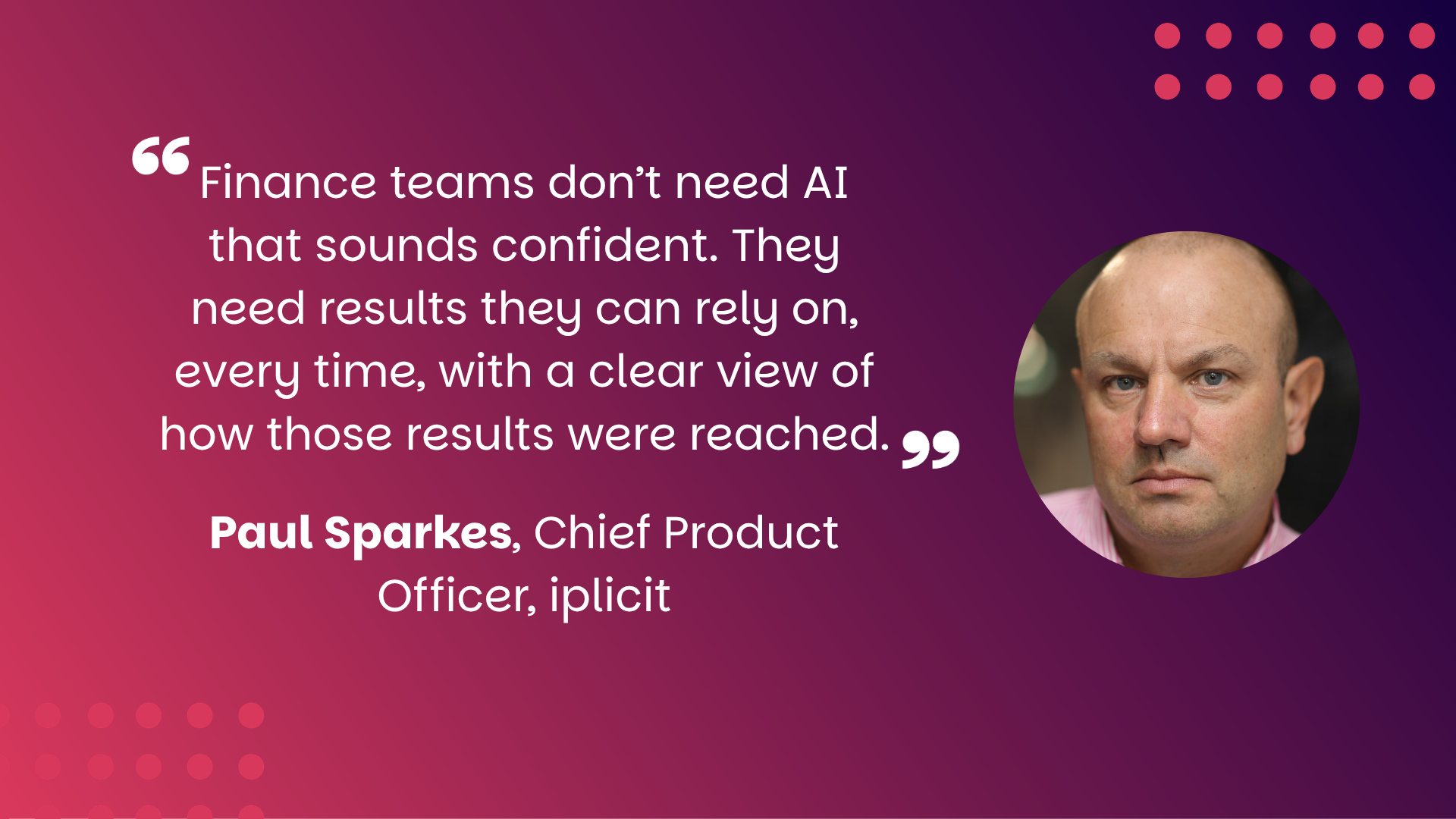
His view is that the platforms that last will keep an exact, deterministic core and build AI around it, rather than the other way round. Plenty of new tools, as he puts it, offer “the icing without the cake” – an impressive AI layer with nothing solid underneath. It’s a point made from a different angle in the show’s own session on why bookkeeping still matters. As Paul Sparkes, iplicit's Chief Product Officer, puts it: “Trust has never mattered more. Finance teams don’t need AI that sounds confident. They need results they can rely on, every time, with a clear view of how those results were reached."
4. Growing without growing the team
One session title summed up the fourth theme neatly: “AI won’t take your job, but someone using AI might”. Mid-market organisations, and the firms that advise them, are finding that hiring isn’t a dependable way to keep up with growth. Good finance people are hard to find and need time to get up to speed. So the focus is on efficiency and how to support a larger, more complex organisation without adding to their headcount at the same rate.
There’s a lot that can be done here with the kind of automation that we at iplicit have been designing since before ChatGPT changed the world. Bank reconciliations can be done by matching statements with the ledger automatically, so nobody has to key in transactions and tick them off. Invoices can be read by OCR (optical character recognition) technology and routed for approval with minimal human input. Deferred revenue and depreciation can be posted automatically, rather than by someone consulting a spreadsheet and journalling manually.
This kind of automation saves an enormous amount of time. For iplicit customer The Recruitment Group, accounts payable went from a job that took six people 1.5 days to one that four people can finish in two hours. At the charity Bransby Horses, reconciliations that took weeks are now done in 3-4 days, while the small finance team has saved at least one week of staff time per month.
With efficiencies like that achieved, you’ve laid the groundwork to really get the best out of AI. Our own AI tool, iplicit Insights, enables you to ask questions in ordinary language about areas such as P&L, trends and KPIs. The reports and analysis that come back are based on data from that deterministic core – so you can trace any output back to what’s in the ledger.
Closing the gap for the missed middle
The Digital Accountancy Show didn’t so much reveal anything new as confirm what many mid-market finance leaders already sense. Entry-level software has run out of road for them, and enterprise systems were never really designed for organisations that need to move quickly with a lean team.
What they need sits in between those options, offering insights early enough to act on, a connected platform rather than a sprawl of tools, AI they can trust and check, and automation that lets a small team support a growing organisation. That is the gap iplicit was built to close, offering enterprise capability without enterprise complexity, typically implemented in weeks rather than months and supported by a UK-based team. More than 2,000 UK organisations already run their finance on iplicit.
See iplicit in action. If your organisation has outgrown its current system, or your clients have, book a demo and see how it works in practice.