
Quick summary
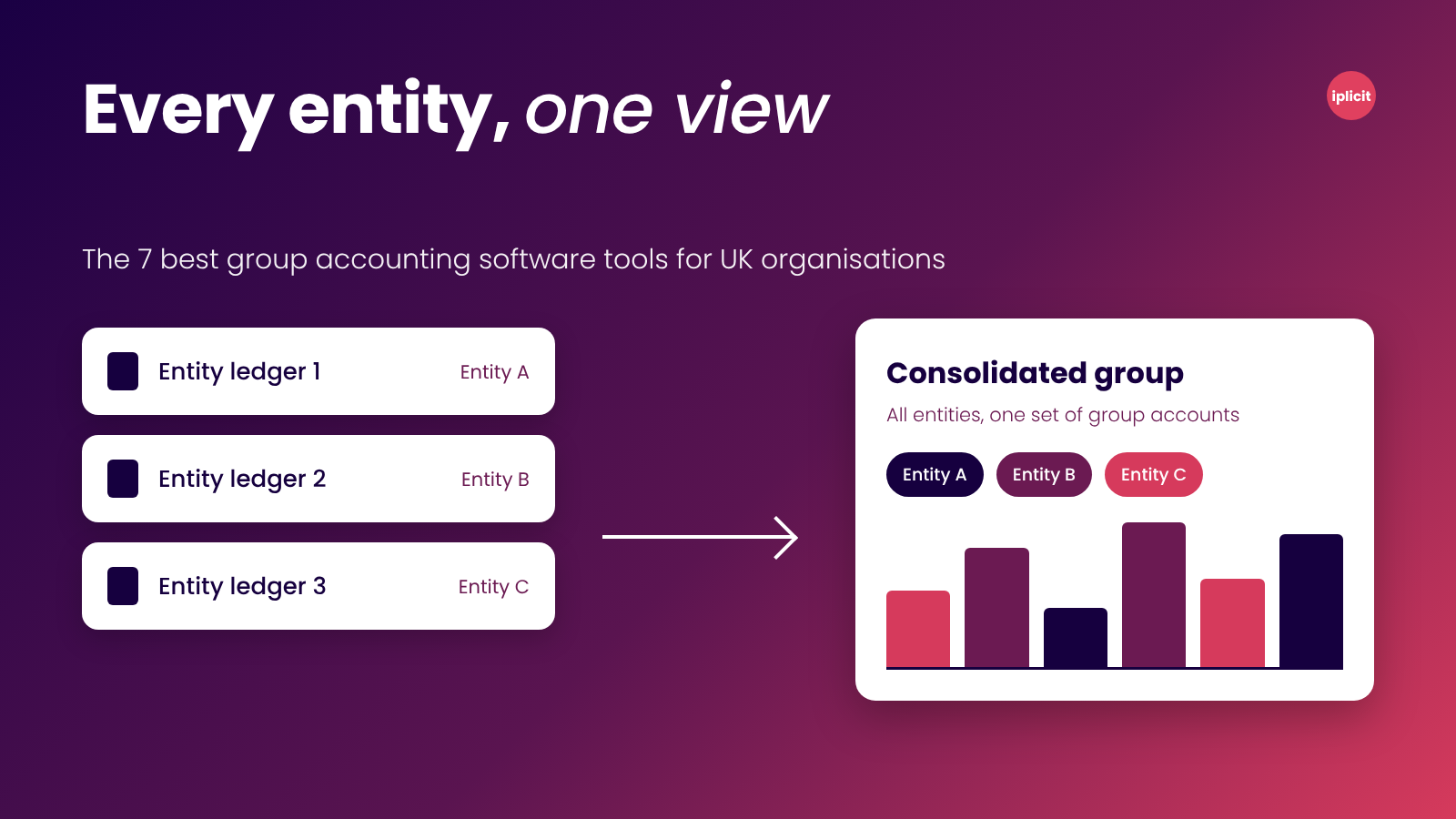
Running multiple entities on Xero means paying for a separate subscription for each organisation, plus any additional add-ons and a consolidation tool. It also means spending more time managing separate ledgers and consolidating the figures. This setup may work for smaller groups with straightforward reporting needs. But as a group grows, a single multi-entity system like iplicit is more practical. It removes the need for separate subscriptions and consolidation tools, while shrinking the time spent on manual accounting and month-end reporting.
Xero’s multi-entity cost adds up fast
If you want to run your multi-entity accounting on Xero, you’ll be billed per organisation. That is, 3 trading entities will need 3 Xero subscriptions, each at full price. Xero previously offered a multi-organisation discount, but it was removed on 1 September 2026.
Xero’s accounting plans also don’t consolidate organisations. So you’ll need a separate reporting tool, or hours of your team’s time each month to pull all the figures together in spreadsheets.
This guide breaks down how much Xero really costs, from upfront subscription fees to consolidation add-on costs and hidden time costs. By the end, you’ll have an honest number for what Xero truly costs your group.
Why trust this article?
At iplicit, we help multi-entity organisations that have outgrown Xero’s pricing model and required manual workarounds switch to a single multi-entity accounting platform. One of our customers, SEP2, switched to iplicit from Xero and fully automated the manual data work behind its deferred income that used to take at least two to three days. They now spend zero time on it.
“Our reporting capabilities have improved dramatically. I no longer worry about manual data manipulation or rigid reporting templates. Everything is faster and more flexible.”
Mahreen Jamil, CFO, SEP2
Our experience helping customers achieve these kinds of results informs the insight in this article.
What Xero charges per entity
On Xero, every legal entity needs its own subscription. Here are the current UK plan prices, excluding VAT.
| Plan | Monthly price | Use multiple currencies | Notes |
|---|---|---|---|
| Simple | £7 | No | Limited features, rarely suitable for a trading entity |
| Ignite | £18 | No | 20 invoices and 10 bills per month |
| Grow | £39 | No | Unlimited invoices and bills |
| Comprehensive | £55 | Yes | Adds multi-currency reporting and budgets |
| Ultimate | £70 | Yes | Adds projects, KPIs and longer cash flow forecasts |
These prices became effective on 1 September 2026. Before then, Ignite was £16, Grow was £37, Comprehensive was £50, and Ultimate was £65.
For groups that bill in multiple currencies, it’s worth noting that multi-currency is only available on the Comprehensive plan and above. If even just one of your entities trades in a foreign currency, you’ll need the £55 or £70 plan for that entity.
Xero’s multi-organisation discount also no longer applies. Before 1 September 2026, groups running several organisations under one subscriber email got a discount. That discount has been removed entirely, and you must pay the full subscription fee for each entity.
Xero charges a monthly subscription fee for each paid organisation.
Subscription costs for 3, 5 and 10 entities
Multi-entity finance teams on Xero tend to run on the Grow or Comprehensive plans. Here are the Xero subscription costs alone, excluding VAT.
On the Grow plan (£39 per month per entity)
| Entities | Monthly cost | Annual cost |
|---|---|---|
| 3 | £117 | £1,404 |
| 5 | £195 | £2,340 |
| 10 | £390 | £4,680 |
On the Comprehensive plan (£55 per month per entity)
| Entities | Monthly cost | Annual cost |
|---|---|---|
| 3 | £165 | £1,980 |
| 5 | £275 | £3,300 |
| 10 | £550 | £6,600 |
If your group has entities on different plans, calculate the subscription cost of each separately. Say you’ve got three entities on Grow and two on Comprehensive. That’s (3 x £39) + (2 x £55) = £227 a month, or £2,724 a year.
Then add VAT at 20%. That increases the cost of the five entities to £272.40 a month. That’s £3,268.80 a year.
And these are subscription costs alone, before factoring in add-ons or costs of consolidation tools.
Xero add-ons that affect multi-entity costs
Beyond the base plan, a few add-ons apply to multi-entity groups. These include:
- Payroll costs £1.50 per additional person per month on most plans, or £1 on Ultimate, with one person included on Grow, five on Comprehensive and ten on Ultimate. If you’re running payroll across three entities on Grow with 30 staff each, that’s an extra £130.50 a month on top of your subscriptions.
- The Company Accounts and Tax add-on costs £120 a year per organisation, billed annually. For five entities, that’s £600 a year.
- Contractor CIS returns, if you need them, cost £5 a month per organisation.
These add-ons aren’t huge individually, but they multiply across entities like the base subscriptions and eventually add up to a significant expense.
The cost of consolidation on top of Xero
Xero’s accounting plans don’t consolidate organisations. If you need group-level financial statements, you have three options:
- Spreadsheets and manual work. This is where many multi-entity Xero users start. You export reports from each organisation, paste them into a spreadsheet, and do the eliminations by hand. The direct cost is zero, but the time cost is a lot. Month-end takes longer with every entity once you add intercompany matching and currency adjustments.
- A consolidation and reporting app. Tools like Joiin, or Xero’s own Syft Analytics, connect to your Xero organisations and pull data into consolidated reports. Joiin’s Core plan starts from £20 a month on annual billing, and the price rises with the number of companies you connect. These tools consolidate reports and eliminate intercompany balances, but each transaction still has to be entered in both Xero organisations.
- A dedicated accounting platform with built-in consolidation. This is the route groups take when they’ve outgrown Xero entirely. We cover this option in more detail later in the guide.
What a third-party consolidation tool adds to Xero’s costs
This table shows what a five-entity group on Grow might pay in a year, excluding VAT, with a consolidation tool. The tool range is our own estimate.
| Cost component | Annual estimate |
|---|---|
| 5 x Xero Grow subscriptions | £2,340 |
| Consolidation tool (our estimate) | £500 to £1,000 |
| Total before staff time (ex VAT) | £2,840 to £3,340 |
This total still doesn’t account for the payroll add-on, CIS returns, or the hours your finance team will spend on manual intercompany work and month-end. Add those, and by our estimate the full cost of running five entities on Xero sits well above that total.
Hidden time costs that don’t appear on the Xero invoice
The subscription cost, add-on fees, and payment for the consolidation tool are the visible costs. The hidden cost that’s rarely accounted for is the time your finance team spends doing:
- Intercompany eliminations. Xero has no dedicated intercompany module. When one entity recharges another, you must manually enter the invoice in one organisation and the corresponding bill in the other, then reconcile them. For groups doing this regularly, the process can take hours each month, and timing differences can leave balances out of sync.
- Month-end close. Without automated consolidation, month-end means logging in and out of each Xero organisation separately, exporting reports, building the consolidation in a spreadsheet and posting manual journals for eliminations.
- Currency translation. Xero tracks exchange rate gains and losses within each organisation and calculates FX adjustments automatically at month-end. What it doesn’t do is translate an overseas entity’s ledger into your group currency for consolidation. That step happens in your spreadsheet or reporting tool, and it grows with each entity.
- Error management: Manual consolidation is error-prone. A mis-keyed elimination or a stale exchange rate can mean restating the numbers. That costs more time and delays reporting to the board.
Across the organisation, this time cost leads to reporting lag. When your finance team spends most of month-end wrangling data, the management accounts arrive late. That means the board makes decisions based on old numbers. This affects every decision that depends on timely financial data.
Xero’s pricing model and time demands also make scaling difficult. Every new entity you add means another Xero subscription, another set of intercompany journals, another organisation to include in the spreadsheet consolidation, and more time needed for month-end.
When Xero still makes sense for a group
Despite these limitations, Xero can still work well for some multi-entity organisations. Not every group needs to move away from it.
If you run two entities that don’t sell to each other and that use the same currency on Xero’s Grow plan, your subscription cost is £78 a month. Add a simple consolidation spreadsheet, and that’s a reasonable setup that should meet your accounting needs and shouldn’t require too much manual work. Plus, you get Xero’s large app marketplace and strong UK bank feeds.
But the situation is different for three or more entities, especially if they use different currencies or recharge each other. At that stage, costs increase significantly, and manual month-end work starts eating into the time your finance team could spend on analysis. That’s when it makes sense to adopt a multi-entity accounting platform.
What a multi-entity platform with built-in consolidation removes from the cost
A single accounting platform built for multi-entity groups removes three cost layers at once.
- One subscription replaces one per entity. You manage all your entities in one system, under a single subscription.
- The consolidation tool becomes unnecessary. You can consolidate across entities and currencies in one system, with intercompany handled in the system and drill-down to the source transaction. You won’t need a separate app to see your group’s financial position.
- The manual month-end work shrinks. Record an intercompany transaction once, and the system automatically creates the matching entry in the other entity. Eliminations are handled for you. Exchange rates can feed in automatically with the optional XE currency updater. And consolidated reports translate using closing, average, or historic rates by account type, set up to match your group policy.
At iplicit, our cloud accounting software gives you these three advantages.
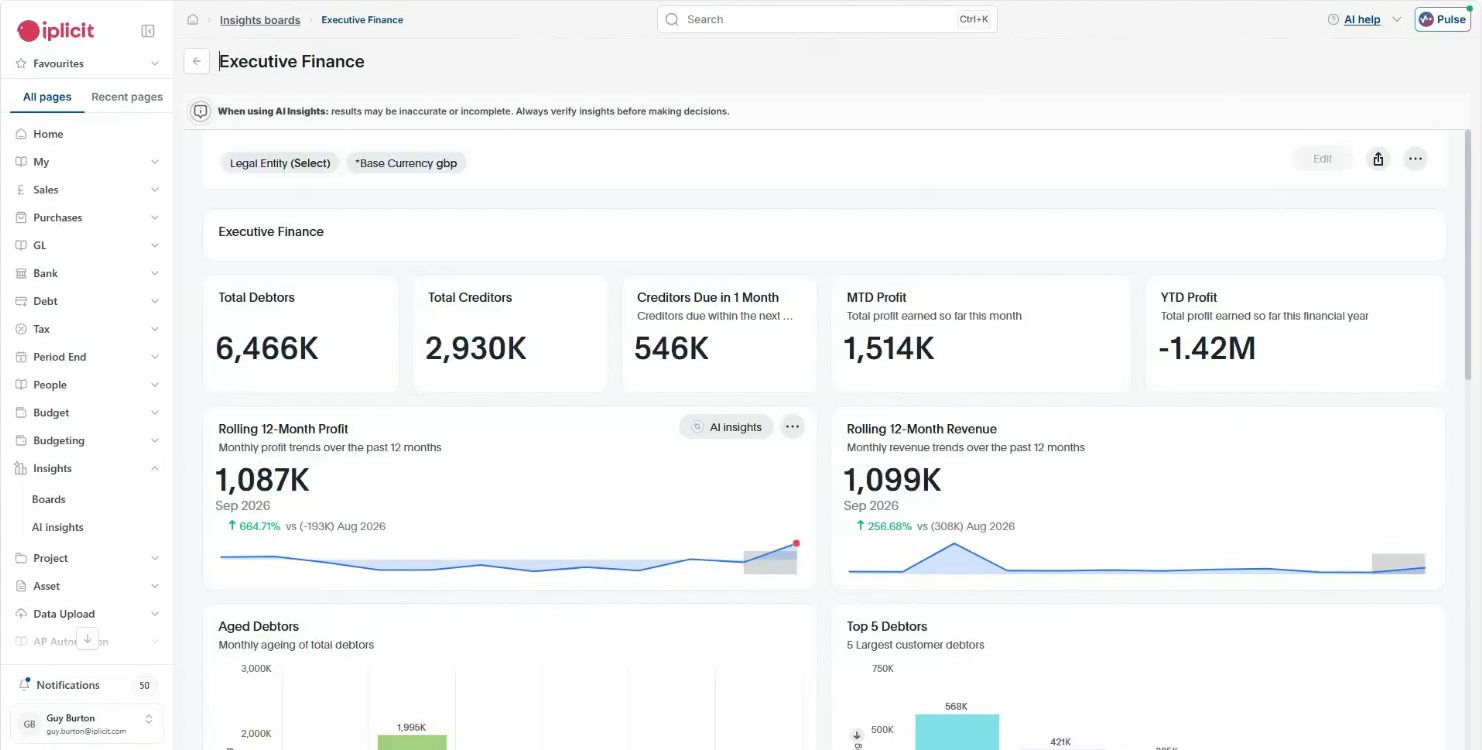
We offer subscription pricing that scales with your users and entities. Every subscription includes automated consolidation and group accounting. Fund accounting, multi-entity and multi-currency capability aren’t sold as extra modules.
Bridges Outcomes Partnerships is a good example of what using iplicit instead of Xero looks like in practice. They were managing around 25 legal entities through separate Xero instances, making group reporting time-consuming. After moving to iplicit, their month-end close fell from nearly four days to about one.
“My role is broader than solely finance – and with the month-end work cut down, I have more capacity to support the other functions I look after, whereas before, I was primarily working on finance and squeezing in other bits and pieces where I could.”
“I feel a lot less trepidation now when people tell me there’s a new project coming down the pipeline. We’re tooled up and prepared for growth.”
Colin Huntington, Director of Finance and Enablement, Bridges Outcomes Partnerships
Calculate your true Xero cost today
If you want to put a number on what your group is actually spending on Xero, here’s a straightforward way to do it.
- Add up your subscriptions. Log in to Xero and head to Subscription to check the plan for each organisation. Multiply the monthly price by the number of entities. Don’t forget VAT (20%).
- Add your consolidation tool. If you’re using a third-party app, check its monthly invoice. If you’re consolidating in spreadsheets, estimate the hours your finance team spends each month. Multiply by their hourly cost.
- Add the monthly close time. How many days does your month-end take? Estimate the hours and multiply by your finance team’s average hourly rate.
- Compare the total. Add up those three numbers, and use the total to judge whether staying on Xero is the right call. Or whether that time and tooling would be better spent on a single multi-entity platform like iplicit.
If you decide on the latter and you’d like to see how iplicit handles multi-entity accounting, book a demo or take the Quick Tour.
At iplicit, we test every migration from Xero in a sandbox before go-live. That way, you can review and fine-tune as needed, and nothing goes live until you’ve tested and signed it off.
More questions about Xero pricing
What’s the cheapest Xero plan that supports multi-currency?
Comprehensive at £55 per month, excluding VAT. The Ignite and Grow plans don’t include multi-currency.
What happened to Xero’s old Starter, Standard and Premium plans?
Xero replaced them in September 2024. The current UK plans are Simple, Ignite, Grow, Comprehensive and Ultimate.
Can you run multiple companies on one Xero subscription?
Can you run multiple companies on one Xero subscription?
No. Each legal entity needs its own Xero organisation and subscription. You can access multiple organisations from one login, but each one is billed separately at the full plan price.
Does Xero offer a discount for multiple organisations?
Does Xero offer a discount for multiple organisations?
Not anymore. Xero removed its multi-organisation discount on 1 September 2026. Every UK organisation now pays the standard list price for its plan.
Does Xero have built-in consolidation?
Does Xero have built-in consolidation?
Not in its accounting plans. To produce group-level financial statements, you’ll need to export data from each organisation and consolidate it in a spreadsheet, or use a separate reporting tool like Xero’s own Syft Analytics or Joiin.
How much does it cost to run five entities on Xero?
How much does it cost to run five entities on Xero?
Five entities on the Grow plan at £39 per month cost £195 a month, or £2,340 a year before VAT. On Comprehensive at £55, it’s £275 a month or £3,300 a year. But that’s before you add the cost of a consolidation tool and staff time.
Is Xero suitable for multi-entity groups?
Is Xero suitable for multi-entity groups?
Xero works well for single entities and small, independent groups. Once you hit three or more entities that need consolidated reporting or intercompany transactions, the per-entity cost and manual workarounds add up quickly. At that point, a purpose-built multi-entity platform is more practical.