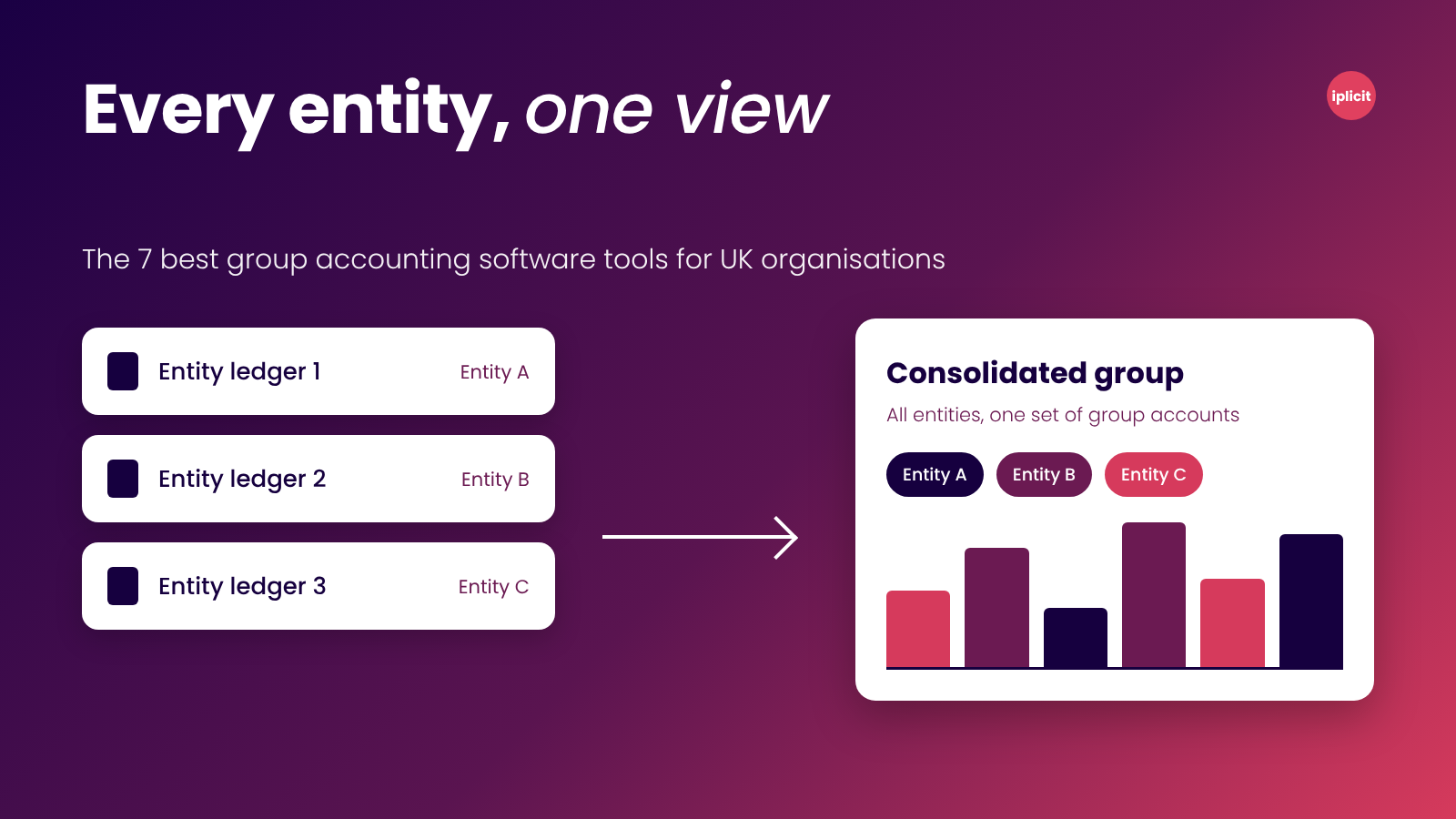

Both AccountsIQ and Sage Intacct support multi-entity accounting and group consolidation, but they package those capabilities differently. Same job. Different packaging. And the packaging affects the price.
AccountsIQ offers sub-consolidation layers, intercompany eliminations, budgeting, and accounts payable across its plans, although the number of entities and analysis dimensions depends on the plan. Sage Intacct offers three consolidation tiers. Currency translation, multi-level consolidation and partial ownership sit in the higher ones. Planning is a separate subscription.
Want multi-entity consolidation, intercompany automation, multi-currency reporting and flexible reporting dimensions in a single subscription? iplicit is built for that. Here’s a quick table that compares the three:
Need to choose between AccountsIQ and Sage Intacct?
If you’re looking for accounting software and have narrowed your options down to AccountsIQ and Sage Intacct, this comparison is for you.
This article compares the two platforms, covering their package tiers, core features, and pricing. You’ll see which one suits a UK group with several entities, multiple currencies and an audit on the way.
You’ll also see where a third option, iplicit, fits if neither matches your group.
AccountsIQ vs Sage Intacct: detailed comparison
AccountsIQ offers different levels of group functionality across its plans, while Sage Intacct builds on its core product with separate consolidation tiers. Here’s how they compare:
AccountsIQ
Best for: UK and Ireland groups that want to manage separate subsidiary ledgers and consolidate them for group reporting, while keeping budgeting and accounts payable in the same system.
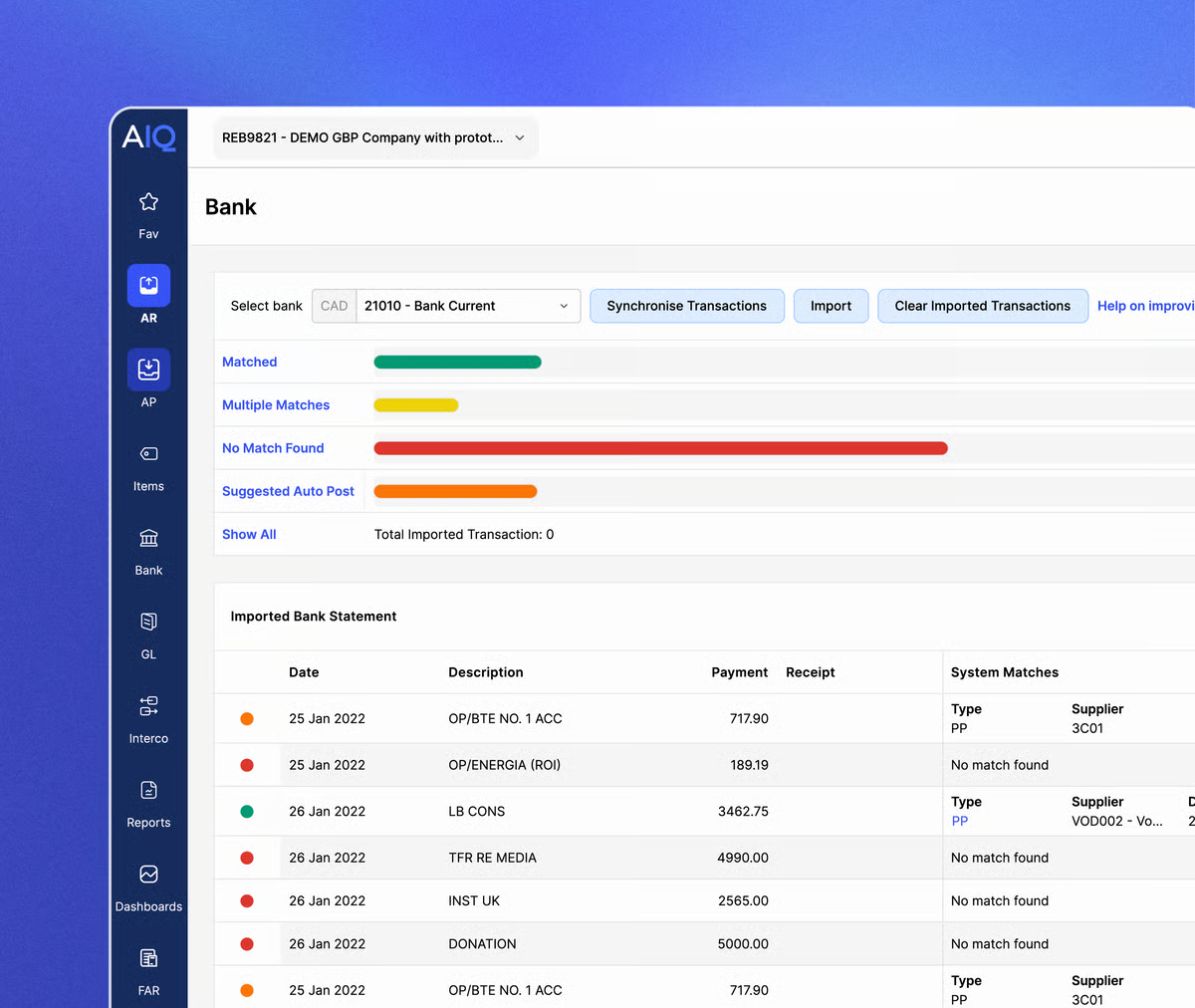
AccountsIQ is a cloud accounting software for mid-market finance teams. It’s registered in Ireland, with offices in Dublin and London. It has more than 35,000 users in over 85 countries.
For a group, AccountsIQ’s distinction is how it brings the financial data from separate entities together. Each subsidiary can maintain its accounts in its own currency, whether pounds, euros, or dollars. The data is then consolidated at group level, with sub-consolidation layers allowing you to combine entities into smaller groups before rolling them up into the parent entity.
Key features
- Consolidation: Run group consolidations in one step, with the system checking your consolidation rules and data consistency before processing.
- Intercompany eliminations: Set up elimination rules once and apply them each time you consolidate. An intercompany matrix gives you visibility into transactions between entities.
- Currency translation: Apply centrally controlled average and period-end exchange rates across subsidiaries when preparing consolidated accounts.
- Group reporting: Drill down from consolidated figures to the underlying transactions without switching between entities.
- Integrations: Connect AccountsIQ to more than 100 third-party systems, including Stripe, HubSpot, and Salesforce.
Key limitations
- The Core plan supports only one entity and two users, so groups need the Growth or Scale plan.
- The number of analysis dimensions depends on your plan: two on Core, four on Growth, and six on Scale.
Pricing structure
AccountsIQ uses custom pricing, with quotes available on request. Its pricing page states that plans start from €275 per month for Core, which includes one entity and two users. The page doesn’t specify setup fees or contract terms, so ask about these when requesting a quote.
Pros
- The Core plan includes budgeting, accounts payable, and bank feeds with automated reconciliation, rather than charging extra for these features.
- VAT and Making Tax Digital (MTD) support are included in the Core plan.
- AccountsIQ has support teams based in the UK and Ireland and reports an average first response time of 27 minutes.
Cons
- Beyond the Core starting price, AccountsIQ doesn’t publish pricing for its Growth and Scale plans. So, it’s difficult to estimate the cost of a group deployment without requesting a quote.
- Analysis dimensions are capped by plan (two, four or six), so deeper reporting means a higher tier
Sage Intacct
Best for: Groups with partly owned subsidiaries or complex, multi-level structures, and finance teams that need dedicated financial planning and budgeting alongside their accounting system.
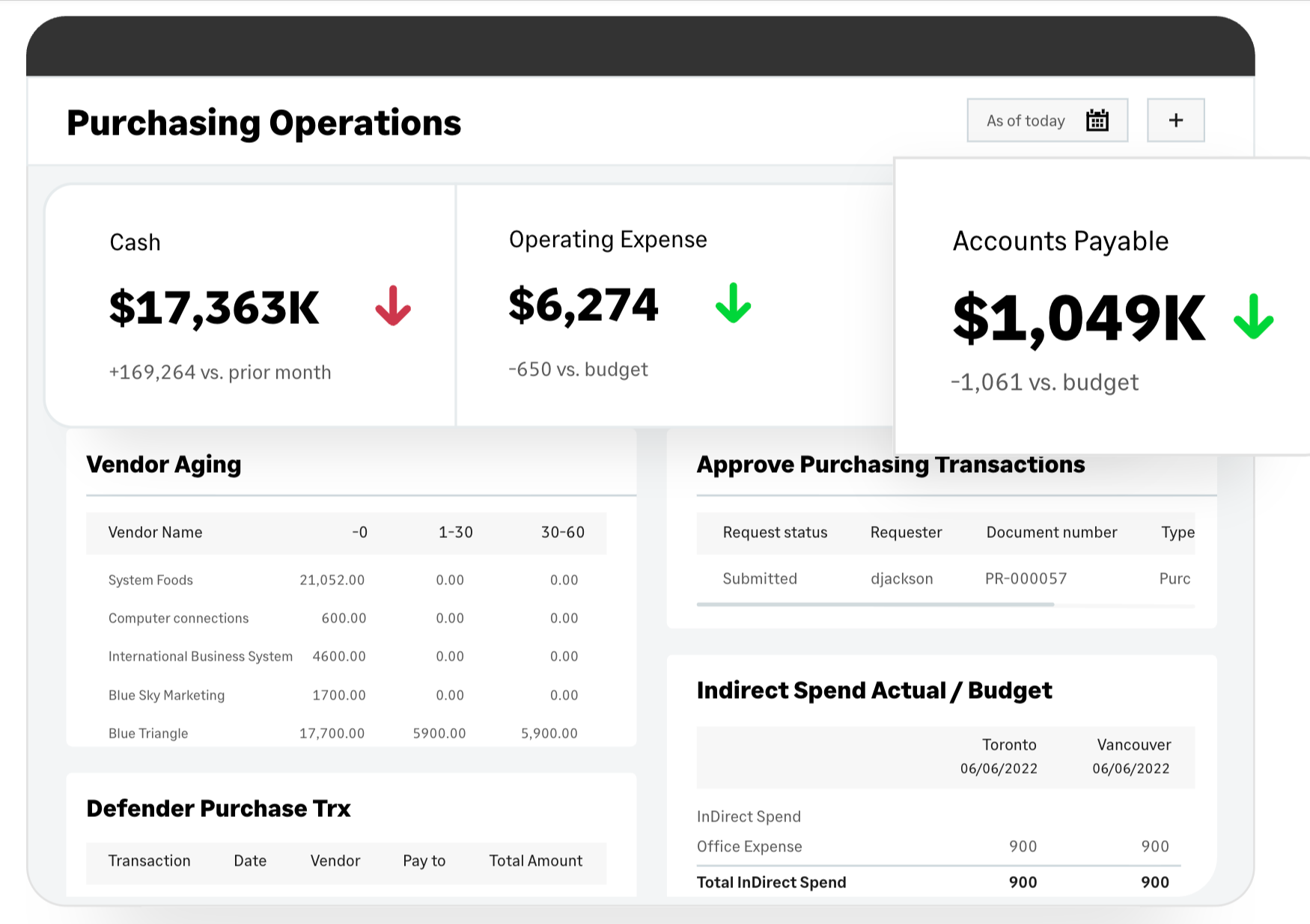
Sage Intacct is Sage’s cloud financial management system. When you manage a multi-entity group in Sage Intacct, the entities can share one set of data lists, including users, the chart of accounts, customers, suppliers, and employees. Administrators can also restrict people to particular entities. According to Sage, Intacct supports up to 31,999 entities.
Consolidation is where Sage Intacct splits into tiers. Domestic Consolidation is the starting point, and it’s for wholly owned entities that all use one base currency. Global Consolidation adds currency translation for groups with two or more base currencies. And Advanced Ownership Consolidation adds multi-level consolidation and partial ownership on top.
Also, partial ownership matters more than it seems. Say you own 90% of a subsidiary. The other 10% belongs to someone else, and your group accounts have to show that share separately as a non-controlling interest. Advanced Ownership Consolidation calculates and creates these entries for you, so your team doesn’t have to handle them manually.
Key features
- Global Consolidation: Translate balance sheet accounts at the spot rate and income statement accounts at the weighted average rate, with historical rates for non-monetary accounts.
- Inter-entity transactions: Post a journal that spans entities and let Sage Intacct add the offsetting transactions to each affected entity’s journals.
- Eliminations: Use optional auto-elimination, with the eliminated amounts held in a dedicated elimination entity.
- On-demand consolidation: Run consolidations whenever needed and drill down from consolidated figures to the underlying general ledger entries.
- Dimensions: Tag transactions with 14 standard dimensions, like department, location, project, customer, and supplier, or create custom dimensions.
Key limitations
- Core Sage Intacct supports multi-entity insights but doesn’t include currency translation, multi-level consolidation, or partial ownership. Currency translation requires Global Consolidation or a higher tier.
- Sage Intacct Planning requires a separate subscription.
- User-defined dimensions may incur additional fees.
Pricing structure
Sage Intacct uses subscription-based pricing, with separate subscriptions for its consolidation tiers and Sage Intacct Planning. Using multiple base currencies adds a fee to the consolidation subscription, and user-defined dimensions may also incur additional charges. Sage’s UK pricing page says Sage Intacct pricing starts from £1,200 per month, excluding VAT, and you’ll need a custom quote that breaks down the costs based on your requirements and number of entities.
Pros
- Advanced Ownership Consolidation supports partial ownership and multi-level group structures, giving groups with partly owned subsidiaries a defined consolidation option.
- Entities share a common chart of accounts, customer records, and supplier records, keeping key financial data consistent across the group.
- Sage provides regular product updates. Its August 2026 R3 release included enhancements to Sage Intacct Planning for UK users.
Cons
- A full group setup may require separate subscriptions for consolidation and planning, with additional fees for multi-currency support and user-defined dimensions.
- Sage publishes only a starting price (from £1,200 per month, excluding VAT), so you need a quote to estimate the cost of a group setup.
Which one should a UK group shortlist?
Your consolidation needs, planning requirements and reporting currencies decide this one. If:
- You need to consolidate subsidiaries in stages: Consider AccountsIQ, which lets you group entities into sub-consolidation layers before rolling their results up to the parent entity.
- Planning depth drives the decision: Sage offers Planning as a separate product, while AccountsIQ includes budgeting and revised budgets in its plans. Test both against the same forecasting requirements before you decide.
- You report in several currencies: Compare how each platform handles currency translation and whether its exchange rate settings match your group’s accounting policy.
Whichever you shortlist, ask both vendors for a quote based on your number of entities. Also request a walkthrough of their Making Tax Digital VAT return process and a reference customer with a similar group structure.
A third option if group complexity is the main problem
If your group has outgrown its accounting system and neither vendor’s packages quite fits, iplicit is built for that.
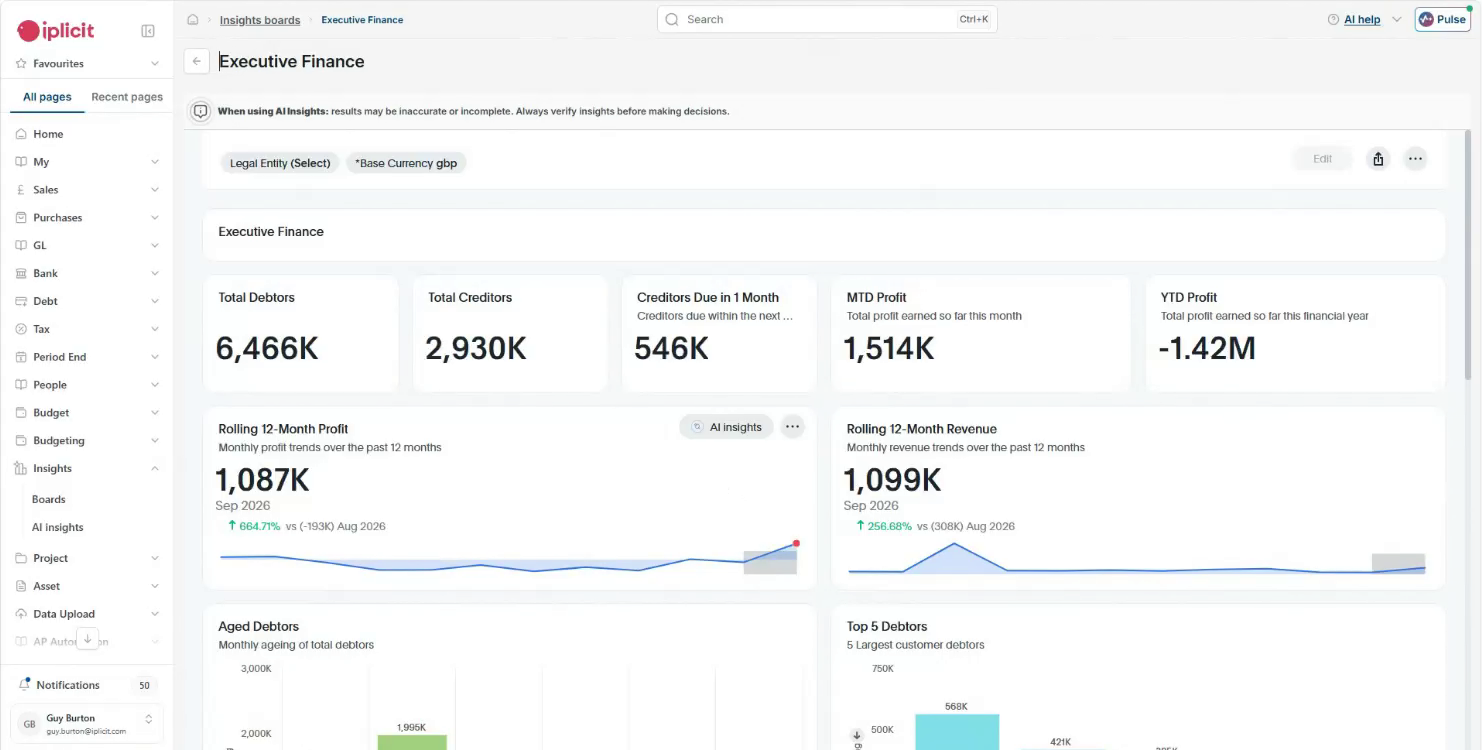
iplicit is cloud accounting software for UK organisations that run more than one entity and have outgrown entry-level systems.
With iplicit, you can manage accounting across multiple entities and currencies in one platform. Intercompany transactions are handled within the system, with drill-down to the source transaction. Live exchange rates feed in automatically, and consolidated reports translate using closing, average, or historic rates by account type, configured to match your group’s accounting policy.
You also get flexible reporting dimensions, so you can analyse your P&L, balance sheet and trial balance by department, project, location, fund or other business areas. You can read more about how iplicit handles group consolidation on our automated consolidation page.
AccountsIQ caps analysis dimensions by plan. iplicit gives you flexible reporting dimensions. And where Sage Intacct sells its consolidation tiers and Planning as separate subscriptions, iplicit includes multi-entity and multi-currency capability rather than selling them as extra modules.
Barwood Capital, an FCA-approved property fund manager that oversees more than 30 active legal entities, moved its team from Exchequer, which required a separate login for each entity, to iplicit. After the move, Barwood’s Senior Finance Manager reported that intercompany transactions are now mirrored automatically between entities, and consolidated fund reporting can be produced instantly.
However, iplicit isn’t the right choice for every finance team. If your main requirement is deep budgeting and forecasting, look at Sage Intacct Planning first. And if you’re a manufacturer that needs bills of materials, you’ll need a different system. Single-entity organisations using Xero also have no reason to switch. Our finance software evaluation checklist can help you assess how well each option fits your organisation’s needs.
To see how iplicit will handle your group structure, book a demo. Or take the Quick Tour if you’d rather assess the platform yourself.
AccountsIQ vs Sage Intacct vs iplicit: feature comparison
Simplify your multi-entity accounting with iplicit
Now that you know what AccountsIQ and Sage Intacct offer, and where their limitations lie, you can decide which best fits your group’s needs.
And if neither quite meets your requirements, iplicit offers another option. It brings multi-entity consolidation, intercompany automation, multi-currency reporting, flexible reporting dimensions and spend management together in one cloud accounting platform, without requiring separate subscriptions for each capability.
Book a demo to see how iplicit handles your group’s accounting, or take the self-guided Quick Tour to explore the platform at your own pace.
What is the difference between Sage and Sage Intacct?
What is the difference between Sage and Sage Intacct?
Sage is the software company, and Sage Intacct is one of its products. Intacct is a cloud financial management system for mid-sized organisations that’s separate from Sage 50 and Sage 200, with its own help documentation and numbered releases.
Is Sage Intacct an ERP or a CRM?
Is Sage Intacct an ERP or a CRM?
Sage Intacct is a finance system that covers purchasing, contracts, inventory, and project accounting, according to its 2026 R3 release notes. Customer relationship management isn’t on that list. Whether you call it an ERP depends on how much of the operational side you switch on.
Who is behind AccountsIQ?
Who is behind AccountsIQ?
AccountsIQ was founded by accountants who saw an opportunity to build better accounting tools for mid-sized organisations. Its founder, Tony Connolly, became Executive Chairman in October 2024, when Darren Cran took over as CEO.
In June 2024, AccountsIQ raised €60 million in a Series C investment from Axiom Equity. The company later expanded its finance software offering by acquiring expense management provider ExpenseIn in January 2025.
Is Sage Intacct better than Xero?
Is Sage Intacct better than Xero?
Sage Intacct is built for multi-entity groups, with shared financial data and consolidation across currencies. If you run a single company with straightforward accounting needs, Xero is likely a better fit. Sage Intacct becomes more useful when you manage several entities that need consolidated reporting. Our post on Sage Intacct alternatives explores when switching makes sense.