Once the auditors leave, a short review of what went well, plus better habits for keeping records audit-ready all year, will help make a multi-academy trust's next audit faster and less stressful. The Academy Trust Handbook also requires the audit and risk committee to formally assess the auditors’ effectiveness.

The short version
- Review what went well with the audit and what didn't while it's still fresh, taking into account input from non-finance staff such as HR.
- Keep records audit-ready all year round, rather than scrambling before the auditors arrive.
- Work from a checklist with a named owner and deadline for each item, rather than starting from scratch every autumn.
- MATs that keep documents attached to transactions in their finance system have cut audit preparation, eliminating boxes of paperwork and many hours of staff time.
- MATs must legally assess their external auditor's effectiveness after every audit, including sector expertise, understanding of the trust and use of technology – and must re-tender the contract at least every five years.
If you work in a multi-academy trust's finance team, the annual external audit can dominate the autumn term, even when it goes well. But the work isn’t over when the auditors leave.
There are some follow-up actions that a trust is legally required to take after the auditors have departed. At the same time, it makes sense to review what went well and what didn't – and to use that review to prepare properly for next time.
This guide looks at how to review how the audit that’s just finished – and what you might do differently for an easier audit next time.
What must a MAT do after its external audit?
Academy trusts must have their audit and risk committee carry out an evidence-based assessment of the external auditor's quality and effectiveness after every audit, as set out in the Academy Trust Handbook. That assessment feeds directly into whether the trust reappoints its auditor, re-tenders the contract or looks for a replacement. It can draw on a short staff survey or debrief session with everyone who dealt with the audit.
How to assess auditor effectiveness
Under the current Handbook, the committee's assessment should cover:
- the auditor's sector expertise
- the auditor’s understanding of the trust and its activities
- whether the audit process lets issues get raised at the right level and in good time
- the quality of the auditor's comments and recommendations on key areas
- the personal authority, knowledge and integrity of the audit partners and their staff, and how well they challenge the trust's managers
- the auditor's use of technology.
When a MAT can change auditor
There are three routes by which a MAT can part company with its auditor:
- Re-tendering. Trusts must re-tender their audit contract at least every five years and must take the assessment factors above into account when they do.
- Resignation. An auditor can resign by giving written notice. Under the current handbook, the letter of engagement must require the auditor to explain the resignation within 14 calendar days.
- Removal. It doesn't happen often but members can remove an auditor by majority vote at a general meeting. They must give reasons to the board of trustees, and the auditor keeps their rights under the Companies Act. Either way, the trust must notify the DfE immediately.
How to find a new auditor
If a MAT does need a new auditor, the DfE's guidance points to three routes: word of mouth from other trusts, the Register of Statutory Auditors (searchable by individual, firm, area or supervisory body), and procurement through the DfE's recommended audit services framework, run via the Crescent Purchasing Consortium.
How should a MAT review how the audit went?
It pays to review how the audit went while it is still fresh in everyone's memory, ideally within a week or two of the auditors leaving. Look at where records took too long to find, which questions staff struggled to answer and whether the right people, including non-finance staff such as HR, were available when auditors needed them.
A second, separate session is worth holding once the auditor's actual findings and recommendations come through, so the trust can work through what needs to change before next year. Both sessions work best when they include non-finance staff, not just the finance team, since gaps in HR or estates input are a common source of audit delay.
When should MATs start preparing for the next audit?
Preparation for the next audit should begin now and take place continuously. Every academy trust is expected to run a year-round programme of internal scrutiny, overseen by a mandatory audit and risk committee, encompassing financial and non-financial controls. Treating that scrutiny as a habit rather than an annual event will ensure a MAT is ready when the external audit arrives.
Trusts over £50million in annual income must use an in-house internal auditor or a bought-in service. Smaller trusts have more flexibility, including peer review arrangements or a trustee appointment. Whichever option a trust uses, it must confirm which one it has applied, and why, in its governance statement, and its internal scrutiny summary report is due to the DfE by 31 December each year, alongside its audited accounts.
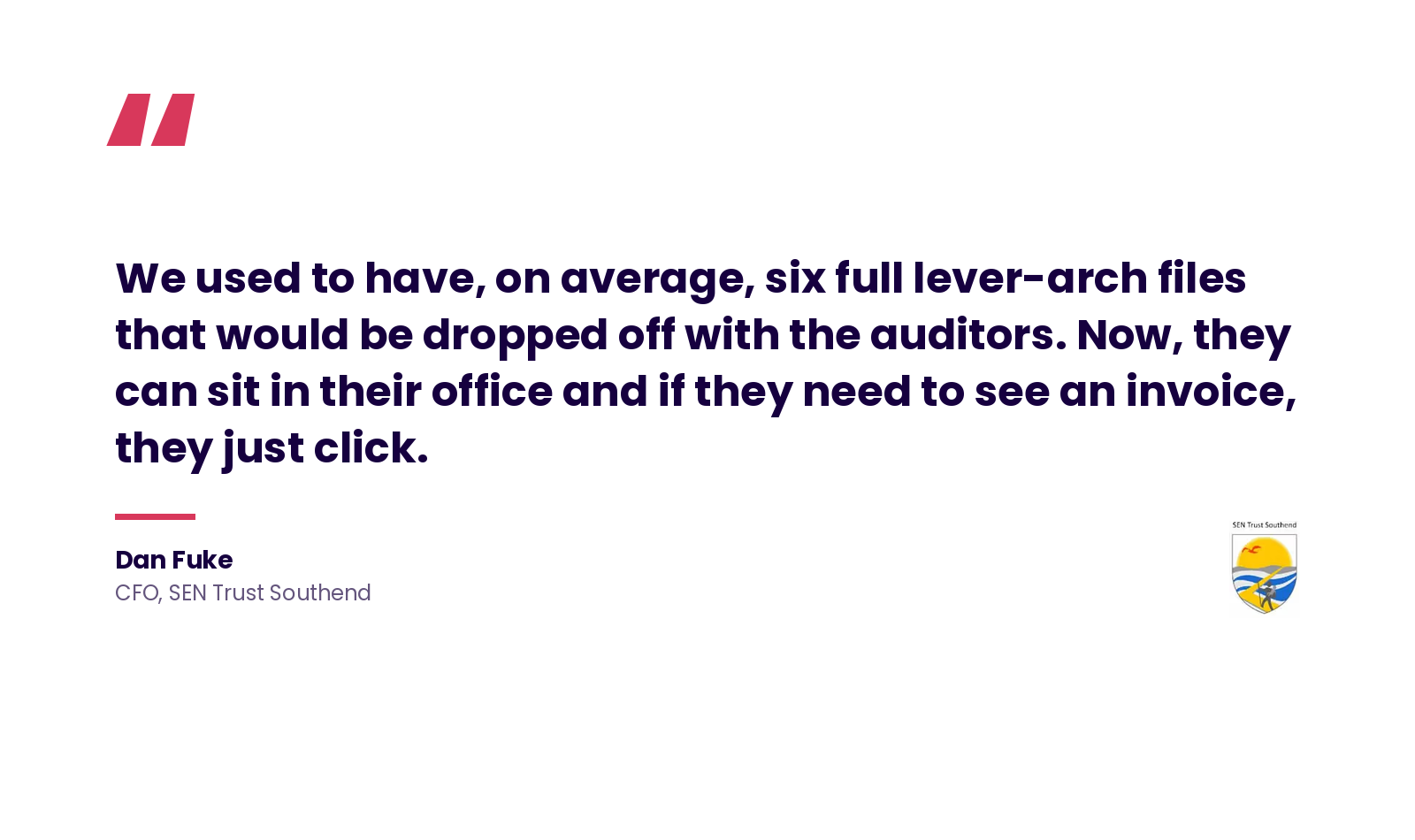
In practice, the clearest sign of whether that scrutiny is working day to day is whether records are retrievable whenever someone asks for them, not just at audit time. SEN Trust Southend used to hand its auditors six full lever-arch files each year. After moving to digital, document-linked records, its auditors said they wouldn't be increasing fees, and were "even looking at a fee reduction next year". Bradford Academy saw a similar shift. The 10 archive boxes it used to prepare for audit each year came down to one, once every order and approval carried a clear digital audit trail.
Contract-award paperwork and non-financial records, such as staff pay communications, cause particular problems if they're not to hand when auditors ask. If your finance system doesn't link budget items directly to their supporting documents, you'll need a reliable way of cross-referencing them by hand instead.
What should be on a MAT's audit-preparation checklist?
A checklist that lists exactly what auditors need, who owns each item and when it is due, will make audit more straightforward. Your auditor will often supply one and the government publishes its own version too.
That document, the External Audit Preparation Checklist for Academy Trusts, sets out the specific pieces of information your auditor may ask for, grouped under headings covering the financial statements, the governance statement, income and expenditure, the balance sheet, cash flows, notes to the accounts and key supporting documents such as the articles of association, funding agreement and risk register. Gov.uk says this is meant as a starting point for trusts that don't already have their own list, not an instruction from Whitehall.
Additional preparation top tips
Our partners in the academy audit specialist team at Price Bailey Chartered Accountants suggest taking the following additional steps for a smooth audit.
- Make sure management findings from the prior year have been actioned accordingly to avoid a repeat point
- Make sure all required disclosures on the Trust website are complete
- Make sure the list of Trustees and Members is up to date and is consistent across the website, GIAS and Companies House
- Make sure the fixed assets register is up to date, the brought forward values agree to the prior year accounts and the net book value agrees to the accounting system
What should you expect during the auditors' visit?
A good auditor tries to keep disruption to the school day to a minimum – but the trust still needs to plan around the visit. As soon as a date is confirmed, block out time for the finance team and any non-finance staff, particularly in HR, who may need to answer questions or supply records.
If your MAT's academies sit on multiple sites, build in time to get the right records to the right place before the visit starts. Trusts that go into the audit with a clear digital trail see the difference. Excalibur Academies Trust's first audit after digitising its records took two weeks, against nearly a month the year before, and its auditors described the process as "a pleasure this year compared with the previous year".
Where iplicit fits
Audit runs more smoothly when the evidence auditors ask for is already in the finance system, attached to the transaction it relates to, rather than scattered across spreadsheets, email threads and paper files. Accounting software that’s built for multi-entity trusts makes that possible, ensuring data can be consolidated across academies but is also auditable down to the level of individual transactions.
iplicit's cloud accounting software keeps supporting documentation attached to the relevant line item in the accounts and lets auditors work from read-only access to the system itself rather than waiting for files. At Active Learning Trust, that setup impressed both the external auditors and a separate HMRC audit team, who described the trust's finance system as "the Rolls-Royce of finance systems".
Audit-readiness as a habit
Audit exists to give funders and the public assurance that money intended for children's education has been spent properly. That's easy to lose sight of in the middle of a stressful audit week but it's also why the process rewards trusts that are open about mistakes rather than trying to hide them. A trust that is transparent about an honest error is in a very different position to one that wasn't.
The trusts that get an easier audit each year are the ones that treat the four things above – assessing the auditor, debriefing the team, keeping records audit-ready, and working from a checklist – as ongoing habits rather than a once-a-year fire drill.
Want to see what an audit-ready finance system looks like in practice? Take a quick tour of iplicit, or book a demo to see how it would work for your trust.
Why should a MAT hold a debrief after its audit?
Trusts should hold a short debrief with finance and non-finance staff soon after the auditors leave. Reviewing which records were hard to find, which questions staff struggled to answer and where non-finance input fell short makes the next audit faster and less stressful.
How can a MAT keep its records audit-ready all year?
Keep supporting documents, contract paperwork and non-financial records such as staff pay communications easily retrievable all year. Trusts using cloud accounting software that links documents directly to transactions typically cut the time and paperwork needed to prepare for audit.
What's the difference between external audit and internal scrutiny at a MAT?
External audit checks the trust's annual accounts are accurate and gives assurance to funders and the public that money has been spent properly. Internal scrutiny is a year-round programme, run through the audit and risk committee, that reviews financial and non-financial controls before the external auditors ever arrive.
What must a MAT's audit and risk committee do after an external audit?
The Academy Trust Handbook requires a MAT's audit and risk committee to carry out an evidence-based assessment of the external auditor's quality and effectiveness after every audit. That assessment covers the auditor's sector expertise, understanding of the trust, timeliness, and use of technology, and it feeds into decisions on reappointment or re-tendering.
How often must a multi-academy trust re-tender its audit contract?
Academy trusts must re-tender their external audit contract at least every five years under the Academy Trust Handbook. A trust can also change auditor sooner if the auditor resigns or is removed by a majority vote of members at a general meeting.