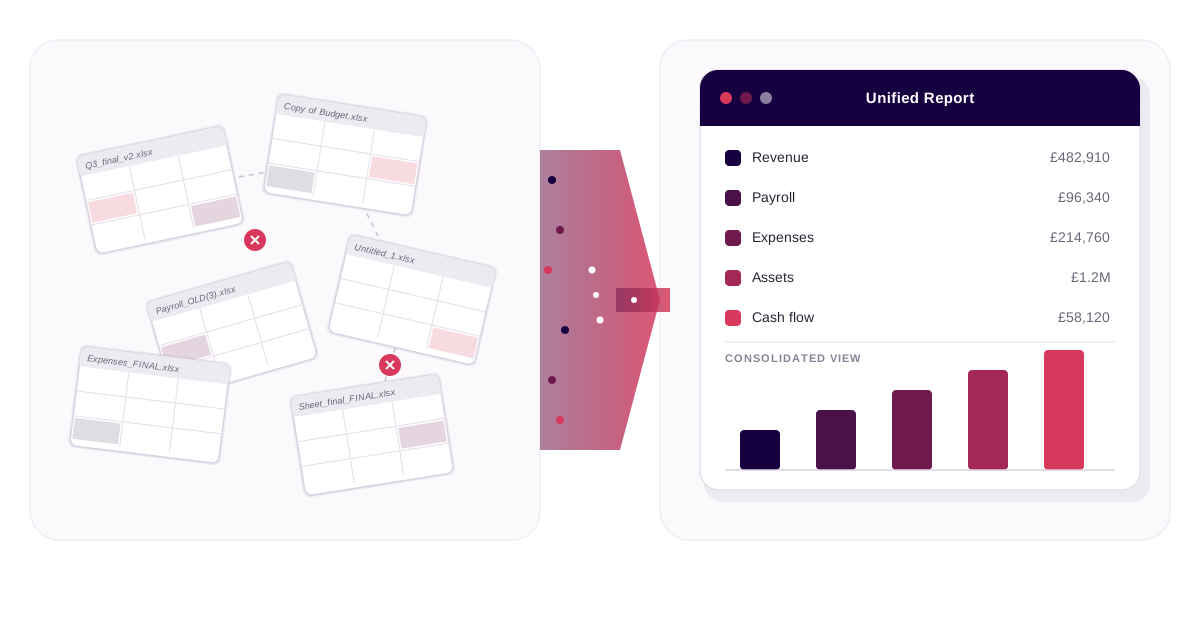
For many charities, the finance system is a source of daily frustration. Workarounds and transactional work suck up the team’s time and reporting takes much longer than it should. In our recent webinar, we brought together two of the nonprofit sector's most experienced finance voices to give charity finance leaders a straight-talking, practical guide to changing your finance system.
Mark Salway, charity finance expert, was joined by Darren Tiffney, Director of Finance and Central Services at Yorkshire Wildlife Trust, for a frank conversation about one of the most significant decisions a finance team will make.
If you missed it, you can watch the full recording on demand here. We’ve pulled out the key insights from the session.
Why charities stay stuck with the wrong finance system
The session opened with a live poll. We asked attendees: What is your biggest finance system frustration right now? The top answer, by some margin, was poor reporting and too many spreadsheets. But what was equally striking was the spread of responses. Manual processes, approval headaches, poor integrations and general uncertainty about where the problem even sits were all strongly represented.
As Darren put it: "The problems compound on themselves and they get to a point where you're ready for a leap."
Mark drew on decades of consulting experience to explain why organisations so rarely take that leap. His framing was a KPMG model he first encountered in 1999: a pyramid with approximately 70% of finance team effort sitting at the bottom, in transaction processing and controls. The aspiration, even then, was to invert that pyramid entirely so that management information and strategic decision-making sat at the top. "Until now," Mark observed, "we haven't really had the tools to do that. But now you've got good systems, now you've got AI. We can really drive that through."
The barrier, he argued, is not technology. It is mindset. Charities tend to see finance system costs as annual line items rather than long-term investments.
Darren added that for Yorkshire Wildlife Trust, the signs were clear when he joined: an on-premises system accessible only to the finance team, a lack of purchase ordering or expense functionality for wider staff and an Excel-based VAT return because the system could not handle Making Tax Digital. "I arrived in 2021," he said. "There was a note in my drawer from the outgoing Director of Finance that said the first thing you need to change is the finance system."
Pillar 1: Knowing when it's time to change
The webinar is built around a four-pillar framework, developed by Mark and available as a free downloadable toolkit. The first pillar is about recognising the signals.
Mark's summary was direct about the key signal: "It's when I walk in and people are just whinging about the finance system." But beneath that, he outlined three areas to investigate: people, process and technology. Are the right people doing the right things? Are processes efficient or paper-based and clunky? Is the technology enabling good decisions, or holding the team back?
Darren identified the following as his clearest indicators at Yorkshire Wildlife Trust:
- The system was closed to anyone outside finance, making it unsustainable as the organisation grew from 120 to 200 headcount and from £10m to £15m turnover
- It was on-premises, which blocked remote working and carried risk
- Loading a linked spreadsheet took long enough, he joked, to build a matchstick model of Big Ben
- Senior leadership had low confidence in the management information coming out of the system.
Mark also raised the hidden costs that organisations rarely account for: server maintenance, inability to support a distributed workforce, security vulnerabilities and the ongoing cost of manual workarounds. "There's a hidden cost that we just ignore sometimes,” he added.
Pillar 2: How to choose the right system
Once an organisation accepts that change is needed, the instinct is often to start watching software demos. Mark's advice: stop.
"The single biggest reason for failure is not doing the gap analysis properly," he said. “You never implement on bad process." His recommendation is to map where you are now, where you need to get to and what your system needs to deliver. Then bring people from across the organisation into the conversation, not just finance.
"If you're asking people to download management information and look at their actual versus budget and they can do it themselves, they democratise the system. Whereas if finance is just over there and everybody has to go to finance to get the information, there's a power dynamic that is not healthy,” he added.
Darren recalled his shortlist of prerequisites when Yorkshire Wildlife Trust went to market:
- Intuitive design that non-finance staff could use without extensive training
- Stability and value for money, not just lowest cost
- A vendor with a genuine commitment to continuous improvement
- Willingness to understand and solve the organisation's specific challenges, because every charity has them.
"Every charity thinks they are idiosyncratic in the way they account, and they probably are," Darren said. "We have 80 budgets and 150 funds. You want a provider who goes: I know your problems."
Mark's advice, once you have done the groundwork was to see a lot of systems, ask for a sandbox, test with real scenarios and find reference customers you can speak to honestly.
Pillar 3: How to implement well
Implementation is the area where, in Mark's words, "you can completely fluff things up".
Darren said underestimating the internal resources required for an implementation is the most common mistake. Running a live finance function while building a new one is hard. He also advised bringing the whole team on the journey, not just the project lead. He admitted that by concentrating implementation effort in his own hands and those of a volunteer change expert, he left the wider finance team behind. He recalled: "When we went live, they still asked: Darren, I used to do this in the old system. Where do I do it now?"
- He advised people to phase the rollout – starting with the fundamentals, creditors, debtors, bank balance, payments and add ordering, workflows, and integrations in subsequent phases. He warned data must be clean, not just sufficiently clean to get you through go-live. And he urged people to “train the trainers”, identifying early adopters who will help the rest of the organisation.
Mark reinforced the importance of user acceptance testing, not just for finance staff but for anyone who will touch the system. He also stressed not accepting the default from vendors: "A lot of vendors will just give you a workbook on how to do things. I think you have to have somebody on hand to help you through the system and to show."
Pillar 4: How to make the investment work long-term
The organisations which get the most from their finance system are those that treat it as a continuous improvement programme rather than a completed project. "If you're not keeping it up to date, you're not getting the benefits,” said Mark. “You can drive a good 30% of additional efficiency by continuing to learn, by removing the problems, by using the functionality better."
He urged charities to give ownership of key processes to named individuals, ask regularly whether it is working, go back to the vendor with specific questions about what else the system can do and keep moving people away from transactional work towards analysis and decision support.
Darren recalled that, after going live, one team member's monthly bank reconciliation dropped from half a day to 10 minutes. The improvement in efficiency created an unexpected challenge when staff started to worry about their value. "I used to say to my team, you thought you were a player in the orchestra pit. For me, you are now little mini conductors. You are going to help your colleagues as business partners rather than put in transactions,” he said.
Key takeaways for charity finance leaders
The message from both speakers was that change is daunting but the payoff comes quickly.
Mark said, "If people are whinging about the finance system, start to understand why. Look at the people, the process, the technology. It is quick to identify what is driving the need to change. Then take the first step."
Darren added: "You know when the system needs to change. Trust your instincts. I cannot underestimate how much efficiency and opportunity you unlock from the team by doing it. Although it is painful and daunting, the payoff comes – and it comes quickly."
You can also download Mark Salway's free Charity Finance System Toolkit here. It includes checklists for each of the four pillars, designed to help you assess where your organisation sits and what to do next.