
Xero and QuickBooks are built for start-ups and most organisations eventually outgrow them. This article sets out five clear signs a growing finance department needs a true cloud accounting system instead: unsustainable manual work, limited reporting, spreadsheet-dependent board reports, growing accounting complexity and the need to keep adapting as the organisation changes.
The short version
- Xero and QuickBooks are built for start-ups. By the time organisations pass around 30 staff or moves from six to seven figures in revenue, most begin hitting the same wall.
- Manual processes, such as approvals and bank reconciliation, are usually the first sign. Processes that worked with sticky notes and email threads start to hold you back once transaction volumes grow.
- Reliance on spreadsheet-built board reports is a second red flag. Not only are they time-consuming to produce but the prospect of broken formulas introduces a new element of risk.
- Multiple legal entities, tax jurisdictions or offices push an organisation’s accounting requirements beyond what entry-level software is designed to handle.
Most finance teams have already adopted the cloud in some form. Tools such as Xero and QuickBooks have made cloud accounting easy to adopt for start-ups and small organisations, while platforms such as NetSuite, Oracle and Microsoft Dynamics have done the same at the enterprise end.
Xero alone reported 4.4 million total subscribers worldwide as of 31 March 2025, according to its FY25 annual report, so getting finance onto the cloud clearly isn't the problem it once was.
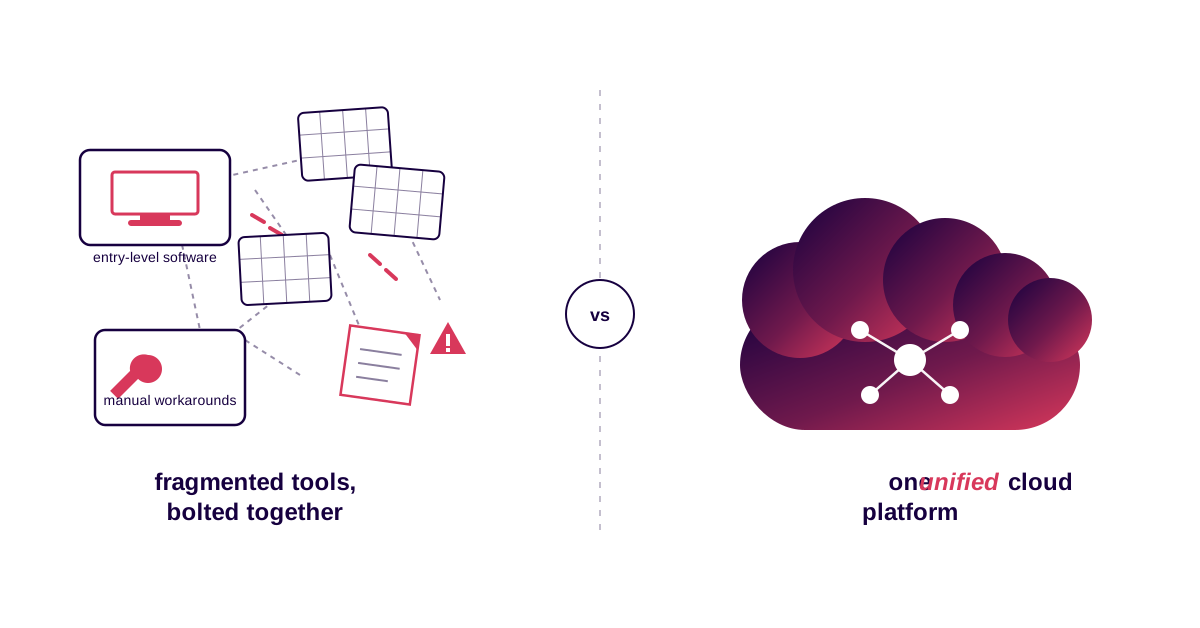
The problem comes later, once an organisation starts to grow. The entry-level software that made cloud adoption easy in the first place isn't built to scale with a fast-growing mid-market organisation. Traditionally, there was no obvious next step between those entry-level products and enterprise-grade systems.
This article sets out five signs a growing organisation has outgrown its entry-level accounting software, and what a true cloud accounting system offers instead.
Why growing finance teams outgrow entry-level cloud accounting software
Entry-level cloud accounting software such as Xero and QuickBooks is built for small, simple organisations. It works well until an organisation crosses a growth threshold, typically around 30 staff or revenue that’s rising from hundreds of thousands of pounds into the millions. Past that point, transaction volumes rise, approval processes become unmanageable and budgeting outgrows the capabilities of a spreadsheet that’s kept outside the accounting system.
Five signs it's time to upgrade your cloud accounting software
The following five signs show up repeatedly in organisations that have outgrown their entry-level accounting software. Each one points to a gap between what the finance team now needs and what the current system can deliver.
The volume of manual work has become unsustainable
As transaction volumes grow, the need for automation, from bank reconciliation to recurring invoices, quickly outpaces what entry-level software can handle. An organisation that scales its sales team also needs to scale its finance capabilities. That doesn’t automatically mean more staff but it does mean handling more work.
If a finance team has become bogged down in repetitive manual tasks, it will struggle to get on top of routine activity and move on to strategic work. A true cloud accounting system with built-in approval workflow, rules and automation removes much of that manual load.
The Recruitment Group is a concrete example. Before automating with iplicit, a team of six took around one and a half days to key in invoices by hand. Afterwards, a team of four was able to generate and send the same invoices in about two hours.
You need better reporting for real-time decisions
Real-time management information is what finance leaders often say drives their best decisions. Entry-level software can only report so far and once finance directors want to drill into the data at the level of a specific customer, project or location, they run into a hard limit on what the system can show.
A true cloud accounting system removes that ceiling by making comprehensive, real-time reporting a core part of the platform rather than an add-on. Besa Lane, Head of Finance at the hospice charity ellenor, says: “Before, I was spending a lot of time in spreadsheets, trying to get things right and eliminate mistakes. But now we have more valuable reporting that helps strategic decision making, so I’m spending more time on risk management and strategic analysis. If we put all this information together, we can make very well-informed decisions about where to focus for the next two or three years.”
You're effectively running a shadow system in Excel
For years, Excel has held financial reporting together for many growing organisations. Once an organisation outgrows its entry-level system, it often ends up with a web of spreadsheets that are used to manipulate data into management and board reports. One iplicit customer described this way of working as requiring "a PhD in Excel physics."
These spreadsheets get ever more complex – and a broken formula can go unnoticed until it's too late. Add in staff changes and requests from multiple stakeholders and the whole approach becomes unworkable.
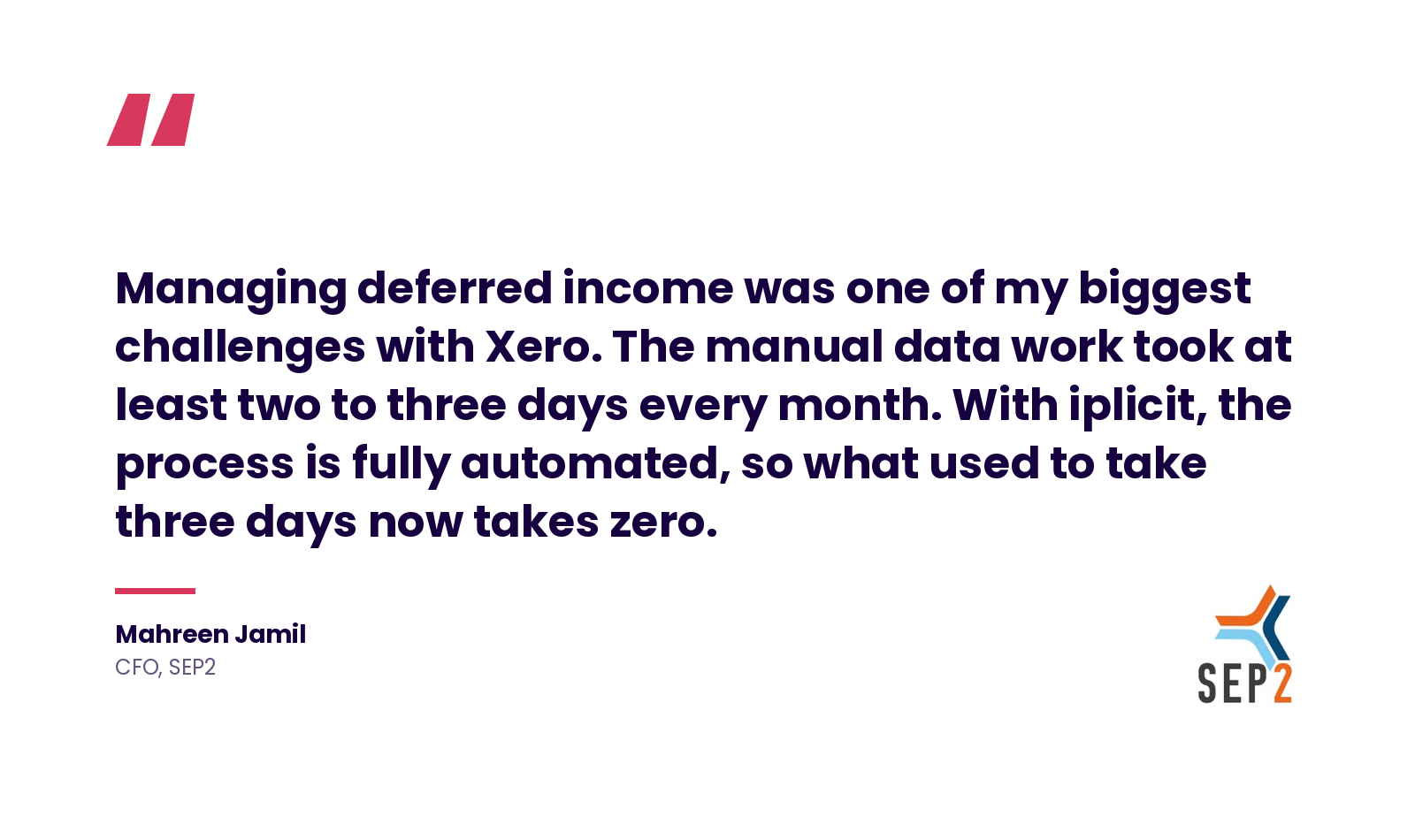
SEP2, a former Xero customer, ran into exactly this with deferred income. Manual data work took two to three days every month. After automating the process in iplicit, that work happens instantaneously.
Your accounting requirements have outgrown a single entity
If your organisation now spans more than one legal entity, more than one tax jurisdiction or more than one office, and processes have become more manual to compensate for what your entry-level system can't do, that's a sign you've outgrown it. Colin Huntington, Director of Finance and Enablement at Bridges Outcomes Partnerships, had 25 entities to account for. “Xero worked pretty well for each individual entity – but each time you switched from one to the next, you had to come out of one instance of Xero and go into another one,” he says. “If something had to be done across all entities, you had to do it 25 times.”
You need a system that can change as you do
Growing organisations need to stay agile. New markets, new approaches and new people bring new requirements. Entry-level cloud software is built around a fixed, simple set of needs, so adapting to anything new usually means finding workarounds. A true cloud accounting system can flex with that change as it happens, without running up against new barriers.
Where iplicit fits
A true cloud accounting system is built to handle the reporting, automation and multi-entity complexity that entry-level software cannot. iplicit is a cloud accounting platform designed for mid-market organisations that have outgrown tools such as Xero and QuickBooks but don't need the cost or complexity of an enterprise ERP system.
iplicit also connects to the other systems a growing finance team relies on, through native integrations, a public API and third-party platforms, so data doesn't need to be re-entered or exported by hand.
The bottom line
Not every organisation outgrows its entry-level accounting software and many will happily keep using Xero or QuickBooks for years. But once manual work, limited reporting, spreadsheet dependency or growing complexity start slowing the finance team down, staying on entry-level software becomes the more expensive option.
With iplicit, organisations can move from an entry-level system to a true cloud accounting platform in weeks rather than months.
Ready to see what a true cloud system can do?
Take a quick tour of iplicit, or book a free demo to see how it would work for you.
What is entry-level cloud accounting software?
Entry-level cloud accounting software, such as Xero or QuickBooks, is built for start-ups and small organisations with simple accounting needs. It covers core bookkeeping, invoicing and basic reporting, but offers limited workflow, automation and multi-entity capability as an organisation grows.
What's the difference between entry-level and true cloud accounting software?
A true cloud accounting system is built as a single platform for more complex, growing organisations, with automation, real-time reporting and multi-entity consolidation included as standard. Entry-level software covers core bookkeeping but usually needs manual workarounds or add-ons to handle greater requirements.
Why do growing organisations outgrow Xero or QuickBooks?
Growing organisations generate more transactions, more approvals and more complex reporting needs than entry-level software is designed to handle. Processes that worked manually at a small scale, such as email approvals or spreadsheet-based budgets, become unmanageable once headcount and transaction volumes increase.
How do you know it's time to upgrade your accounting software?
Common signs include unsustainable manual work, reporting that cannot answer real-time questions, board packs built from exported spreadsheets and accounting requirements spanning multiple entities, tax jurisdictions or offices. Any one of these suggests entry-level software has become a constraint rather than a help.